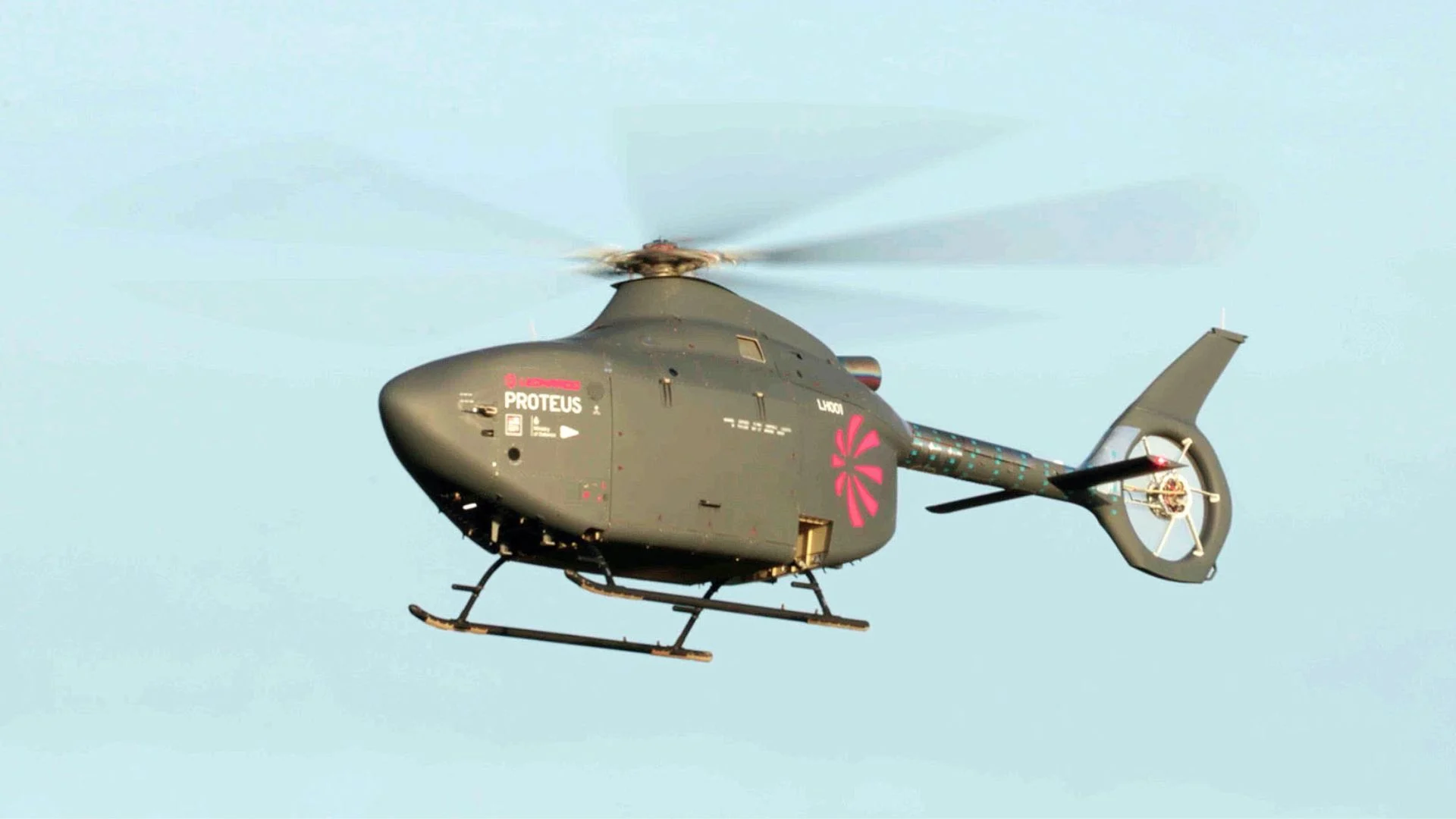
Leonardo will use Shield’s Hivemind autonomy software to further develop mission autonomy for Proteus, its full-size uncrewed rotorcraft demonstrator built for the Royal Navy, under an agreement announced in London on October 29, 2026. Working through the Hivemind Software Development Kit (SDK), Leonardo engineers will build new autonomy capabilities for rotary-wing anti-submarine warfare (ASW), intelligence, surveillance, and reconnaissance (ISR), and contested logistics missions.
The deal arrives at a pivotal moment for Proteus. The aircraft flew for the first time on January 16, 2026, from Predannack Airfield in Cornwall, and Leonardo confirmed at the Farnborough International Airshow in July 2026 that program funding had been extended to mid-2027. The Royal Navy wants a hybrid air wing that pairs crewed helicopters with uncrewed rotorcraft, and Proteus informs its Maritime Aviation Transformation (MATx) strategy, which charts naval aviation through 2040. Moving autonomy work onto a commercial SDK signals that Leonardo intends to industrialize the software layer rather than build all of it in-house.
How Hivemind Reshapes Proteus Autonomy Development
Under the agreement, the two companies will integrate Hivemind into Proteus so Leonardo engineers can write, test, deploy, and continuously update their own autonomy behaviors. Shield’s model gives partners ownership of what they build, allowing them to sustain and modify autonomous pilots independently as missions, environments, and threats evolve. The company argues this lowers lifecycle cost through code reuse and rapid iteration.
Tom Schaefer, vice president of Hivemind engineering at Shield, framed the arrangement around that ownership. “Autonomy software is never finished,” he said, adding that Leonardo’s engineers can tailor the software to their mission sets “and the work stays with them.”
The distinction matters for a sovereign UK program. Proteus already flies with Leonardo-designed autonomy embedded, and Hivemind is intended to sustain further development of those capabilities rather than replace them with a closed system. For the Ministry of Defence, whose UK Defence Innovation (UKDI) organization develops Proteus alongside the Royal Navy, keeping design authority over mission code inside a UK-based prime simplifies certification, export control, and long-term upgrades.
Hivemind already runs across a broad range of platforms. Shield builds the software into its own V-BAT and X-BAT aircraft and has integrated it with systems from primes including Airbus, Kratos, and L3Harris. In February 2026, Taiwan’s National Chung-Shan Institute of Science and Technology (NCSIST) signed a contract to use the same SDK to develop locally produced AI pilots. Proteus ranks among the most visible applications of the stack on a full-size helicopter.
Adam Wardrope, vice president of market development for Helicopters UK at Leonardo, said the company could take Hivemind beyond Proteus, “potentially also extending it through other programmes within our rotary-wing portfolio.” That portfolio includes the AW101 Merlin and AW159 Wildcat, both in Royal Navy service.
Proteus Payload, ASW Role, and the Royal Navy Hybrid Air Wing
Proteus is an uncrewed vertical take-off and landing (VTOL) technology demonstrator developed with the Royal Navy and UKDI under the Rotary Wing Uncrewed Air System (RWUAS) CCD Phase 3B Technology Demonstrator Programme. Publicly available information indicates the airframe derives from Leonardo’s civil AW09 single-engine helicopter and that the original development contract, awarded in 2022, was worth £60 million over four years.
The aircraft’s defining feature is a large modular payload bay sized for roughly one tonne of payload or two standard NATO 463L pallets. Leonardo designed the bay to accept customer and mission-specific kits, with ASW, airborne early warning (AEW), and intra-theater lift identified as candidate roles.
ASW is the priority. The Royal Navy says Proteus is designed to patrol the seas and locate submarines by drawing on information from a network of allied ships, helicopters, submarines, and detection systems, and its payload bay can carry sonobuoy dispensers. That role ties directly to Atlantic Bastion, the program the Ministry of Defence announced in December 2025 to counter Russian submarine activity in the North Atlantic by pairing crewed antisubmarine forces with uncrewed systems.
The January maiden flight was deliberately modest: a short test routine in which the aircraft operated its own flight controls, under constant supervision from test pilots on the ground. Leonardo had first validated the autonomy stack in all-synthetic operational scenarios using a digital twin. Key performance parameters for the demonstrator, including endurance, range, and maximum take-off weight, have not been publicly disclosed.
Analysis: The agreement reflects a structural shift in how European primes approach autonomy. Rather than building every layer in-house, Leonardo is adopting a mature autonomy framework and concentrating its engineering effort on mission behaviors, sensor integration, and airworthiness, the areas where its rotorcraft expertise is hardest to replicate. For the Royal Navy, the arrangement could shorten the path from demonstrator to operational capability, provided UK industry retains design authority over mission code. It also gives Shield, a US firm, a foothold in a British naval program whose operational derivatives Leonardo aims at Merlin and Wildcat operators in the UK and abroad.
Neither company disclosed the value of the agreement, the integration timeline, or when Hivemind-developed behaviors will first fly on Proteus. With program funding currently running to mid-2027, the next milestones to watch are at-sea ASW trials, any decision to move Proteus beyond the demonstrator phase within MATx, and whether Leonardo applies Hivemind across the rest of its rotary-wing portfolio.