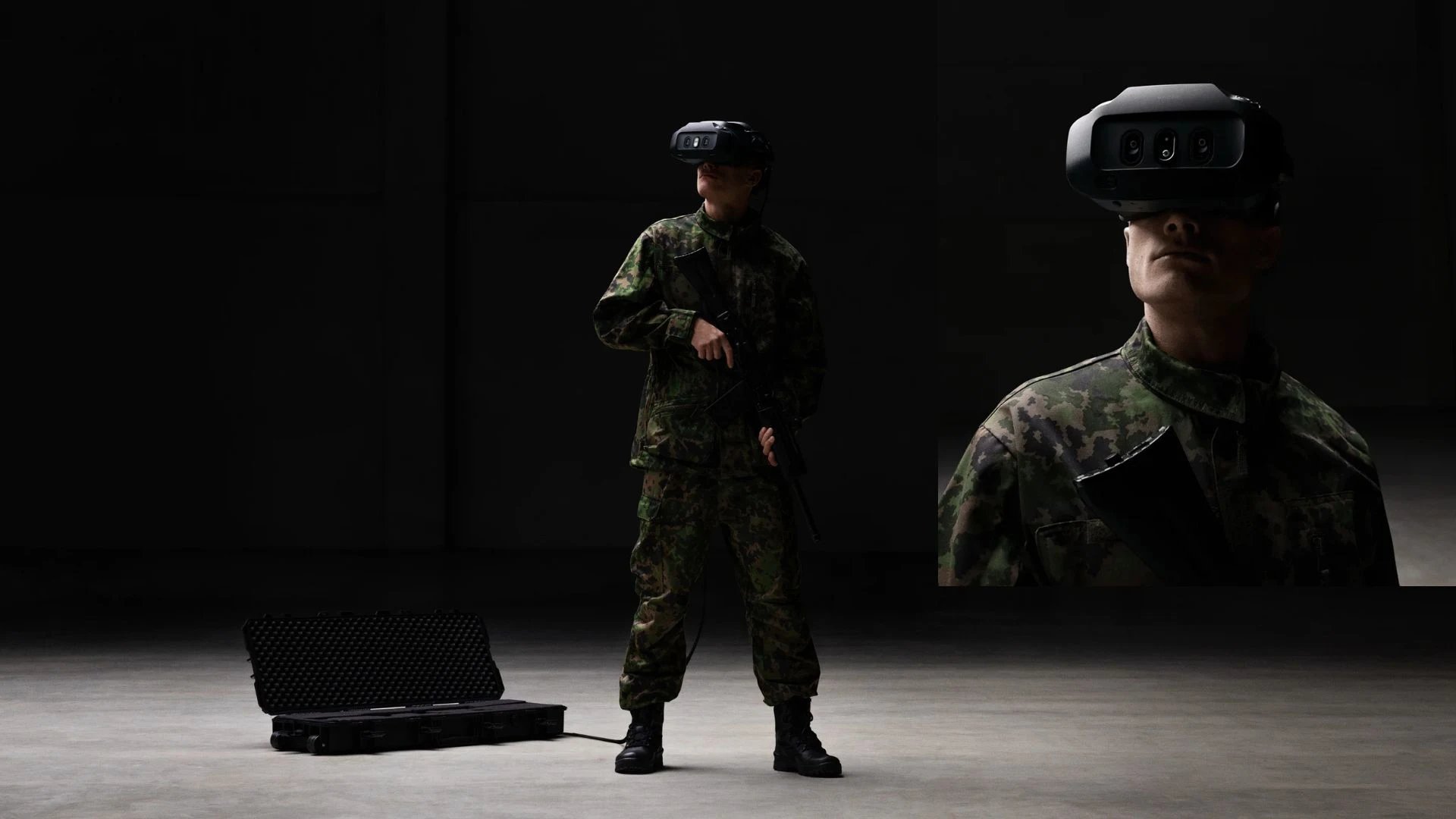
The Finnish Defence Forces Innovation Unit and Helsinki-based mixed reality manufacturer Varjo are piloting virtual counter-unmanned aircraft system (C-UAS) training with a brigade-level unit of the Finnish Defence Forces (FDF), the two parties announced on October 29, 2026. The project uses the Varjo XR-4 Series headset, which the partners say delivers enough visual clarity to train soldiers against a five-inch first-person view (FPV) drone at realistic engagement distances.
The effort draws directly on the war in Ukraine, where FPV micro-drones and loitering munitions have become a constant threat to ground troops. Preparations began in February 2026, as the Finnish Army was already widening its own drone base: FPV instruction for conscripts started at the Army Academy in autumn 2025 and expanded to additional brigade-level units in early 2026. On August 24, 2026, the FDF signed a multi-year agreement worth up to €14 million, including options, with Insta Group for domestically built 7-inch and 10-inch FPV drones to extend that training across every brigade-level unit.
Finland Drone Training Moves Into Mixed Reality at Brigade Level
The pilot targets the defensive side of the drone fight: teaching soldiers to understand drone effects, operate under the threat, and react in time. According to the FDF, training of this kind must be realistic, repeatable and readily available. Major Ville Kuparinen, Head of the FDF Innovation Unit, said virtual technology allows troops to train against drone threats repeatedly “without consuming real resources.”
Varjo chief executive Timo Toikkanen framed the drone threat as one of the critical challenges of the modern battlefield and said the partnership helps align training with operational needs.
Key details remain undisclosed. Neither party has named the participating unit, the simulation software, the number of headsets, the pilot’s duration, or its cost. Varjo already pairs the XR-4 with Horizon Guardian, a C-UAS simulator developed by Australia’s Applied Virtual Simulation in which one trainee flies an FPV drone while another attempts to bring it down with a firearm. That system is in use in Ukraine and in trials with the Australian Defence Force, but the FDF has not said whether its pilot uses it.
Varjo XR-4 Optics and the Five-Inch FPV Detection Problem
Small FPV drones are hard to train against in simulation because they occupy only a handful of pixels at range. Publicly available specifications indicate the XR-4 Series uses two mini-LED panels of 3,840 by 3,744 pixels per eye, a peak density of 51 pixels per degree (PPD), a 120 by 105 degree field of view, a 90 Hz refresh rate and 200 nits of brightness. Mixed reality passthrough relies on two 20-megapixel cameras, rated at 33 PPD on the standard model and 51 PPD on the Focal Edition with gaze-driven autofocus. The headset also carries LiDAR depth sensing and 200 Hz eye tracking, and weighs over 1 kilogram.
As an illustrative calculation, at 51 PPD a target roughly 25 centimeters across at 100 meters covers about seven pixels. Halve the pixel density and that drops to three or four, close to the point where a trainee stops tracking a drone and starts guessing.
The FDF has not specified which XR-4 variant it uses. The Secure Edition, built for secure and classified training environments, is assembled in Finland, compliant with the US Trade Agreements Act, works fully offline and can be configured without radio components.
Analysis: The pilot gives the Finnish Defence Forces both halves of the drone fight at brigade level. Insta’s airframes build offensive FPV skills with live hardware, while synthetic drills target the most expensive part of defensive training: repeated live fire against small, fast targets, which is limited by range safety, ammunition stocks and airframe attrition. Both efforts rely on Finnish suppliers, and the FDF Logistics Command has said domestic drone production strengthens security of supply, a priority for a frontline NATO state bordering Russia.
The project remains a pilot, with no procurement decision, budget or fielding date announced. The next indicators to watch are whether the FDF extends virtual C-UAS training beyond the initial brigade, links it to live-fire and FPV red-teaming with Insta-equipped units, and moves the program from the Innovation Unit into formal acquisition.