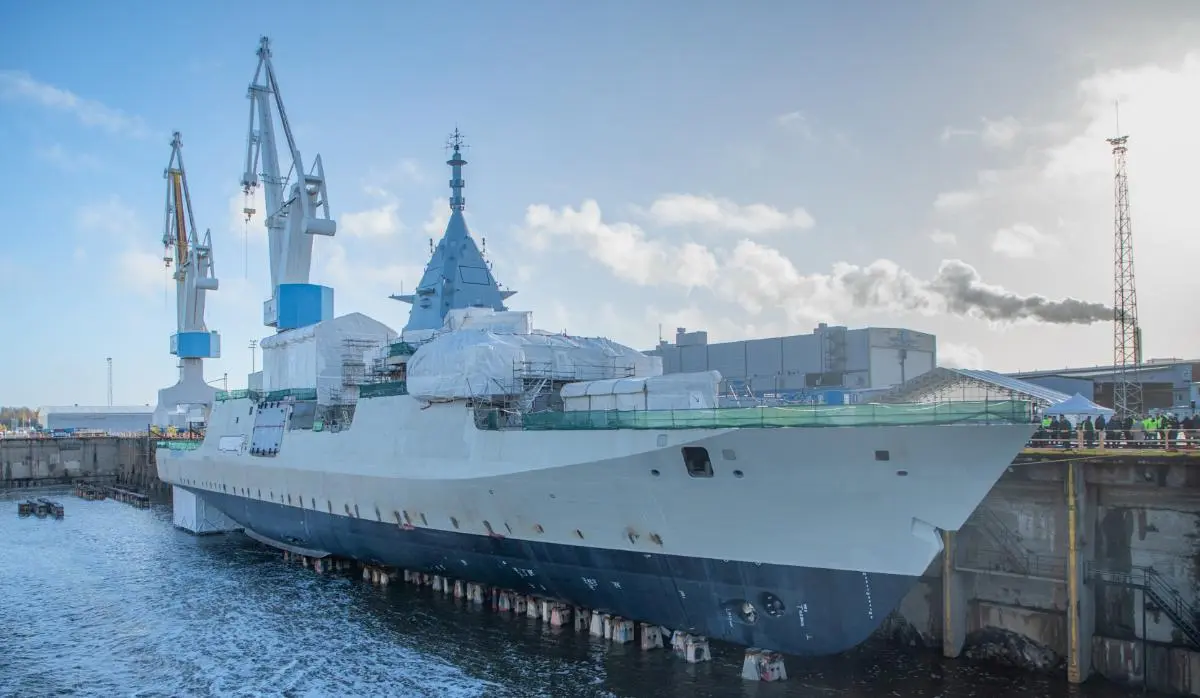
Finland launched the third of its four Pohjanmaa-class multi-role corvettes at the Rauma Marine Constructions (RMC) shipyard on October 29, 2026, putting three ships of the Squadron 2020 program in the water, the Finnish Navy said. The launch opens the next phase of the ship’s construction and outfitting. All four corvettes are due to be completed by 2029 and will then enter service in phases, according to the Navy, whose announcement gave no date for the third ship’s sea trials.
The launch comes as Helsinki rebuilds its surface fleet around a single class of ice-capable warships, three and a half years after Finland joined NATO on April 4, 2023. Squadron 2020, formally launched in 2015, replaces seven aging vessels: four Rauma-class missile boats, two Hämeenmaa-class minelayers and the retired minelayer Pohjanmaa, whose name the new class carries. The program carried an approved budget of about €1.32 billion at contract award in 2019, and construction, originally planned for 2022, began only in late 2023 after a prolonged detailed design phase and delays on the shipyard’s civilian projects.
Pohjanmaa-Class Corvette Build Schedule: Four Hulls in Parallel at Rauma
Construction has accelerated since first steel was cut for the lead ship on October 30, 2023. That ship was laid down in April 2024, launched in May 2025 and is now fitting out. The second hull, laid down on May 8, 2025, was launched on May 21, 2026. The third ship went from steel cutting on August 26, 2025, to keel laying in January 2026 and launch less than 10 months later. RMC started production of the fourth hull in January and laid its keel in July, so all four ships are now under construction at the same time.
“The launch of the third vessel shows the progress of long-term and persistent work,” said Rear Adm. Tuomas Tiilikainen, commander of the Finnish Navy.
RMC Defence Oy, a subsidiary of RMC, builds the ships for the Finnish Defence Forces Logistics Command under a €647.6 million design and construction contract awarded in 2019. Saab supplies and integrates the combat system, while the weapons are procured separately as government-furnished equipment.
Publicly available specifications put each corvette at 117 meters (384 feet) long, with a 16-meter beam, a 5-meter draft and a displacement of roughly 4,300 tonnes, closer to a light frigate than a traditional Baltic corvette. They are the largest surface combatants the Finnish Navy has ordered since the coastal defense ships Ilmarinen and Väinämöinen of the 1930s. A combined diesel-electric and gas (CODLAG) plant, reported at 28 MW, drives two controllable-pitch propellers: electric motors handle normal cruising to keep the underwater signature low, and the gas turbine provides sprint speeds above 26 knots. Each ship carries a crew of about 70, has a 14-day endurance and a range of about 3,500 nautical miles. Finnish ice class 1A hulls allow year-round operations in the Gulf of Finland and the Gulf of Bothnia, which can freeze in winter, giving the Navy a surface presence and minelaying capacity that no longer depends on the season.
Gabriel V, ESSM Block 2 and Sea Mines: Squadron 2020 Combat Suite
The Pohjanmaa class consolidates missions the Navy currently spreads across several smaller hulls. Saab’s 9LV combat management system integrates a Sea Giraffe 4A fixed-face active electronically scanned array (AESA) radar and a Sea Giraffe 1X short-range 3D radar on an integrated mast, two Ceros 200 fire-control directors, and a Patria-supplied variable-depth sonar with a towed array.
Air defense rests on an eight-cell Mk 41 vertical launch system holding 32 quad-packed RIM-162 Evolved Sea Sparrow Missile (ESSM) Block 2 interceptors, designated ITO 20 in Finnish service. The Block 2 active radar seeker reduces dependence on fire-control illumination and supports multiple simultaneous engagements, giving each ship a local-area defense against cruise missiles and aircraft over the confined Baltic littoral. Surface strike comes from eight Israel Aerospace Industries Gabriel V anti-ship missiles, designated PTO 2020, in two quad launchers.
For anti-submarine warfare, the corvettes carry Saab Torped 47 400 mm lightweight torpedoes. A Bofors 57 mm Mk3 gun, transferred from the Hamina-class missile boats, two Saab Trackfire remote weapon stations and Rheinmetall MASS decoy launchers complete the self-defense layer. Stern rails accommodate up to 100 naval mines, the mission that ties the class most directly to Finland’s defense of its shallow coastal approaches. Composite ballistic armor protects key compartments.
Analysis: The Pohjanmaa class moves Finland’s surface force from short-range fast attack craft toward multi-role ships that can operate alongside allied navies across the Baltic. The Mk 41 and ESSM Block 2 combination aligns Finnish air-defense logistics with the US Navy and other ESSM consortium members. At roughly 4,300 tonnes, each Finnish corvette outsizes the Steregushchiy-class corvettes of Russia’s Baltic Fleet, publicly reported at about 2,200 tonnes, and pairs that with a mining capacity positioned along the sea approaches to St. Petersburg. Building all four hulls in parallel also protects the 2029 completion target, but it compresses sea trials, combat system integration and crew training into a narrow 2027 to 2029 window.
The next milestones are the lead ship’s handover, scheduled for 2027, and the launch of the fourth hull, for which no date has been announced. The Navy has not disclosed the third ship’s sea trial schedule or an updated program cost. It plans to keep the class in service into the 2060s.