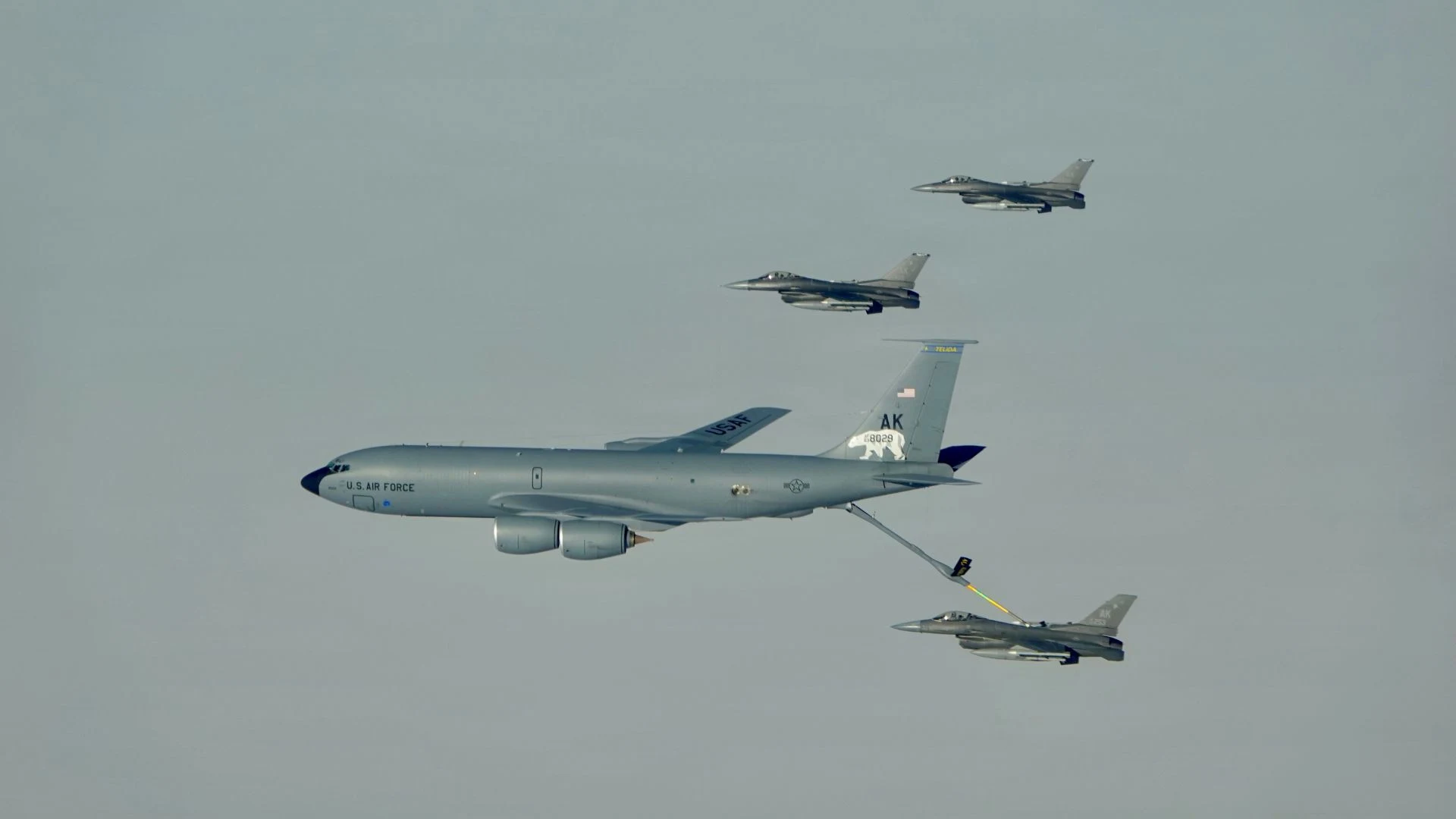
US Air Force F-16 Fighting Falcons held an air defense alert posture at Eareckson Air Station on Shemya Island, at the western end of Alaska’s Aleutian chain, from October 18 to 26, 2026, and launched on October 25 as part of a binational homeland defense mission, the North American Aerospace Defense Command (NORAD) announced on October 30, 2026. Armed with live air-to-air missiles, the jets stood the first fighter alert on the island in decades.
Shemya was a frontline Cold War outpost, hosting F-4 Phantom II and later F-15 Eagle detachments tasked with intercepting Soviet aircraft approaching from the Kamchatka Peninsula. Routine fighter operations ended in the early 1990s, and the installation was redesignated Eareckson Air Station in 1993. Fighters have passed through since, but never on alert. The return comes as NORAD rebuilds capacity on its northern and Pacific flanks, after years of Russian long-range aviation activity near Alaska and a first joint Russian-Chinese bomber patrol inside the Alaska Air Defense Identification Zone in July 2024.
Inside the Eareckson Air Station Alert, From Noble Defender to Noble Eagle
The F-16s launched under Operation Noble Defender, a recurring NORAD air defense operation built to demonstrate the command’s ability to defend the United States and Canada from any approach. As the October 25 mission developed, it shifted to Operation Noble Eagle, the standing homeland air defense mission, in support of northern sovereignty operations, and grew into a coordinated binational force package.
The package included two F-16s, F-35A Lightning IIs and additional F-16s from Eielson Air Force Base near Fairbanks, and Royal Canadian Air Force CF-18 Hornets from Cold Lake, Alberta. An E-3 Sentry Airborne Warning and Control System (AWACS) aircraft from Joint Base Elmendorf-Richardson provided airborne command and control. Multiple KC-135 Stratotankers and a Canadian CC-150 Polaris handled aerial refueling, and an HC-130J Combat King II from the 211th Rescue Squadron covered search and rescue and personnel recovery.
NORAD split the Alaska theater into sectors. The Eareckson F-16s covered the southern portion, the Eielson F-35As and F-16s took the northwest, and the CF-18s held the northern approaches. Eareckson sits roughly 1,600 miles from Eielson and 2,600 miles from Cold Lake, making tanker support the enabling factor.
“Operating from Eareckson Air Station proved we can deploy to an austere location, maintain alert, launch on short notice, and seamlessly integrate U.S. and Canadian forces to defend the northern approaches,” said Lt. Gen. Robert D. Davis, commander of the Alaskan NORAD Region.
The deployment also certified the F-16 on Eareckson’s arresting system, a prerequisite for fighter operations at an airfield with few diversion options. NORAD did not disclose the missile loadout, the number of alert launches, or whether any foreign aircraft were intercepted during the period.
Block 30 F-16s and the 18th Fighter Interceptor Squadron Role
The Eielson F-16s belong to the 18th Fighter Interceptor Squadron (FIS), formerly the 18th Aggressor Squadron. Redesignated in 2024, the unit shifted from adversary training to aerospace control alert and homeland defense. Publicly available information indicates the squadron flies F-16C Block 30 aircraft powered by the General Electric F110-GE-100 turbofan, rated at roughly 28,000 pounds of thrust in afterburner. The Block 30 predates the Block 40 and 50 jets that dominate the fleet, but the squadron’s aggressor heritage gives its pilots detailed knowledge of the Russian and Chinese tactics they would face when intercepting Tu-95MS or H-6 bombers.
The 18th FIS has already rehearsed dispersed operations. In September 2025, four of its F-16s deployed to King Salmon Airport on the Alaska Peninsula under the Agile Combat Employment (ACE) concept, which disperses aircraft to complicate enemy targeting. Eareckson pushes that model roughly 1,000 miles farther west.
The CF-18s reflect Ottawa’s operational stake in continental air defense; Canada committed C$38.6 billion over 20 years to NORAD modernization in June 2022.
Cobra Dane and Shemya’s Strategic Role in the North Pacific
Shemya’s value rests largely on the AN/FPS-108 Cobra Dane radar, a large L-band phased-array system that publicly available specifications indicate entered service in 1977. It provides ballistic missile warning, space surveillance, and tracking data for Ground-based Midcourse Defense. The island lies roughly 500 miles from Russia’s Kamchatka Peninsula, home to the Kura missile test range and the Pacific Fleet submarine base at Vilyuchinsk, placing the radar near its targets but also within reach of cruise missiles and one-way attack drones.
Protecting the site has become a recurring exercise theme. In 2021, Army Green Berets from Special Operations Command North deployed to Shemya by sea with FIM-92 Stinger man-portable air defense systems to rehearse the defense of Cobra Dane. In August 2023, MH-60M Black Hawks from the 160th Special Operations Aviation Regiment flew to Eareckson during Operation Polar Dagger. Forward-based fighters add an outer layer, engaging aerial threats before they reach the radar.
Sustaining fighters there for weeks, however, would require fuel, munitions, maintainers, and force protection delivered by air or sea into some of the harshest weather on US territory.
Analysis: The arresting gear certification matters more than the alert window itself. It converts Eareckson from a contingency divert field into a qualified F-16 operating location, giving NORAD an intercept node more than 1,000 miles west of its main Alaskan bases and a dispersal option if Elmendorf or Eielson come under missile attack. It also places an organic air defense layer over Cobra Dane. The limits are equally clear. Eareckson has a small permanent footprint, a supply chain that depends on airlift and sealift, and no publicly described plan to protect parked aircraft against cruise missile or drone attack. The October rotation demonstrates a capability; it does not establish a persistent posture.
NORAD has not said whether alert rotations at Eareckson will recur or on what schedule. Indicators to watch include further Noble Defender iterations in the western Aleutians, F-35A certification at the airfield, and military construction requests for fuel, munitions storage, and aircraft protection at Shemya in the fiscal 2028 budget.