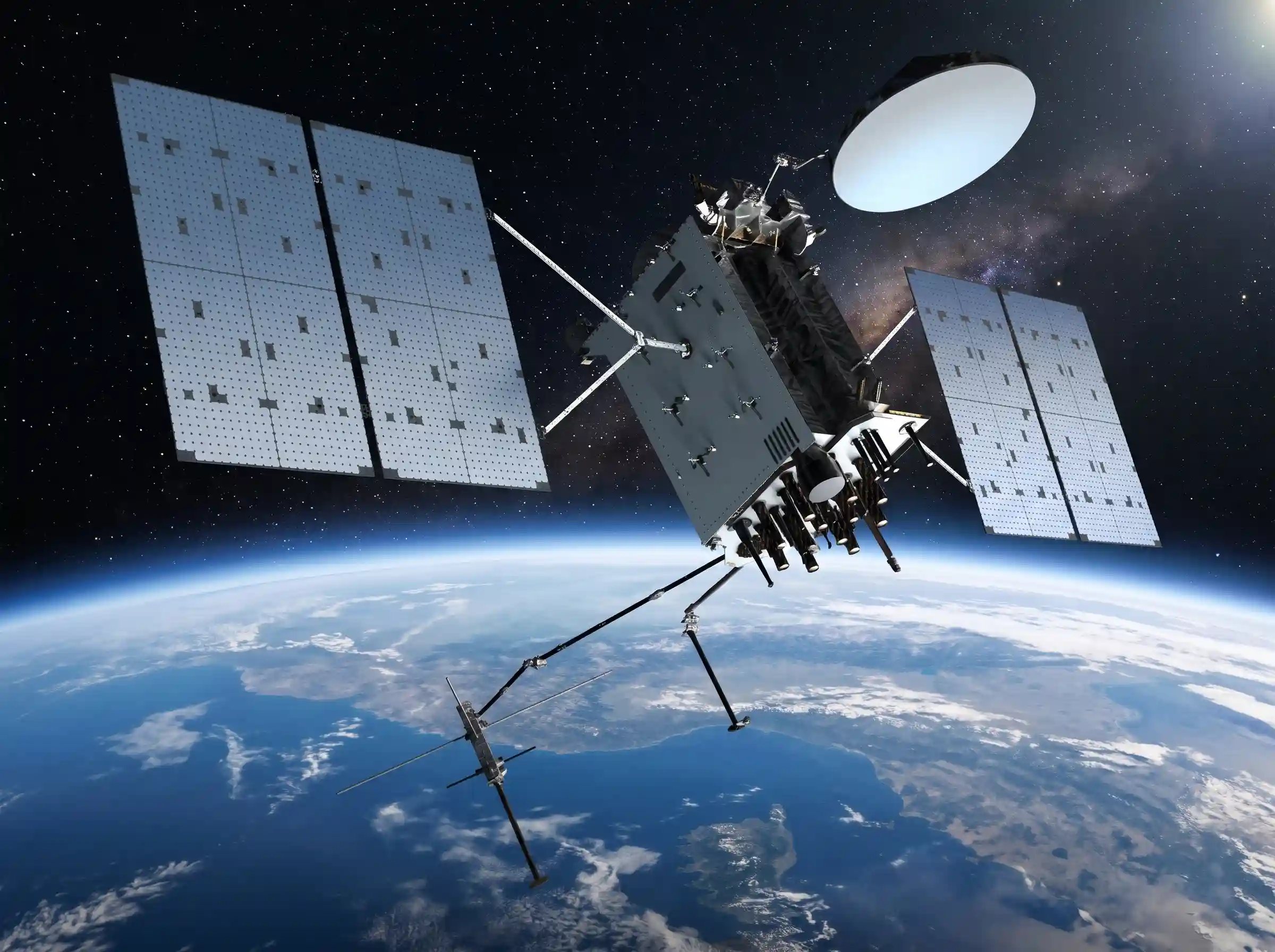
The US Space Force has awarded Lockheed Martin a $95 million contract modification to fully fund the company’s request for equitable adjustment (REA) tied to the Zero Buy year on the GPS III Follow-On (GPS IIIF) satellite production line. Announced by the Pentagon on October 30, 2026, modification P00208 to contract FA8807-18-C-0009 raises the contract’s cumulative face value from $4,633,023,341 to $4,728,023,341, with the full amount obligated at award from fiscal 2025 and 2026 procurement funds.
The payment puts a price on a budget decision. In its fiscal 2026 request, the Space Force deferred the planned annual purchase of GPS IIIF satellites and sought only $110 million in procurement funds for the program. Appropriators warned that a gap year would trigger a penalty payment under the 2018 contract, which covers up to 22 satellites with options worth up to $7.2 billion and relies on pre-priced annual production lots. Congress added $528 million for two satellites, and the Space Force awarded Space Vehicles (SV) 23 and 24 for $514 million on June 15, 2026, bringing the GPS IIIF order book to 14 spacecraft.
How the GPS IIIF Zero Buy Triggered a $95 Million Adjustment
An REA is the mechanism a contractor uses to recover costs caused by a government action that changes the conditions of performance. On an annual-option production contract, a skipped buy disrupts supplier orders, workforce loading, and the learning-curve assumptions built into pre-negotiated prices. The Pentagon announcement does not itemize the costs the $95 million covers, and neither the Space Force nor Lockheed Martin has publicly detailed the breakdown.
Work will be performed at Littleton, Colorado, where Lockheed Martin builds GPS satellites. The announcement lists a completion date of October 27, 2026, three days before the award was made public. The contracting activity is the Space Force Portfolio Acquisition Executive for Satellite Communications and Positioning, Navigation, and Timing at Los Angeles Air Force Base, California.
The sum is material against the program’s unit economics. At the June 2026 award price, a GPS IIIF space vehicle costs roughly $257 million before launch, which places the Zero Buy adjustment at about 37 percent of one satellite.
Regional Military Protection and the LM2100 Combat Bus Upgrade
GPS IIIF is the Space Force’s primary path to a jam-resistant constellation. Its headline capability, Regional Military Protection, uses a high-gain spot beam to concentrate encrypted M-code signal power over a defined theater rather than spreading it evenly across the visible Earth. Lockheed Martin rates the feature at a 63-fold increase in anti-jam capability over legacy satellites.
The block also introduces the first fully digital navigation payload on a GPS satellite, which supplier L3Harris says can be reprogrammed on orbit. Beginning with SV13, the spacecraft move from the LM2100M bus used on SV11 and SV12 to the LM2100 Combat Bus, which adds cyber hardening and improved power, propulsion, and electronics. The satellites continue to broadcast civil signals, including L1C and L5.
Schedule pressure predates the funding gap. In late 2024, production problems with the new Mission Data Unit put the first GPS IIIF satellites eight to 11 months behind the Space Force’s preferred available-for-launch schedule, although Lockheed Martin was reported to remain on track for its contractual delivery dates.
Analysis: The $95 million settlement shows that annual-option production contracts carry a hidden cost of discontinuity. The Space Force had pitched cheaper Resilient-GPS (R-GPS) satellites, targeted at $50 million to $80 million each, to reinforce the constellation, but it ended that effort in January 2026 after funding for the next phase was left out of the fiscal 2026 budget. Pausing GPS IIIF did not eliminate the expense; it converted part of it into a payment that procures no hardware. For a constellation that still depends on aging legacy satellites, the episode strengthens the case appropriators have made for treating GPS IIIF as a protected line rather than a bill payer.
The next markers are the fiscal 2027 appropriations cycle and delivery of SV11 in 2027. After appropriators instructed the Air Force Secretary to prioritize GPS IIIF, the fiscal 2027 request seeks two GPS IIIF satellites with nearly $680 million in procurement funds. With 14 of up to 22 satellites on contract, eight options remain. Whether the Space Force sustains an annual cadence through those options will determine if the Zero Buy adjustment stays a one-time cost.