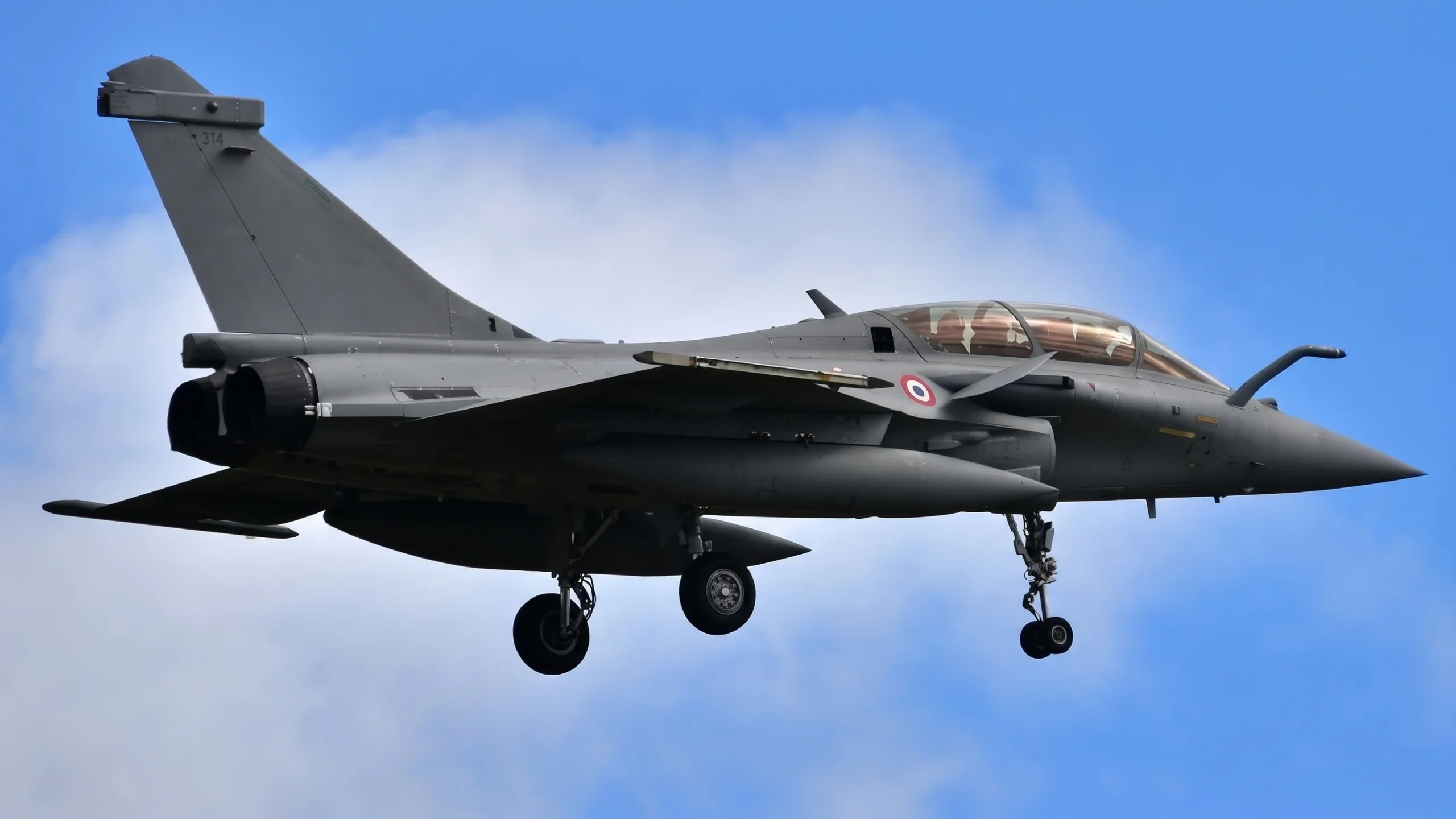
France’s Directorate General for Armament (DGA) has delivered the first Rafale configured as a flying testbed to its flight test center, DGA Essais en vol, the agency announced on November 2, 2026. The two-seat aircraft, serial B374, will carry the test campaigns for the equipment and weapons of the Rafale F5 standard, the fighter’s mid-life upgrade.
Built by Dassault Aviation, B374 is the 73rd and final aircraft of the Rafale’s fourth production tranche, which the DGA says was notified in 2021 to Dassault Aviation, Thales, Safran and MBDA. Its arrival lines up with the F5 calendar: the DGA notified the first upstream F5 development contracts over summer 2026, and the formal launch of full development, the lancement en réalisation, is expected by the end of 2026. Armed Forces Minister Catherine Vautrin told the French Senate in April 2026 that €3.4 billion is allocated to F5 under the current military programming law.
Rafale Testbed for the F5 Standard: Inside France’s New Flying Laboratory
The DGA designates B374 an Avion banc d’essais (ABE), a heavily modified aircraft fitted with measurement equipment, data recorders and a datalink connecting it to flight test conduct teams on the ground. The ABE functions as a flying laboratory, allowing engineers to evaluate navigation and attack systems, sensors, weapons, communications and onboard software under real flight conditions.
B374 was delivered at the F4.1 standard, which the DGA qualified on March 13, 2023, and which introduced collaborative air combat capabilities to the Rafale fleet. Publicly available specifications indicate that the baseline aircraft is powered by two Safran M88-2 turbofans rated at 7.5 tonnes of thrust each with afterburner, and carries the Thales RBE2 active electronically scanned array (AESA) radar and the SPECTRA self-protection suite. F5 replaces or overhauls each of these systems.
B374 is the first Rafale ABE assigned to DGA Essais en vol. It will eventually replace Rafale B348, which the French Air and Space Force has lent to the center on a long-term basis. The change ends the center’s reliance on a frontline airframe borrowed from operational squadrons. Delivery also comes later than first planned: a January 2025 DGA release had scheduled the testbed’s delivery for early 2026.
From Reversible Instrumentation to Permanent Fit: B374 Conversion Timeline
In a first phase, B374 will receive reversible test and measurement installations, known in French as Installations d’essais et de mesures (IEM). In that configuration, the aircraft will support development work on the current Rafale standard.
Around the second quarter of 2027, Dassault Aviation will carry out a major transformation of the aircraft. The work will integrate the interfaces DGA Essais en vol needs to install complete and permanent flight test instrumentation. According to the DGA, the upgrade will give the center improved analysis capability for the next increments of the F4 standard and prepare the ground for F5 trials.
B374 is due to return to the DGA Essais en vol test fleet in 2028. At that point it will carry an orange version of the Rafale’s modular data processing unit, the Ensemble modulaire de traitement de l’information (EMTI). The orange EMTI is a software build of the onboard computer dedicated to testing, separate from the build flown by operational squadrons. The DGA says this configuration will allow the aircraft to accept future F5 sensors, starting with the next-generation RBE2-XG radar now in development.
The DGA has not disclosed the cost of the conversion, the length of the 2027 downtime, or whether additional Rafale testbeds are planned.
RBE2-XG Radar and the F5 Systems Awaiting Flight Trials
The F5 content set out by the DGA on September 10, 2026, explains why the center needs a dedicated testbed. The centerpiece is the Thales RBE2-XG, an evolution of the in-service RBE2 AESA. The DGA expects higher output power and detection range, better performance against targets with very low radar cross-sections, greater resilience including against cyber threats, and sensors able to work together without pilot intervention. Because the radar keeps the current footprint, the integration challenge lies in validating its modes and sensor fusion in flight.
F5 also adds a new jam-resistant datalink known as IVDL, a fully digital SPECTRA F5 electronic warfare suite developed by Thales and MBDA, and the Safran M88 T-REX engine, which raises maximum thrust by 20 percent, from 7.5 to 9 tonnes. The standard integrates MBDA’s ASN4G hypersonic air-launched nuclear missile, which will renew France’s airborne nuclear component. The updated military programming law provides for the acquisition of 47 F5-standard Rafales by 2035, and the DGA targets qualification of the standard around 2033.
Because these systems interact through the mission computer, the test-specific EMTI build sits at the core of the 2028 configuration. The DGA has not said whether B374 will also fly the T-REX engine.
What the New Rafale Testbed Means for France’s 2033 F5 Qualification Target
Analysis: B374 is a modest piece of hardware with outsized programmatic weight. The F5 standard is a mid-life renovation broad enough to touch the radar, electronic warfare, datalink, propulsion and nuclear strike roles at once, and its credibility depends on test capacity as much as on contracts. The schedule, however, is tight. If B374 returns in its final configuration in 2028, the test enterprise has roughly five years to clear the RBE2-XG and associated systems before the targeted 2033 qualification, with a single government testbed identified so far. With the Franco-German-Spanish Future Combat Air System no longer proceeding in its original trilateral form, F5 now carries a larger share of France’s combat aviation modernization into the 2040s, which raises the cost of any slip in the test campaign.
The next milestone is the formal launch of F5 full development, expected before the end of 2026. B374 enters Dassault Aviation’s facilities around the second quarter of 2027, with a return to the DGA test fleet planned for 2028. Open questions remain on the cost of the conversion, the date of the first RBE2-XG flight on B374, the future of B348 once it is released, and whether the DGA will add a second Rafale testbed as F5 trials ramp up.