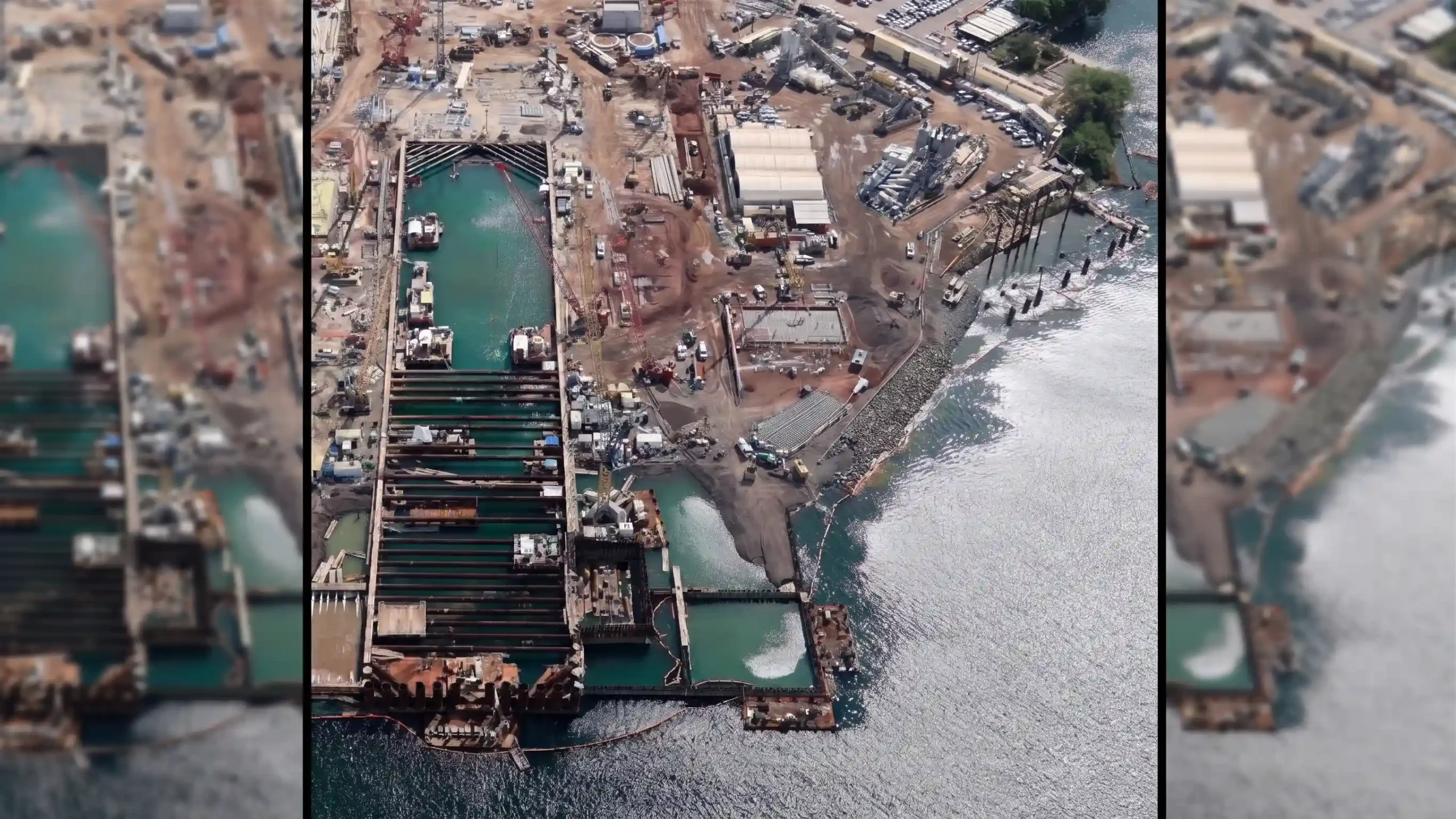
Norfolk Naval Shipyard (NNSY) in Portsmouth, Virginia, has completed its $134 million Dry Dock 4 Refueling Complex, a facility built to refuel and defuel nuclear-powered submarines and to support the inactivation of Ohio-class and Virginia-class boats. The Navy marked completion with a ribbon-cutting ceremony on October 29, 2026. In Hawaii, crews building Dry Dock 5 at Pearl Harbor Naval Shipyard placed more than 900 cubic yards of concrete underwater during October, advancing what the Navy has called its largest construction project to date.
Both projects fall under the Shipyard Infrastructure Optimization Program (SIOP), launched in 2018 to recapitalize the Navy’s four public shipyards at Norfolk, Portsmouth in Maine, Puget Sound and Pearl Harbor. The program’s scale has grown sharply. The Navy initially estimated SIOP at $21 billion over 20 years; a Government Accountability Office (GAO) report dated September 25, 2026, concluded that executing the program as planned will surpass $200 billion, with the last projects not scheduled for completion until after 2080. The two updates show SIOP moving at two speeds: facility upgrades reaching completion while multibillion-dollar dry docks advance pile by pile.
Norfolk Naval Shipyard Refueling Complex Expands Reactor-Servicing Capacity
Naval Facilities Engineering Systems Command (NAVFAC) Mid-Atlantic awarded Cianbro Corp. the design-bid-build contract for the complex in October 2023. According to the Navy, the modernization corrects design limitations in the former complex that had constrained efficiency, and adds upgraded radiological storage and expanded workspace to support reactor-servicing operations. The facility also provides dedicated training space for reactor-servicing personnel.
The inactivation mission is the immediate driver. USS Georgia (SSGN 729), the first of the Navy’s four Ohio-class guided-missile submarines to leave service, returned to Naval Submarine Base Kings Bay, Georgia, on July 27, 2026, and is scheduled to shift homeport to Norfolk for inactivation at NNSY in July 2027, according to a Navy statement reported by The War Zone (TWZ). The remaining SSGNs are slated to follow over the next several years, and the complex’s Virginia-class capability positions the yard for the eventual retirement of that class’s earliest hulls.
“Dedicating this complex further fortifies our capabilities at Dry Dock 4 and positions us to service a variety of submarine classes for decades into the future,” said Rear Adm. Kavon Hakimzadeh, commander of NNSY.
The project builds on the Dry Dock 4 infrastructure recapitalization completed in 2023. According to GAO data, Norfolk had 25 SIOP construction projects completed, underway or in design as of April 2026, valued at about $4.27 billion. Unlike Portsmouth, Pearl Harbor and Puget Sound, Norfolk has no new dry dock in that current project set; its modernization is proceeding through incremental upgrades to existing docks, utilities and facilities.
Pearl Harbor Dry Dock 5 Pushes Underwater Construction Toward 2029
At Joint Base Pearl Harbor-Hickam, the P-209 project overseen by the Officer in Charge of Construction Pearl Harbor Naval Shipyard (OICC PHNSY) logged several structural milestones in October. Beyond the 900-plus cubic yards of concrete placed 40 to 60 feet underwater, divers in the pump well finished trimming foundation piles to the required elevation and installed protective plastic jackets nearly 80 feet below the surface, while workers continue installing above-water bracing. Once operational, the pump well will dewater the dry dock basin. Crews also completed pile driving for the west quay wall and north cofferdam, bringing those two features to nearly 200 piles combined, and poured foundation slabs for the basin water treatment system and the east electrical substation.
Dry Dock 5 replaces Dry Dock 3, the smallest of Pearl Harbor’s four docks and a World War II-era structure that cannot accommodate Virginia-class submarines. It is the first new dry dock built at Pearl Harbor since 1943 and is designed for a 150-year service life. The contractor is a joint venture of Dragados USA, Hawaiian Dredging Construction Company and Orion Government Services, and construction formally began on August 19, 2023.
Cost and schedule have moved. Navy statements at the start of construction targeted completion in 2027. According to GAO, the Navy reported an $834 million increase in the project’s estimated cost, and its April 2026 budget request sought a total authorization of $4.47 billion, with completion now expected by March 2029.
Analysis: The two announcements expose the core tension in SIOP. The Navy is delivering back-end capacity for defueling and inactivation at Norfolk at modest cost, while front-line Pacific maintenance capacity hinges on a single dry dock whose estimate and schedule have both slipped. GAO reports that the majority of Virginia-class submarines are planned to homeport at Pearl Harbor by 2030. A March 2029 completion leaves little margin between the dock’s arrival and that concentration of attack submarines, and any further delay would push depot-level work for Pacific-based boats onto other yards already carrying heavy backlogs. At Norfolk, the new complex arrives as SSGN retirements begin to add inactivation workload to a yard that also maintains aircraft carriers.
Several decision points now follow. Georgia’s arrival at NNSY in July 2027 will be the first major test of the new complex. At Pearl Harbor, construction of the dry dock walls is the next major phase, while work on the pump well continues. The Navy planned to present an overall SIOP cost and schedule baseline to senior leadership by September 2026; the outcome has not been publicly confirmed. GAO has also asked Congress to consider requiring consolidated annual reporting on SIOP costs and risks for the life of the program.