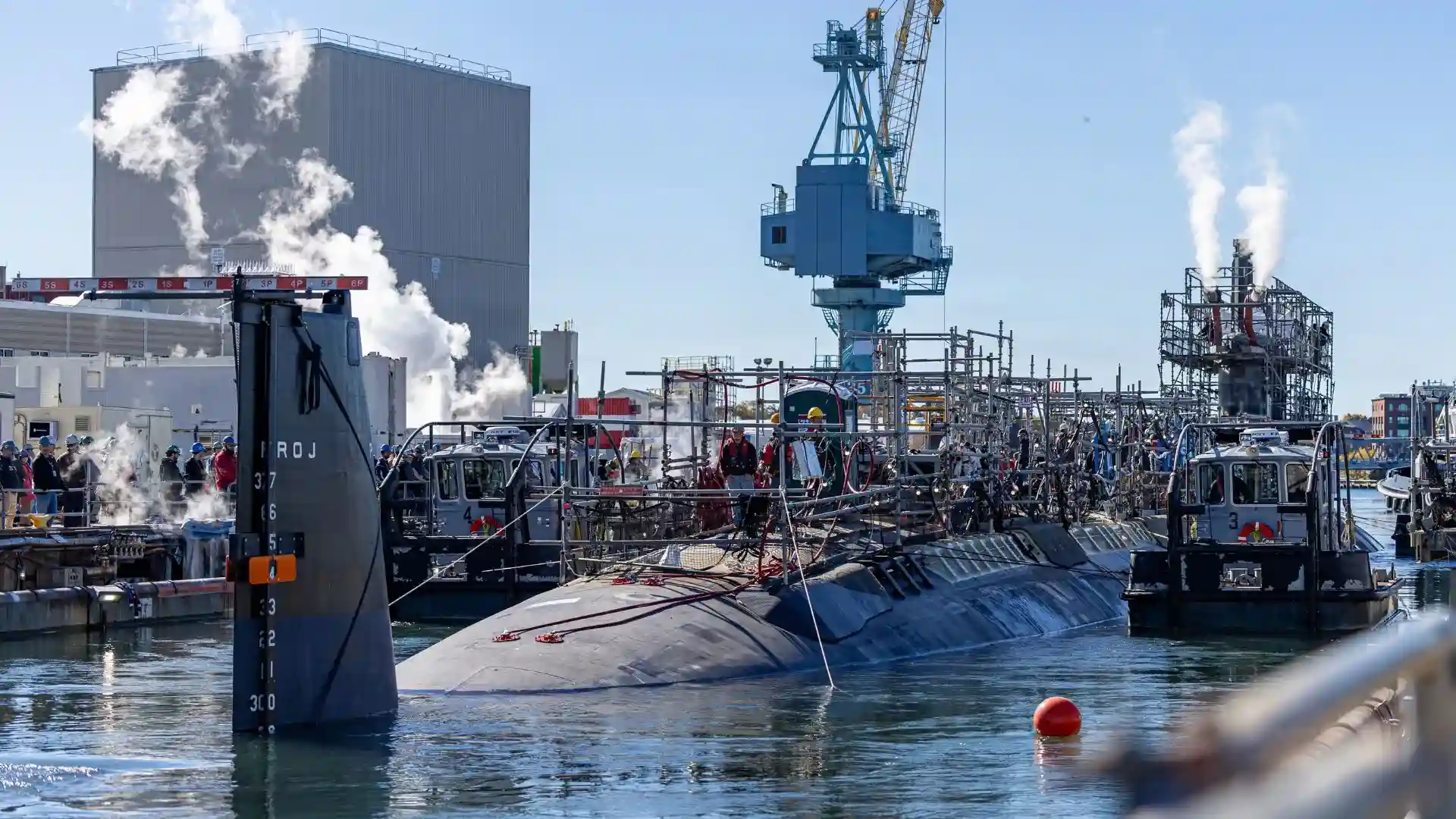
The U.S. Navy’s next-generation attack submarine program office on Oct. 30, 2026, asked industry to register interest in a competition to apply Super Intelligence, the service’s new official term for artificial intelligence, to the internal layout of the SSN(X). Expressions of interest are due by 12:00 a.m. Eastern Time on Nov. 6, 2026, and a formal Area of Interest notice under Other Transaction (OT) authority could launch as early as next week, according to the presolicitation notice.
The notice, issued by Naval Sea Systems Command’s (NAVSEA) Director, Submarine Programs through the SSN(X) Program Office (PMS 351), arrives while the Virginia-class successor remains in an extended concept phase. The Navy’s fiscal 2025 budget deferred procurement of the first boat from fiscal 2035 to fiscal 2040, citing limits on its total budget, and the service has warned that the gap between Columbia-class design work and SSN(X) design strains the submarine design workforce. Tools that compress early design iteration speak directly to that problem.
Why System Arrangement Drives SSN(X) Attack Submarine Design Risk
The forthcoming opportunity will solicit competitive industry concepts to “leverage Super Intelligence to advance the design of a novel SSN(X) System Arrangement Concept Design and reduce technical risk associated with its integration within a hydrostatically balanced Whole-Ship Submarine Concept Design (SCD),” the notice states.
The wording reflects a terminology change rather than a new technical category. An executive order signed Sept. 29 directed federal agencies to use “Super Intelligence” and “SI” in place of “artificial intelligence” and “AI,” defining the new terms by the existing statutory definition of AI. A Navy administrative memo issued Oct. 22 applied the change across the service, and the SSN(X) notice is among the first Navy acquisition documents to use it.
System arrangement sets where the reactor plant, propulsion train, weapons stowage and handling, sonar and other sensors, combat systems, and crew spaces sit inside the hull. Every placement shifts the boat’s weight and center of gravity. Submerged, a submarine must stay hydrostatically balanced, with weight closely matched to buoyancy so it can hold depth and trim. The Navy wants tools that generate and screen candidate layouts against whole-boat balance before engineers commit to a baseline.
Size is the cost driver. Navy officials have said SSN(X) should combine Seawolf-class speed and payload, Virginia-class quieting and sensors, and Columbia-class availability and service life. In January 2025, the Congressional Budget Office (CBO) assumed a submerged displacement of about 10,100 tons, roughly 11 percent more than Seawolf, and estimated an average unit cost of $8.7 billion in fiscal 2024 dollars, against the Navy’s $7.1 billion. An arrangement that saves internal volume feeds directly into that price.
Other Transaction Authority Opens SSN(X) Work to Nontraditional Vendors
The Navy will run the effort under 10 U.S.C. § 4022, the prototype OT authority that operates outside the Federal Acquisition Regulation. The notice points vendors to subsection (d)(1), which generally requires at least one nontraditional defense contractor or nonprofit research institution participating to a significant extent, a team made up of small businesses or nontraditional contractors, or a non-government cost share of at least one third. Respondents must also state whether they are a traditional or nontraditional defense contractor.
The notice gives no dollar value, number of awards, or schedule beyond the response deadline.
Funding has tightened. The Navy requested $622.8 million for SSN(X) research and development in fiscal 2026, including $366.0 million for class development and $256.8 million for next-generation attack submarine nuclear propulsion. The fiscal 2027 request for SSN(X) development fell to about $316 million.
The notice does not say how SI-generated concepts would reach General Dynamics Electric Boat and Huntington Ingalls Industries’ Newport News Shipbuilding, the only two U.S. yards that build nuclear-powered submarines. Both are committed through July 2038 under the $76.6 billion package awarded July 29, 2026, for nine Block VI Virginia-class and five Build II Columbia-class boats.
Analysis: The choice of OT authority, paired with the explicit traditional-versus-nontraditional question, signals that PMS 351 wants computational design and software firms, not only the two shipbuilders, competing for early concept work. Under section 4022, a successful, competitively awarded prototype can lead to a follow-on production agreement without further competition, giving winners a potential path into the program’s design toolchain. The open question is validation: generated layouts must still clear shock, acoustic, and naval nuclear propulsion requirements that sit with the shipbuilders and Naval Reactors, and the notice is silent on that hand-off.
The next milestone is the Nov. 6 response deadline, followed by the formal Area of Interest notice, which should define scope, evaluation criteria, and the number of agreements. Funding for the effort, the shipbuilders’ role, and how any SI-derived arrangement will feed the Whole-Ship Submarine Concept Design ahead of a first-boat buy still planned for fiscal 2040 remain unknown.