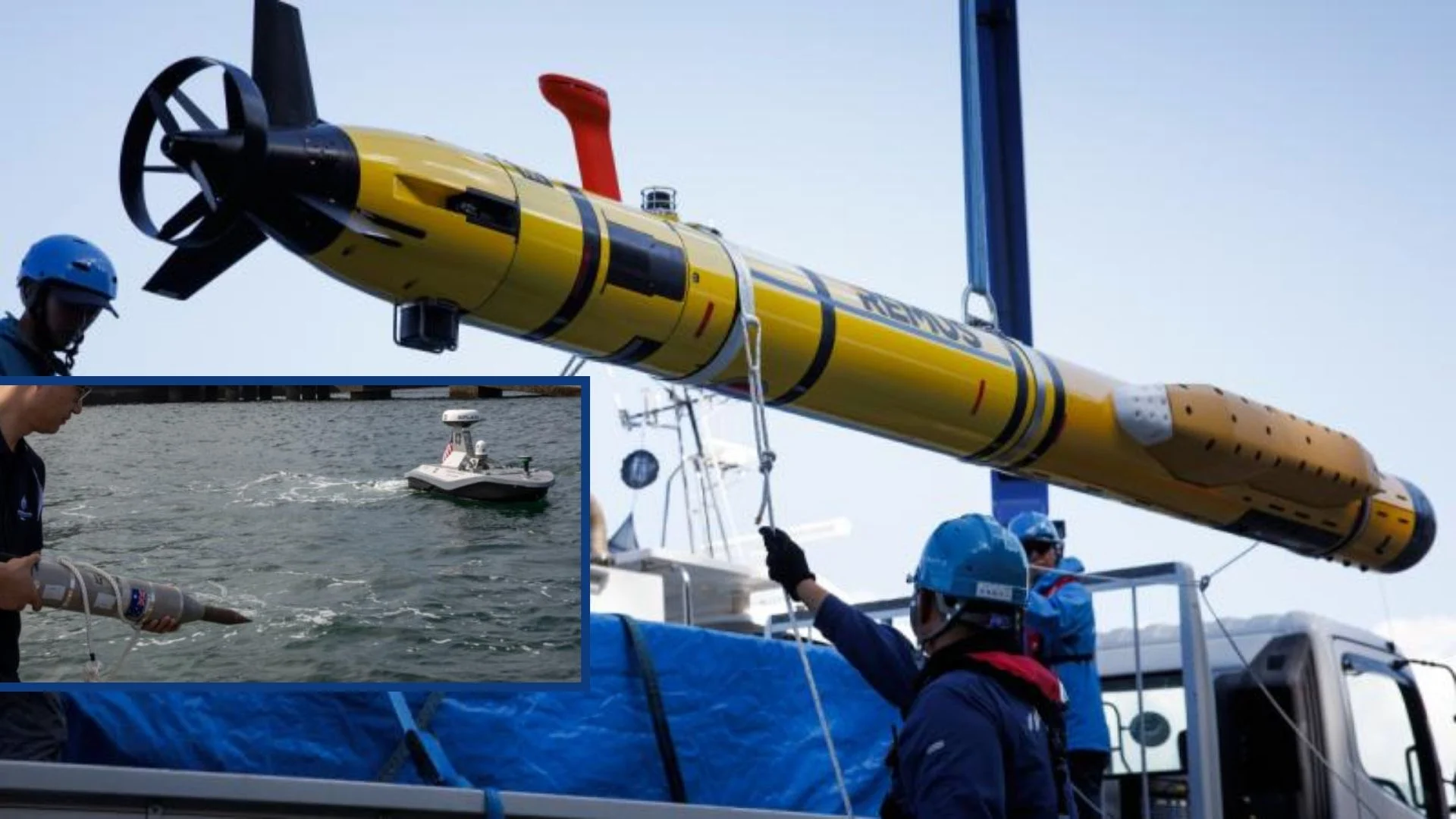
Australia, Japan and the United States linked autonomous maritime systems from all three nations through a single underwater communications network during Exercise Keen Sword 27, the Australian Department of Defence announced on November 3, 2026. The trilateral experiment relayed positional data from a Japanese REMUS 620 unmanned underwater vehicle (UUV) through an Australian acoustic node and a US gateway to a US ground station, then sent a command signal back to the vehicle.
Keen Sword 27, the 18th iteration of the biennial Japan-US field training exercise, ran from October 19 to 29, 2026, with about 45,000 Japanese and 11,000 US personnel alongside partner-nation contingents. Australia, which first joined Keen Sword in 2022, deployed almost 300 Australian Defence Force (ADF) personnel, with the coordinated employment of robotic and autonomous systems among its objectives. The Defence Science and Technology Group (DSTG) contributed key elements to the experiment’s design and delivery.
How the Trilateral Underwater Communications Network Closed the Loop
The chain ran in four steps. The Japanese REMUS 620 transmitted its position to Australia’s Rock Lobster underwater communication node. Rock Lobster passed the data to a US gateway, which relayed it to a US ground station. A command signal then traveled back through the same network to the UUV, demonstrating two-way communication across Australian, Japanese and US systems.
That architecture reflects the physics of the domain. Radio signals attenuate within short distances in seawater, so data beneath the surface moves acoustically, where noise, interference, multipath echoes and transmission delays degrade every link. Connecting a submerged vehicle to a shore-based command node requires a relay layer that converts acoustic traffic into radio or satellite links at the surface, the role the US gateway appears to have filled.
“Through this experiment, we demonstrated new levels of trilateral interoperability in an operationally relevant environment, integrating Australian, Japanese and United States technologies,” said Brice Mitchell, DSTG’s experimentation lead. Captain Nakashima Junta, chief of the System Integration and Interoperability Section of Japan’s Joint Staff, called it the first trilateral warfighting experiment of its kind conducted in Japan. Colonel Jeffrey Newcamp of US Pacific Command said such experimentation helps partners “rapidly transition advanced science and technology concepts from the laboratory to the tactical edge.”
Defence has not disclosed the transmission ranges, data rates, latency, acoustic waveforms or encryption used, nor the US gateway system involved or where in Japan the experiment took place.
Rock Lobster Acoustic Relay and REMUS 620 UUV Capabilities
Rock Lobster is a deployable, disposable underwater acoustic communication relay developed by L3Harris’s maritime team in Australia with the Royal Australian Navy and DSTG. During Exercise Autonomous Warrior 2023 in Jervis Bay, it relayed mission information from the United States to an underwater system, then matured through the Maritime Innovation Challenge and Maritime Big Play series. In July 2026, it operated alongside US Navy undersea capabilities and the Lightfish uncrewed surface vessel in an AUKUS Pillar II activity at Rim of the Pacific (RIMPAC) 2026. Keen Sword 27 adds Japanese systems to that interoperability work.
The REMUS 620 is a medium-class UUV built by HII and unveiled in November 2022. Publicly available specifications indicate a 32.4-centimeter (12.75-inch) hull diameter, a 600-meter depth rating and controllable speeds of 2 to 8 knots. Power comes from swappable 9.6-kilowatt-hour lithium-ion modules, up to three per vehicle for 28.9 kWh. HII cited endurance of up to 110 hours and range of up to 275 nautical miles at launch; payload-equipped configurations in later company data list shorter figures, such as 50 hours and 132 nautical miles. Acoustic communications use a Woods Hole Oceanographic Institution Micromodem 2.0 operating at 8 to 16 kilohertz, and the open architecture supports the US Navy’s Unmanned Maritime Autonomy Architecture. Defence did not specify which Japanese organization operated the vehicle.
Analysis: The experiment targets a practical gap in allied undersea operations. Australian, Japanese and US unmanned systems run different vehicles, modems and command software, and a shared communications layer is a precondition for any distributed allied undersea network in the Western Pacific. A single relay chain carrying both data and command traffic shows the three nations can pass information across national systems at the technical level. It does not yet show that the link holds at operational range, under jamming, against an adversary listening for acoustic emissions, or with the cryptographic separation national caveats require. DSTG has previously named Phorcys, a secure underwater protocol developed with the United Kingdom, as a candidate for Rock Lobster integration; its use at Keen Sword 27 has not been stated.
The next markers are whether Rock Lobster moves from demonstrator to a funded Royal Australian Navy program, whether Japan’s Ministry of Defense fields compatible relay nodes, and whether trilateral undersea experimentation reappears at Talisman Sabre 2027 or future AUKUS Pillar II events.