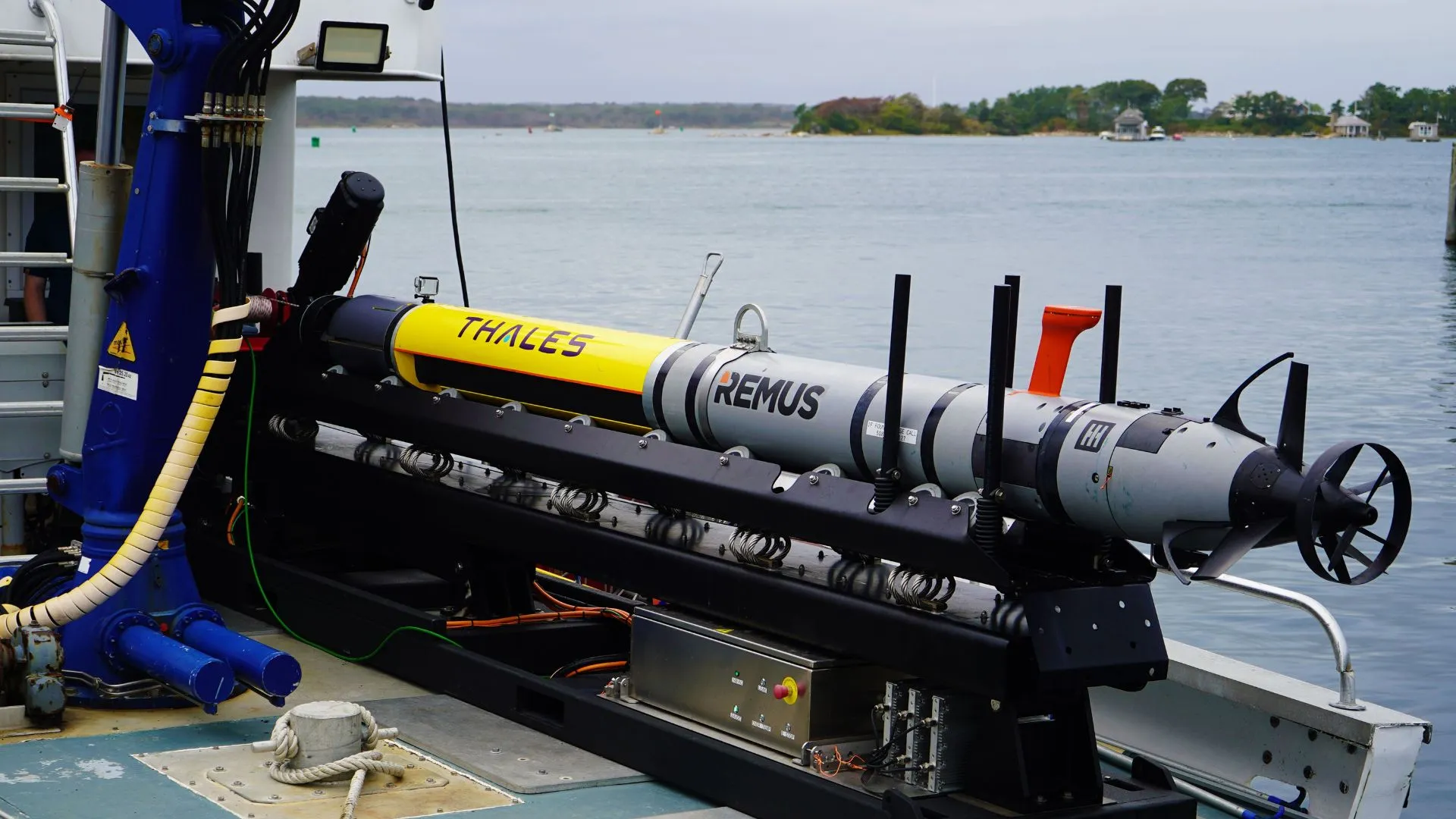
HII and Thales have completed an end-to-end autonomous mine countermeasure demonstration that ran detection, classification and neutralization through a single command and control architecture, the two companies announced on November 3, 2026. The trial paired HII’s REMUS 620 unmanned underwater vehicle (UUV) and Thales’ SAMDIS 600 synthetic aperture sonar with the ANGLER neutralization system from Advanced Acoustic Concepts (AAC), a Thales company, all orchestrated by Thales’ Expeditionary PathMaster mission system.
The demonstration comes as navies on both sides of the Atlantic retire crewed minehunters in favor of stand-off, unmanned toolkits that keep sailors outside the minefield. It also extends a partnership that began at the sensor level: in August 2025, the two companies completed integration and field testing of the SAMDIS 600 aboard the REMUS 620 at HII’s Pocasset, Massachusetts, facility, a milestone announced on September 9, 2025. The new exercise adds mission management, AI-assisted data exploitation and mine neutralization. The companies did not disclose the trial date, test area or environmental conditions.
Inside the Autonomous Mine Countermeasure Chain: Find, Fix, Finish
In the find phase, the REMUS 620 searched the seabed autonomously with the SAMDIS 600 multi-aspect synthetic aperture sonar (SAS), controlled by HII’s Odyssey command and control (C2) software, which interfaced with the Thales Expeditionary Portable Operation Center (ePOC). HII’s Sea Launcher system handled automated launch and recovery of the vehicle. HII demonstrated Sea Launcher’s shipboard launch and recovery of a REMUS vehicle in January 2026.
The REMUS 620 is HII’s next-generation medium-class UUV, with a 32.4-centimeter (12.75-inch) hull and a 600-meter depth rating. HII specifications list a top speed of 8 knots and up to 110 hours of endurance over 275 nautical miles in its three-battery, 28.9-kilowatt-hour configuration. Those figures fall with a sonar payload installed: HII data for the Kraken MINSAS 60 dry payload list 78 hours and 205 nautical miles. Endurance with the SAMDIS 600 has not been published.
SAMDIS 600 is a multi-aspect synthetic aperture sonar. Thales says the SAMDIS line produces three views of each contact from different angles in a single pass, reducing ambiguity in classification and cutting false alarms. The French Navy has ordered SAMDIS 600 aboard eight Exail A18-M autonomous underwater vehicles under its SLAM-F program, and earlier SAMDIS versions were selected for the Franco-British Maritime Mine Counter Measures (MMCM) program and Japan’s OZZ-5 UUV.
In the fix phase, operators in the ePOC combined the multi-aspect imagery with AI-enabled Automatic Target Recognition (ATR) to classify and localize mine-like objects. The finish phase fell to ANGLER, a reusable micro remotely operated vehicle (ROV) that reacquired the contacts and visually identified the threat. According to AAC, ANGLER carries either a 66 mm shaped charge or high-velocity 20 mm underwater projectiles and is designed to neutralize a mine without necessarily triggering sympathetic detonation, then document the effect. The companies did not state whether a live charge was fired.
Expeditionary PathMaster and the Open Architecture Bet for NATO Navies
Expeditionary PathMaster, which Thales launched in March 2026, is built around the ePOC and runs the company’s M-Cube mission management and Mi-Map sonar analysis software. M-Cube and Mi-Map were already delivered to the French Navy and the Royal Navy under the MMCM program. The system scales from a three-screen laptop to a shore operations room and can run from shore, a small boat or a minehunter. Thales claims its algorithms process sonar data up to four times faster with 99 percent correct classification; those claims remain unverified.
Thales describes the architecture as NATO-compliant and supplier-agnostic, able to fold third-party UUVs, ROVs and legacy minehunters into one operational picture. The Lithuanian Navy has already trialed it as it seeks to pair existing minehunters with uncrewed systems. At its March launch, Thales said no navy had yet contracted for the system and that a basic configuration could be delivered within about six months.
“This demonstration advances our work with Thales from sensor integration to a complete mine countermeasure mission capability,” said Duane Fotheringham, president of HII’s Unmanned Systems group. Sébastien Guérémy, vice president of Underwater Systems at Thales, said the trial showed PathMaster can integrate autonomous platforms, sensors, mission management and neutralization systems into a single AI-powered framework.
Analysis: The demonstration matters less for any single component than for who owns the mission layer. A French C2 system tasked an American UUV and a US-based effector through a common open architecture, the interoperability problem multinational task groups face in the Baltic and the Gulf. For HII, which has delivered more than 750 REMUS vehicles to over 30 nations, with 14 NATO navies among the users, plugging into a European C2 layer widens its addressable market. For Thales, hosting vehicles many navies already operate lowers the barrier to selling PathMaster. The weak link remains the finish phase: until a reusable effector neutralizes live mines at stand-off range under operational conditions, the chain is demonstrated, not proven.
Neither company named a customer, a contract or a production timeline, and the announcement cited no navy participation. The next markers to watch are a first Expeditionary PathMaster contract, a live-fire ANGLER neutralization trial, and HII’s stated plan to integrate REMUS with its ROMULUS unmanned surface vessel family, a step that could move the full sequence off board.