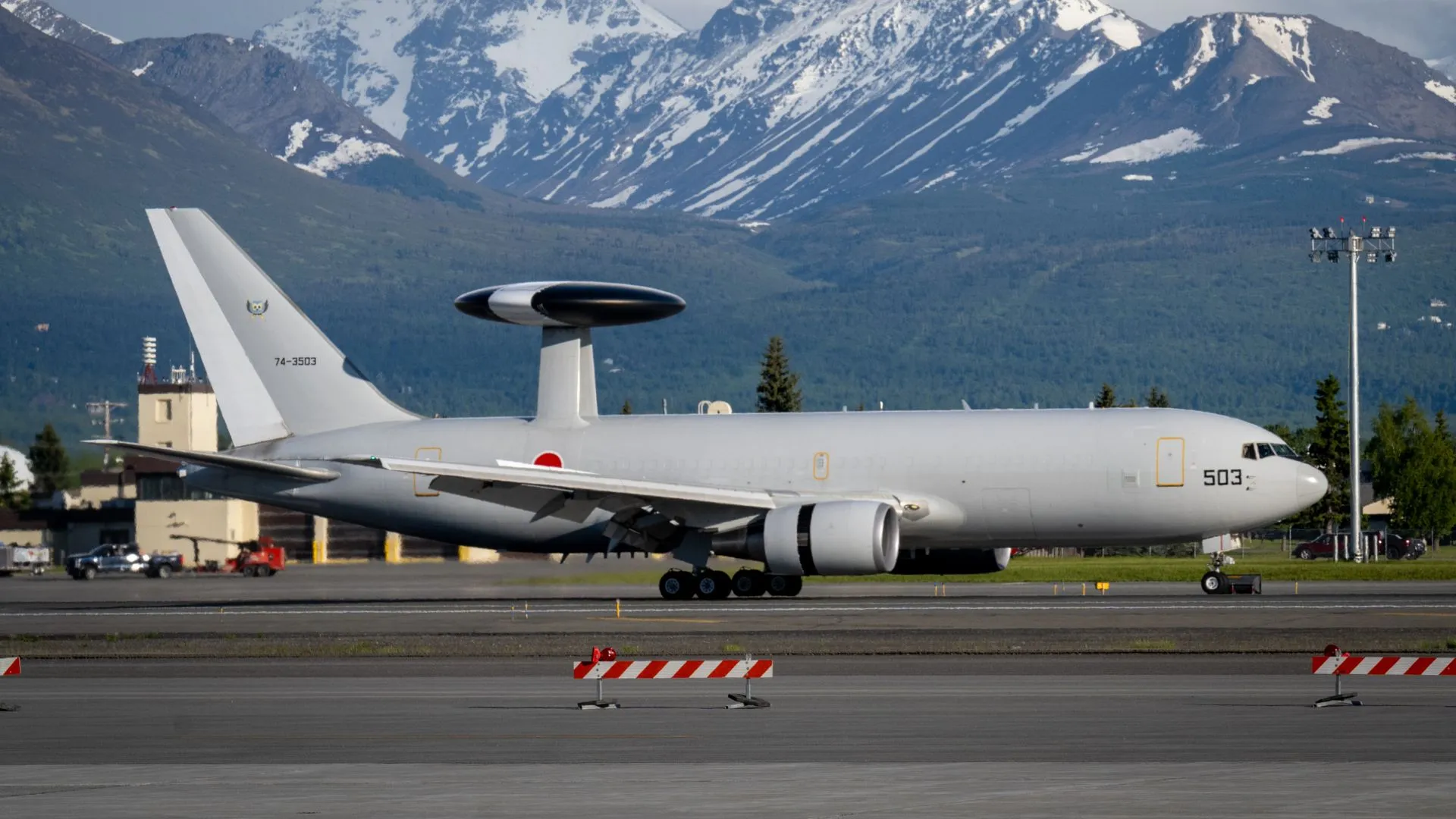
The U.S. Air Force has exercised a $16,910,812 option with Boeing to continue post-delivery support for Japan’s four E-767 Airborne Warning and Control System (AWACS) aircraft, according to the Pentagon’s contract announcements for November 3, 2026. The modification, P00009 to contract FA2363-25-C-B002, was awarded November 2 and funds technical sustainment, engineering, on-site field service representatives, and software maintenance through November 14, 2027.
The award keeps Boeing tied to the Japan Air Self-Defense Force’s (JASDF) senior airborne battle management asset as the fleet emerges from the deepest upgrade of its service life. The contract’s value rose to $35,530,249 in July 2025, when a $34,246,819 modification added post-delivery support tied to the E-767 Mission Computing Upgrade (MCU). The new action leaves that ceiling unchanged: it exercises an option already priced in. Japan obligated the full $16.9 million in Foreign Military Sales (FMS) funds at award, against $3,865,562 committed in July 2025.
Japan E-767 AWACS Mission Computing Upgrade Enters Support Phase
The MCU traces back to a September 26, 2013, Defense Security Cooperation Agency notification to Congress that estimated the package at $950 million. Based on the U.S. AWACS Block 40/45 upgrade, it moves the Japanese fleet to commercial off-the-shelf mission computing and adds four electronic support measures (ESM) systems, eight AN/UPX-40 next-generation identification friend or foe (IFF) interrogators, eight AN/APX-119 IFF transponders, and four KIV-77 cryptographic computers. Installation began in August 2019 at Kelly Field in San Antonio, Texas, and the first modified aircraft was delivered to the JASDF on June 8, 2023. A separate installation and checkout contract, FA8730-18-C-0001, reached a cumulative $330.5 million in March 2025, with work running to December 23, 2028.
The 2013 notification said the upgrade would enhance the fleet’s surveillance, identification, situational awareness, and battle management, and make it more compatible with the U.S. Air Force AWACS fleet. The option now shifts the emphasis to keeping that software baseline current. Hamamatsu Air Base, home of the 602nd Squadron, appears as a place of performance alongside Oklahoma City and San Antonio, which the July 2025 award did not list. That suggests Boeing field engineers will work directly with JASDF crews as upgraded aircraft return to the flight line.
E-767 and E-2D: How Japan Layers Its Airborne Early Warning
Delivered in 1998 and 1999 and declared operational on May 10, 2000, the E-767 marries the E-3 Sentry’s mission system to a Boeing 767-200ER airframe. Publicly available specifications indicate two General Electric CF6-80C2 turbofans, a cabin with about 50 percent more floor space than the 707-based E-3, and the Northrop Grumman AN/APY-2 S-band pulse-Doppler radar in the rotodome, modernized under a Radar System Improvement Program (RSIP) that began with a $108 million kit contract in 2006. U.S. Air Force data credits the APY-2 family with a range of more than 250 miles (375.5 kilometers).
Four airframes are a thin base for persistent coverage across an arc running from Hokkaido to the southwestern islands. Japan fills the gap with the Northrop Grumman E-2D Advanced Hawkeye: 18 have been funded through the fiscal 2023 budget, with the final five due in Japanese fiscal 2028, as the type gradually replaces the E-2C. The E-767 remains the larger command node with the deeper mission crew; the Hawkeyes supply the numbers.
The demand signal persists. JASDF fighters scrambled 595 times in fiscal 2025, including 366 responses to Chinese aircraft and 214 to Russian aircraft. That total was the lowest since 2012, but the activity grew more complex, including a December 9, 2025, joint Chinese and Russian bomber flight near Japan, during which a Russian A-50 airborne early warning aircraft was also observed over the Sea of Japan.
Analysis: The contract matters less for its value than for what it locks in. By funding continuous software maintenance on a Block 40/45-derived baseline, Tokyo keeps its AWACS fleet aligned with the U.S. systems most likely to share tracks with it in a regional contingency. The risk is structural. The E-767 is a four-aircraft type with no other operator, and the U.S. Air Force has been retiring part of its E-3 fleet since 2023. As the parent fleet shrinks, Japan will carry a growing share of the cost of keeping APY-2-era hardware and software supportable, which turns FMS sustainment awards like this one into a standing line item rather than a one-off expense.
The current option runs to November 14, 2027. The announcement does not state whether further options remain under the $35.5 million ceiling, and the installation contract running to December 2028 suggests MCU work across the fleet is not yet closed out. With the JASDF set to become the Japan Aerospace Self-Defense Force under a law enacted June 26, 2026, Japan’s next round of defense planning documents is the likeliest venue for decisions on the fleet’s future.