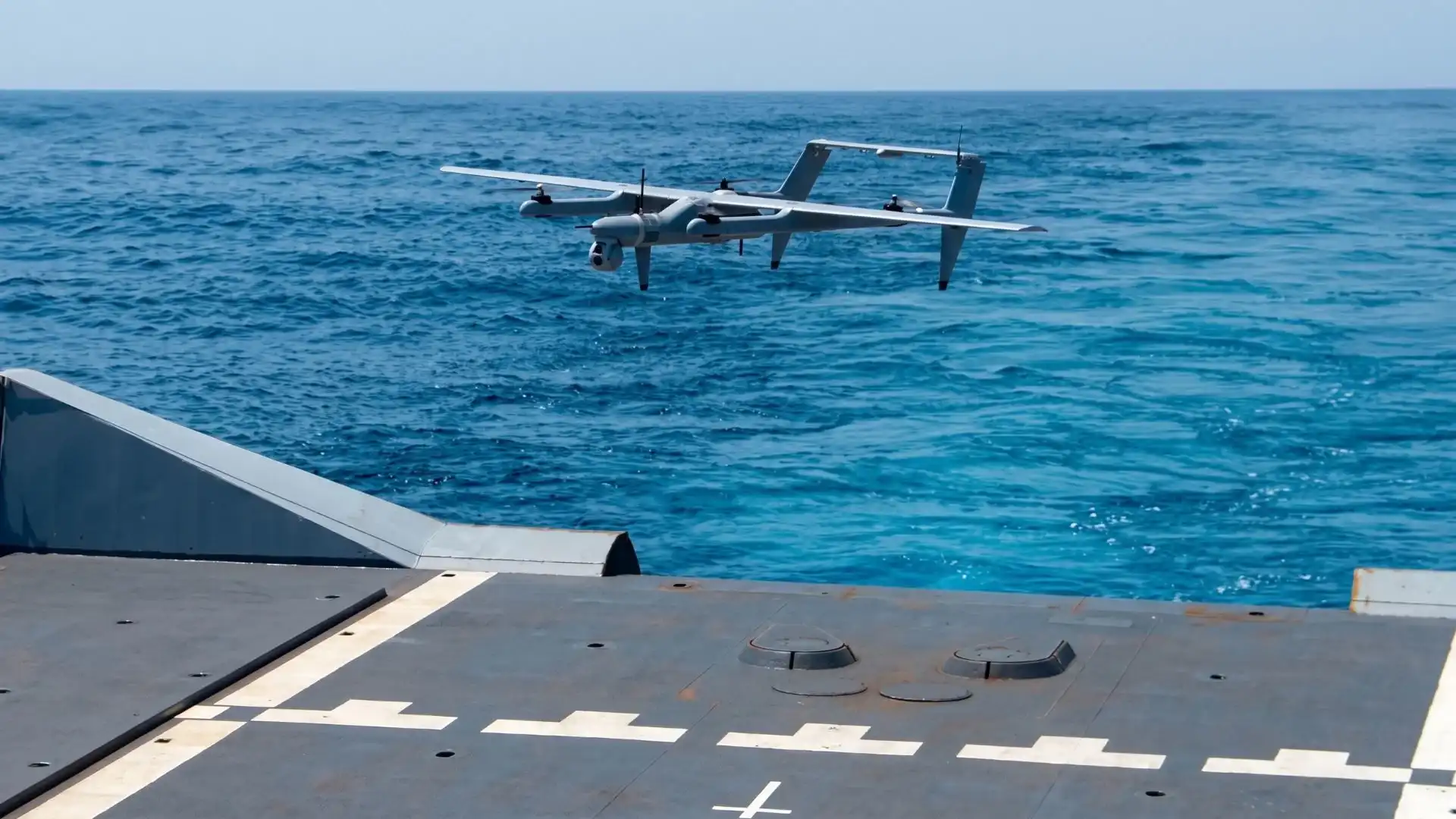
France’s defense procurement agency, the Direction générale de l’armement (DGA), has qualified the vertical take-off and landing (VTOL) variant of the Airbus Helicopters U010 Aliaca tactical uncrewed aerial system (UAS), clearing it for French Navy service under the Système de Mini-Drones embarqués pour la Marine (SMDM) contract. Airbus announced the qualification on November 3, 2026, after a land and sea test campaign conducted with the navy in May and June 2026. The first two VTOL systems reached the fleet in September.
The milestone caps a compressed development cycle. Airbus subsidiary Survey Copter unveiled the VTOL configuration in April 2025, deriving it in under a year from the fixed-wing Aliaca the navy already operates, and the DGA ordered it under an amended SMDM contract in February 2026. The fixed-wing version received DGA qualification on July 28, 2022, and has since equipped high-seas patrol vessels (PHM), overseas patrol vessels (POM) and Floréal-class surveillance frigates, while also flying English Channel search and rescue (SAR) missions since 2023. The VTOL variant extends that capability to hulls that cannot accommodate the catapult and recovery net the original design requires.
Aliaca VTOL Qualification and the SMDM Fleet Mix
The DGA has ordered 34 SMDM systems in total, each comprising two air vehicles, for a fleet of 68 drones. Eight of those systems, or 16 airframes, will be delivered in the VTOL configuration, leaving 26 fixed-wing systems. Airbus has said the fixed-wing SMDM will remain aboard the ships already equipped and will be supported for at least seven years, so the navy will operate both configurations in parallel into the 2030s.
Airbus framed the qualification as the product of a joint effort. “The DGA qualification is a major milestone and it reflects the trust placed in the performance of our technology,” said Victor Gerin-Roze, Head of Uncrewed Aerial Systems at Airbus Helicopters.
The program’s most practical design choice is commonality. Both configurations run on the same Ground Control Station (GCS) and operating system, so operators already qualified on the fixed-wing Aliaca can transition with minimal retraining. For a navy that rotates small drone detachments across patrol and support hulls, a single training pipeline and a shared logistics chain cut the cost of adding a second air vehicle type to the inventory.
Four Lift Rotors, No Catapult: Aliaca VTOL Design Trade-Offs
The VTOL variant keeps the fixed-wing cruise layout and adds four lift propellers for vertical take-off and landing, transitioning to wing-borne flight for the mission leg. The configuration requires no dedicated launch and recovery equipment, eliminating the catapult launcher and net recovery system that define the fixed-wing SMDM’s shipboard footprint.
The rotors carry a weight penalty. Publicly available specifications put the fixed-wing Aliaca at a 16-kilogram maximum take-off weight (MTOW), a 1.5-kilogram payload, a 3.6-meter wingspan and a 2.2-meter length. The VTOL variant rises to a 25-kilogram MTOW, with a 3.5-meter wingspan and a 2.1-meter length. When the February 2026 order was announced, Airbus quoted two hours of endurance and a 50-kilometer range for the naval VTOL configuration, below the three hours the all-electric fixed-wing achieves over the same radius.
Airbus markets two VTOL propulsion options. The all-electric Aliaca VTOL Evo is listed at up to three hours of endurance, a 50-kilometer datalink range and a 2-kilogram payload; the hybrid Aliaca VTOL ER is listed at six hours, an 80-kilometer range and a 3-kilogram payload, although more recent company material cites a 100-kilometer operating radius for the hybrid. Airbus has not publicly detailed which option equips the French Navy systems. The naval mission fit centers on a gyro-stabilized electro-optical/infrared (EO/IR) turret and an Automatic Identification System (AIS) receiver, letting operators correlate visual contacts against broadcast vessel identities, the core task in fisheries and counter-smuggling patrols.
Why BSAM and BSAOM Ships Need a Vertical Mini-Drone
The VTOL systems are earmarked for the navy’s metropolitan support and assistance ships (BSAM) and overseas support and assistance ships (BSAOM). The overseas hulls will operate from homeports in New Caledonia, French Polynesia, Réunion and Martinique, covering sovereignty and maritime security missions across the Indo-Pacific and the Caribbean. The four Loire-class BSAM and four D’Entrecasteaux-class BSAOM ships total eight hulls, matching the eight VTOL systems on order, although the navy has not published an allocation plan.
These are lightly armed, multi-role vessels tasked with towing, logistics, pollution response and patrol across vast areas. France’s exclusive economic zone, publicly cited at more than 10 million square kilometers, lies overwhelmingly overseas. A mini-drone with a 50-kilometer reach pushes a ship’s surveillance horizon well beyond its own radar and optics, enabling identification of non-cooperative contacts linked to illegal, unreported and unregulated (IUU) fishing or narcotics trafficking without diverting the ship.
Analysis: The Aliaca VTOL’s significance lies less in airframe performance than in where it places persistent sensors. France faces a widening mismatch between the size of its overseas maritime estate and the number of frigates available to patrol it, and this qualification pushes organic intelligence, surveillance and reconnaissance (ISR) down to the hulls that carry much of the daily sovereignty burden. The limits are clear: two hours of endurance and a 50-kilometer radius make the system a cueing and identification tool, not a wide-area surveillance asset. It does give Airbus a layered naval UAS offer, with the Aliaca on small hulls and the VSR700 rotary-wing drone aimed at frigates, and a DGA-qualified reference customer to show navies facing similar deck constraints.
Six VTOL systems remain to be delivered, and Airbus has disclosed neither the delivery schedule nor the value of the VTOL order. Milestones to watch include the first operational deployments aboard BSAM ships, expected from late 2026, the first BSAOM embarkations in the Pacific and Caribbean, and whether the navy adopts the six-hour hybrid ER variant or extends the VTOL configuration to further hull classes.