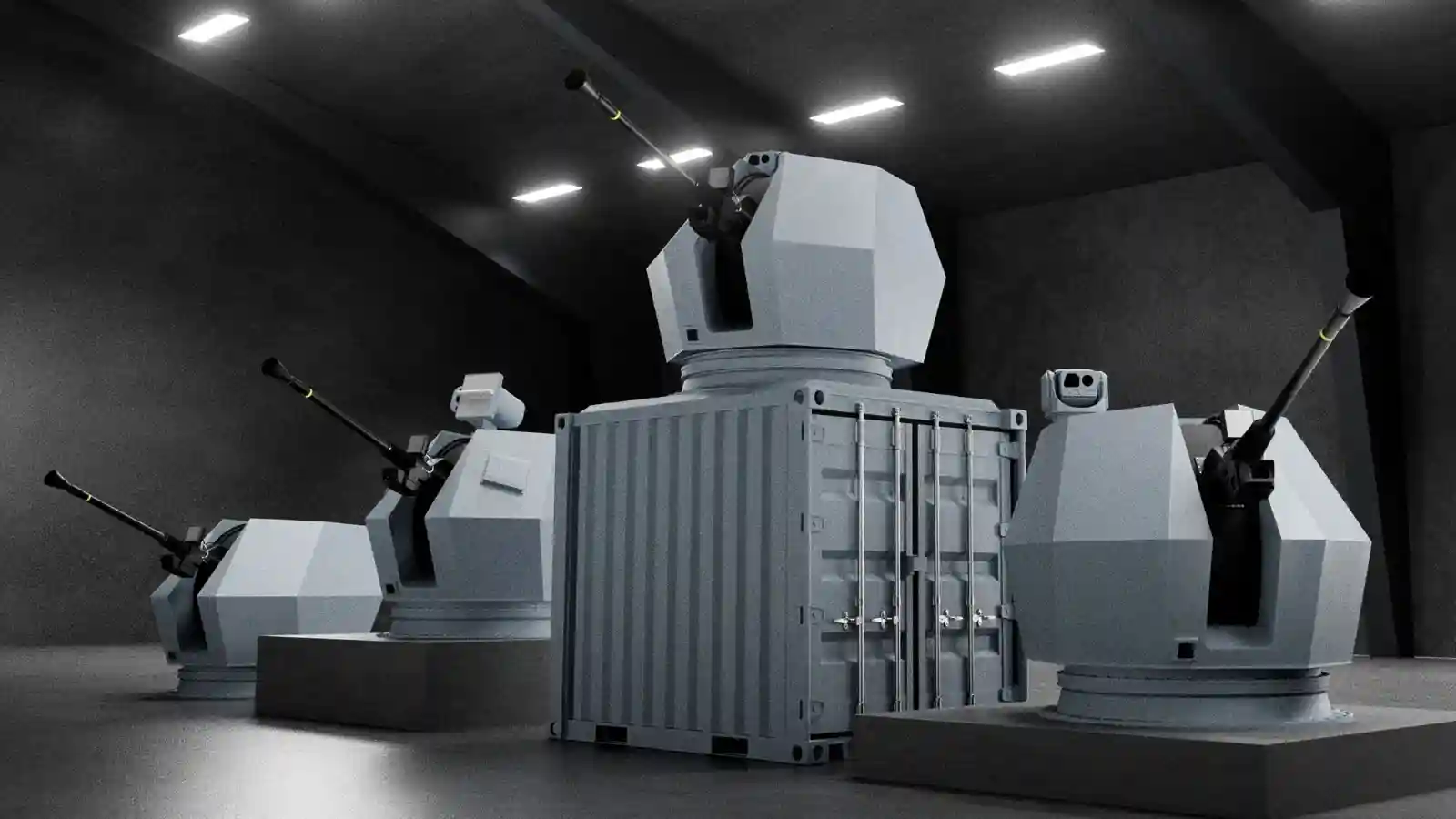
BAE Systems unveiled Sea Tridon, a modular 40mm naval gun system, on November 3, 2026, at the Euronaval exhibition at Paris Nord Villepinte. The system anchors a new four-member family of naval self-protection solutions built around the Bofors 40mm L/70 gun and Bofors 3P programmable ammunition, scaling from a stand-alone electro-optical mount to a radar-directed close-in weapon system (CIWS).
The launch takes the logic of the land-based Tridon Mk2 back to sea. BAE Systems Bofors introduced Tridon Mk2 at Eurosatory 2024 by mounting the Bofors 40 Mk4 naval gun on a Scania truck chassis, then signed a letter of intent with the Swedish Defence Materiel Administration (FMV) in October 2024 to develop a demonstrator. FMV awarded BAE Systems a $180 million Tridon Mk2 contract in April 2026, and Ukraine’s Ministry of Defense confirmed the same month that Sweden would supply Tridon Mk2 systems to counter Shahed drones and other aerial threats. Sea Tridon arrives as one-way attack drones and anti-ship missiles push navies to seek affordable close-in defenses for vessels of every size.
Sea Tridon Naval Gun Family: Four Configurations, One 40mm Core
The family, displayed on the BAE Systems stand (E30), comprises four solutions. Sea Tridon is a maritime adaptation of the Tridon concept, pairing the Bofors 40mm gun with an integrated electro-optical fire-control system. Because the mount closes its own sensor-to-shooter loop, it reduces dependence on the host ship’s combat management system and simplifies integration on hulls without a dedicated weapons suite.
Sea Tridon C is a containerized variant designed for rapid installation on military, government, or commercial vessels requiring temporary or mission-specific self-protection. The format opens the door to arming auxiliaries, patrol assets, and vessels of opportunity for escort or crisis deployments without permanent structural work. BAE Systems has not disclosed container dimensions, system weight, or power requirements.
Sea Trinity is the most capable member, combining the 40mm gun, 3P ammunition, and integrated radar fire control into a complete CIWS intended to counter missiles, drones, and other high-speed threats. The name revives Sea Trinity, a lightweight 40mm CIWS concept Bofors derived from its late-1980s Trinity gun upgrade. The company has not identified the radar, its frequency band, or tracking performance.
The fourth member is the in-service Bofors 40 Mk4 Naval Gun, designed for integration with ship combat systems. All four share training, logistics, and support commonality. Lena Gillström, President of BAE Systems Bofors, said operators can “select the capability level that best meets their operational needs.”
Bofors 3P Ammunition and the 40 Mk4 Engagement Envelope
BAE Systems’ published specifications for the 40 Mk4 set the performance baseline for the family. The 40mm L/70 mount weighs 2,300 kg without ammunition, stands under 2.0 m tall, elevates from minus 20 to plus 80 degrees, and traverses without limit through a slip ring. It fires 300 rounds per minute at a muzzle velocity of 1,012 m/s with 3P, reaches a maximum range of 12,500 m, and holds at least 100 ready rounds. The mount is already specified for platforms ranging from the Royal Navy’s Type 31 frigates, which carry two each, to the 12 mine countermeasures vessels ordered for the Belgian and Dutch navies.
The 3P round (pre-fragmented, programmable, proximity-fused) is the family’s common denominator. A fuze programmer fed continuously by the fire-control computer sets each round immediately before firing to one of six modes: gated proximity for aerial targets, gated proximity with impact priority for larger aircraft, time mode for small fast boats and concealed shore targets, impact, armour-piercing, and a default proximity mode. The round is qualified as an insensitive munition with PBX explosive and LOVA propellant.
Operationally, a single magazine can shift from a drone salvo to a fast inshore attack craft without a feed change, shortening reaction time in congested littorals. The NATO Support and Procurement Agency (NSPA) awarded BAE Systems Bofors a framework agreement for 40mm 3P ammunition on September 24, 2026, which simplifies ammunition sourcing for allied fleets adopting any member of the family.
Analysis: Sea Tridon is less a new weapon than a packaging strategy. By offering one gun and one munition across four levels of sensor integration, BAE Systems positions the Bofors 40mm in the gap between light remote weapon stations and missile-based point defense. Red Sea operations since late 2023 showed navies expending costly interceptors against inexpensive drones; a gun-based layer with programmable airburst rounds addresses that cost asymmetry. The containerized Sea Tridon C is the most consequential option, because it lets fleets surge self-protection onto auxiliaries faster than shipyards can install permanent mounts.
Key unknowns remain: no launch customer, unit price, or delivery schedule has been announced, and BAE Systems has not detailed Sea Trinity’s radar or qualification timeline. Field results from Tridon Mk2 in Swedish and Ukrainian service will likely shape how quickly navies commit to the maritime variants.