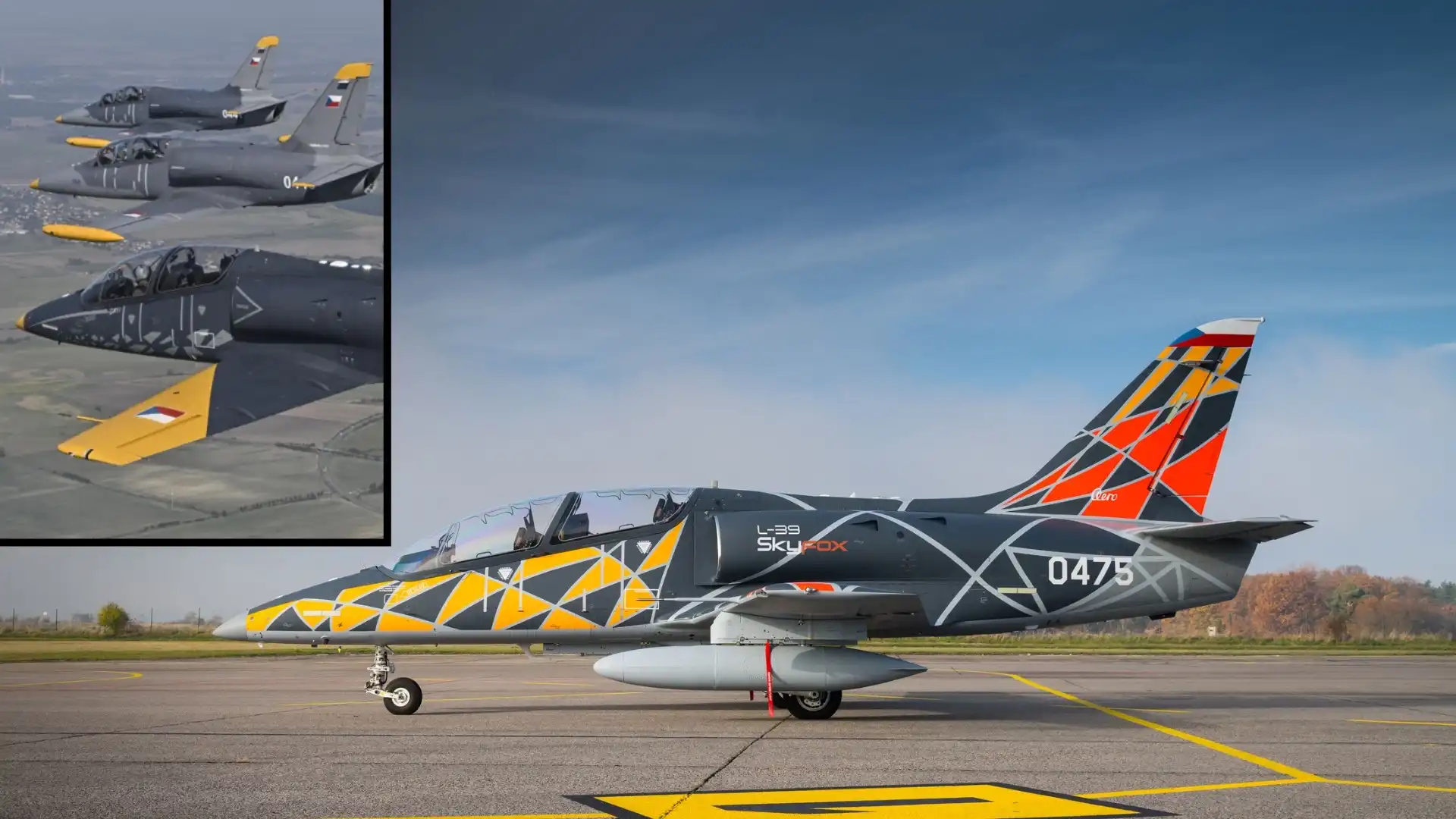
Serbia has ordered six L-39 Skyfox jet trainers from Czech manufacturer Aero Vodochody, Czech Prime Minister Andrej Babiš said on November 5, 2026, at the Prague Security Dialogue conference. He also said Prague had sold L-410 transport aircraft. The contract value and delivery schedule remain undisclosed.
The announcement gives Belgrade a jet lead-in for the 12 Dassault Rafale fighters it ordered from France on August 29, 2024, in a €2.7 billion deal, with first deliveries planned for 2028. It also arrives during a political transition. Babiš discussed the sale with President Aleksandar Vučić and Prime Minister Đuro Macut in Belgrade on July 23, 2026, but Vučić resigned in September and conceded defeat to the Student List in the October 25 parliamentary election.
How the L-39 Skyfox Fits Serbia’s Rafale Training Pipeline
The order falls short of the figure Prague cited in July, when Babiš said he expected to finalize the sale of eight Skyfox aircraft to the Serbian Air Force and confirmed an L-410 offer with financing options. No explanation for the reduction has been published. Aero Vodochody has confirmed only that it submitted a contractual offer to Serbia and has declined to discuss terms, value, or schedule, according to Aviacionline. No public Serbian confirmation had surfaced as of November 9, 2026, and Babiš’s November 5 remarks did not explicitly name Serbia as the L-410 buyer.
Babiš tied the purchase directly to Rafale conversion, telling the conference, according to Aviation Week: “The pilots will feel like they are flying in the Rafale.” The feature most relevant to that claim is the Skyfox’s embedded virtual training system, which simulates radar threats, tactical scenarios, and air-to-air engagements in flight without the sensors those scenarios would otherwise require. Instructors can introduce sensor management and tactical procedures before students reach one of the three twin-seat Rafales in Serbia’s order.
Serbia’s advanced trainer remains the Soko G-4 Super Galeb, which first flew in 1978 and remained in production until 1991, and Belgrade has sought a new trainer and light-attack aircraft to replace it. Aviacionline reports that the Skyfox prevailed over Embraer’s EMB-314 Super Tucano, the Pilatus PC-21, and Textron Aviation Defense’s AT-6 Wolverine after a March 2026 demonstration at Batajnica Air Base near Belgrade. The evaluation criteria remain unpublished, and it is unclear whether six aircraft will replace the G-4 outright.
Williams FJ44 Engine and Wet Wing Reshape the Albatros Design
The Skyfox, designated L-39NG until October 2024, succeeds the L-39 Albatros, of which nearly 3,000 were built. Aero replaced the Ukrainian-made AI-25TL turbofan with the U.S.-built Williams International FJ44-4M. Maximum thrust barely changes, at 16.86 kN (3,791 lbf) according to the manufacturer, but the FJ44-4M reaches maximum power from idle in three to five seconds, against nine to 12 seconds for the AI-25TL. For student pilots, that response widens the margin on approaches and go-arounds.
The new airframe drops the Albatros wingtip tanks for a wet wing and offers up to five hardpoints, compared with two on the baseline L-39. Manufacturer data lists a maximum takeoff weight of 5,600 kg, a payload of 1,350 kg to 1,540 kg depending on the document, Mach 0.8, 490 knots calibrated airspeed, and load limits of +8/-4 g. Internal-fuel range is listed at 1,900 km with 3 hours 45 minutes of endurance. Other published references cite a level-flight true airspeed of about 420 knots.
The cockpit combines multifunction displays, a head-up display, hands-on-throttle-and-stick controls, and open-architecture avionics, with Martin-Baker Mk CZ16H zero-zero ejection seats. Aero advertises symbology suited to both Western and Eastern fighters, relevant to an air force still flying MiG-29s as it moves to the Rafale. A rated service life of 15,000 flight hours matters for a six-aircraft fleet carrying a national jet syllabus.
Drone Hunter Configuration Adds Laser-Guided Rockets but No Radar
Babiš also highlighted the aircraft’s counter-drone potential, although nothing indicates that Serbia ordered the Drone Hunter configuration. As of October 5, 2026, Aero had announced no customer for the variant. Shown at NATO Days in Ostrava on September 19, 2026, it carried two seven-tube rocket launchers and a centerline Phoenix 10 targeting pod, for 14 ready rockets. Aero and Thales Belgium signed a memorandum of understanding on October 5 to continue integrating and testing 70 mm rockets; Thales rates its FZ275 laser-guided rocket at 1.5 km to 7 km. Aero aims to have the conversion kit ready by late 2026, although further testing and qualification of the configuration are still required.
The Skyfox has no radar, so crews depend on ground controllers or airborne early warning before acquiring targets with the pod. In a September 23 commentary, Justin Bronk of the Royal United Services Institute named the L-39NG among the most compelling options for a proposed NATO drone-interception squadron of 16 to 24 aircraft. He said it reaches 300 knots in level flight at medium altitude with external stores, above the 188 to 270 knot cruise he cited for the jet-powered Geran-4, at operating costs comparable to turboprop trainers.
Analysis: If the reported field of competitors is accurate, the order shows that a jet lead-in can still beat turboprop alternatives when a customer is preparing for a high-end fighter. Bronk’s comparison sharpens the point: he judged the PC-21 wing unsuited to armament and the Super Tucano short of performance against jet-powered drones. For Belgrade, the Skyfox could keep a counter-drone path open without requiring an immediate commitment. The main risk is political, since the incoming Student List coalition reportedly plans an independent review of Vučić-era arms procurement.
The next markers are a formal statement on contract status, the delivery schedule, and the new government’s position. Aero said in June that production was booked until the second quarter of 2027, which would place Serbian aircraft behind existing orders unless slots have changed. Prague is also offering the type to Bulgaria, Poland, and Slovakia, while Rafale deliveries from 2028 set the practical deadline for Serbia’s training pipeline.