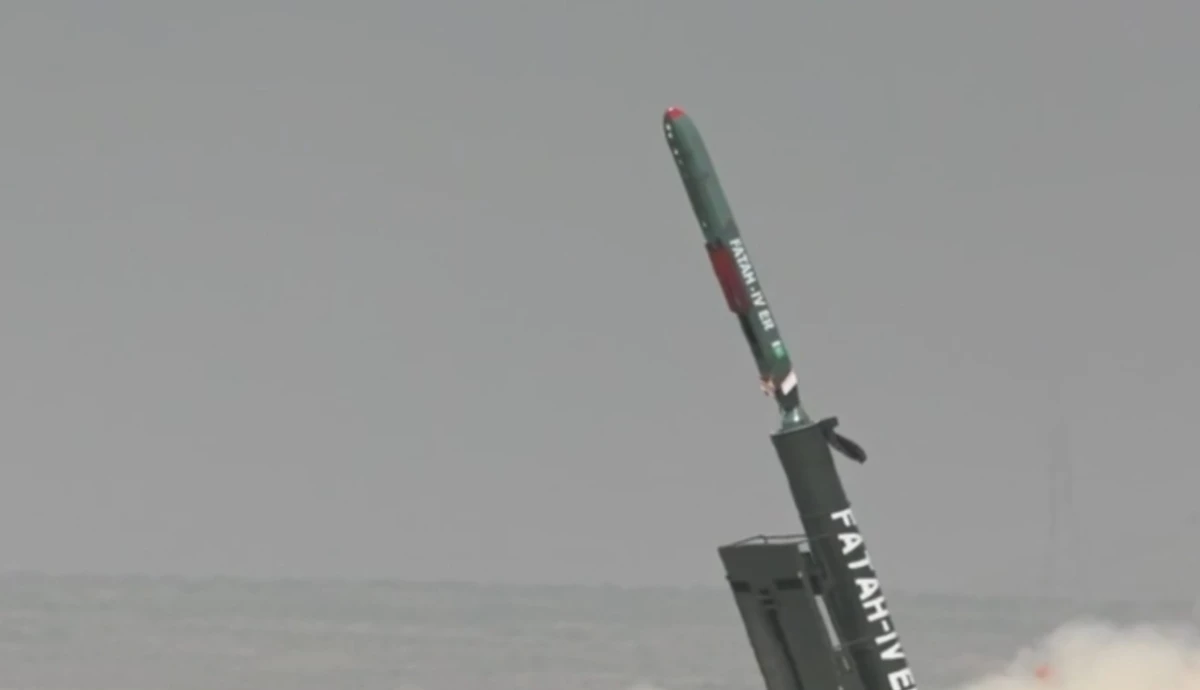
Pakistan test-launched the Fatah-4 ER cruise missile, an extended-range version of its Fatah-4 ground-launched cruise missile (GLCM), on October 6, 2026, according to Inter-Services Public Relations (ISPR), the military’s media wing. ISPR withheld the variant’s range, dimensions, weight, and warhead mass, but launch footage shows a visibly larger airframe fitted with externally mounted folding wings.
The launch is the third publicized Fatah-4 firing in just over a year, after training launches of the 750 km baseline on September 30, 2025, and May 14, 2026. Both were conducted by the Army Rocket Force Command (ARFC), which Prime Minister Shehbaz Sharif announced in August 2025, three months after the four-day conflict with India, to field conventional strike weapons separately from nuclear-capable forces.
What the Fatah-4 ER Cruise Missile Footage Reveals About the Airframe
ISPR referred to the weapon only as an extended version of the Fatah-4 and assigned it no separate designation; Fatah-4 ER is the shorthand used in open-source reporting. The statement said the missile is “capable of engaging targets at extended ranges with high precision and lethality” and that the test validated additional sub-system parameters for improved accuracy and survivability. It released no quantitative results.
The footage carries more information than the text. The new airframe mounts its folding wings on the outside of the fuselage rather than stowing them internally. Moving the wings outboard frees the internal volume that pop-out wing mechanisms consume, volume available for fuel, and simplifies fuselage manufacturing. The change points to a design aimed at both greater range and higher-rate, lower-cost production.
No official range figure exists. Unofficial estimates placing the variant in the 900 to 1,000 km class circulated after the test and could not be independently verified. It is also unknown whether the ER retains the baseline warhead and fits the existing three-canister launcher.
The wording also changed. ISPR called the October 6 event a test launch, not a training launch or training fire as in 2025 and May 2026, and did not name the ARFC as the firing unit. That points to a developmental milestone, not an operational demonstration.
Inside the Baseline Fatah-4: Propulsion, Guidance, and Warhead
The Fatah-4 was developed by the National Engineering and Scientific Commission (NESCOM) and is marketed for export by Global Industrial & Defence Solutions (GIDS). It is a conventional derivative of the Babur subsonic land-attack cruise missile, a family originally built for nuclear delivery. Publicly available specifications give the baseline a range of 750 km, a launch weight of 1,530 kg, a length of 7.5 m, a diameter of 0.5 m, and a cruise speed of Mach 0.7. Open-source assessments describe a solid-fuel booster for launch and a small turbojet for cruise.
The ARFC credits the missile with a 330 kg blast-fragmentation warhead and a circular error probable (CEP) of 5 m. Reported guidance pairs inertial navigation with satellite updates and digital scene-matching area correlation (DSMAC) for terminal correction. That accuracy suits radar sites, parked aircraft, and fuel infrastructure, the target set a conventional deep-strike force is built to hold at risk.
Survivability rests on altitude, not speed. The missile can fly as low as 50 m along terrain contours. For a ground radar with an antenna 10 m above flat terrain, radar-horizon geometry limits detection of a 50 m target to roughly 40 km, under three minutes of warning at Mach 0.7. Terrain masking shortens that window further.
The US Navy’s Tomahawk Block IV, at a comparable launch mass of about 1,600 kg, carries a 450 kg-class warhead roughly 1,600 km, according to publicly available specifications. The gap identifies fuel fraction and engine efficiency as the baseline Fatah-4’s limiting factors, the parameters a larger airframe with freed internal volume would address.
How the Army Rocket Force Command Is Layering Conventional Strike
The Fatah designation covers distinct weapons, not successive upgrades of one design. The Fatah-1 is a guided multiple launch rocket system with a reported range of 140 km. The Fatah-2 is a quasi-ballistic missile reported at roughly 400 km. The Fatah-3, unveiled in May 2026, is a supersonic cruise missile reportedly derived from China’s HD-1. The subsonic Fatah-4 sits at the top of the range ladder.
Combining guided rockets, quasi-ballistic missiles, and low-flying cruise missiles forces a defender to split sensors and interceptors across altitude bands and flight profiles. India’s layered network includes the Russian-made S-400 alongside the Akash and MRSAM systems, but targets at 50 m stress the low-altitude tier, where coverage depends on elevated sensors such as airborne early warning aircraft.
Added reach also changes launcher geometry, allowing ARFC units to fire from deeper inside Pakistan while holding the same targets and reducing exposure of their wheeled transporter-erector-launchers. India is pursuing equivalent reach: its Long Range Land Attack Cruise Missile (LRLACM), flight-tested on November 12, 2024, and June 15, 2026, carries publicly reported ranges of 1,000 to 1,500 km depending on launch platform.
The Fatah-4 and the Harbah NG anti-ship missile share a Babur-derived core across Army and Navy roles, spreading production overhead across a larger order base. GIDS also offers the Fatah-4 for export, a path to recovering development costs.
Analysis: The Fatah-4 ER matters less as a range figure than as evidence of tempo. Pakistan moved from the baseline’s first announced launch to an enlarged variant in just over 12 months by iterating on a mature Babur core rather than starting new designs. That builds conventional strike options below the nuclear threshold, but it carries escalation risk: an Indian operator tracking a low-flying, Babur-derived missile cannot confirm in flight whether it carries a conventional or nuclear warhead, and separate command structures do not resolve that ambiguity for the defender.
The next markers are an official range disclosure, an ARFC training launch of the ER variant signaling induction, and any display of a modified launcher. Warhead mass, propulsion changes, and production rate remain unknown. On the Indian side, LRLACM induction will set the pace of the subsonic cruise missile competition.