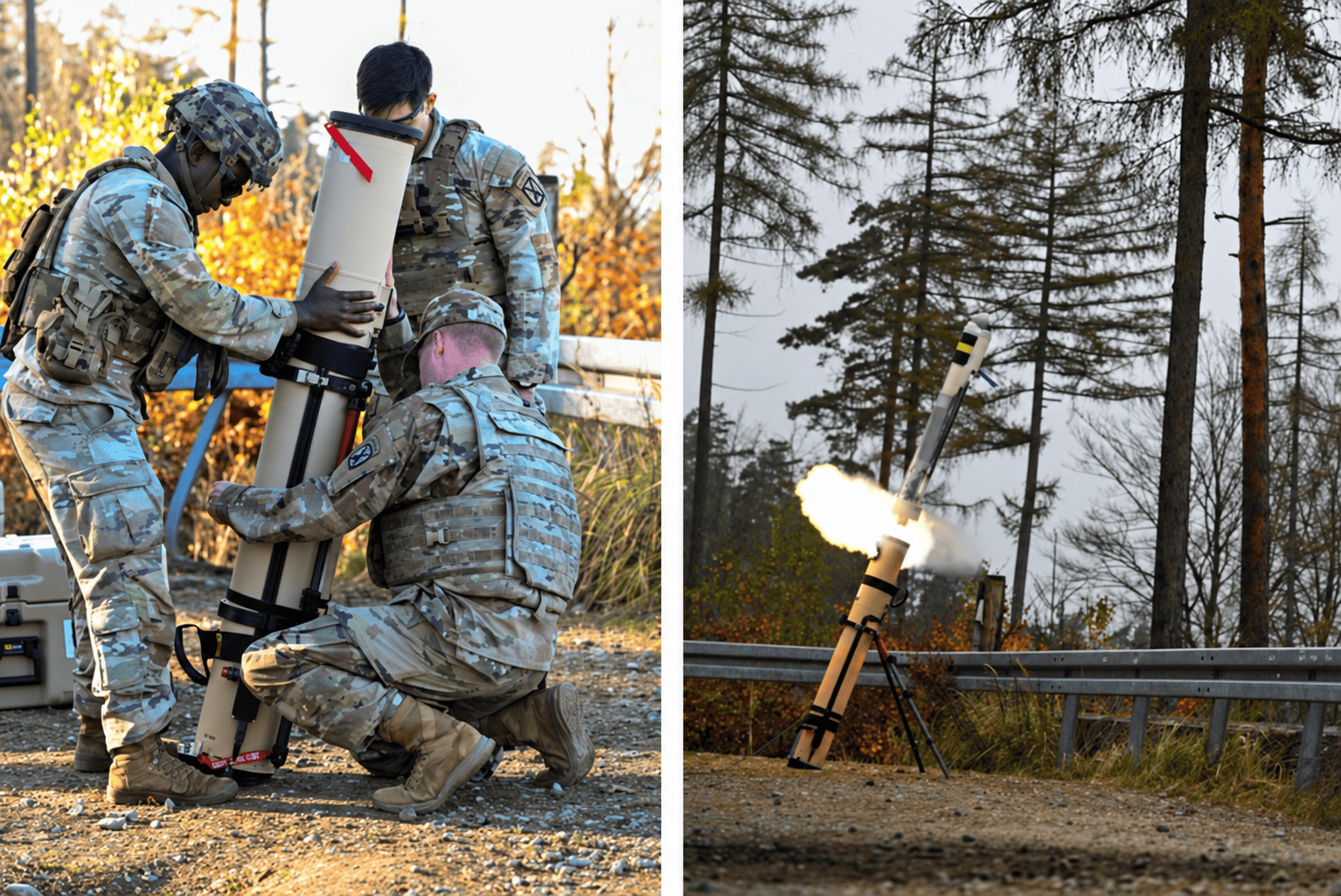
Lithuania has received its first batch of AeroVironment Switchblade 600 loitering munitions, the Lithuanian Ministry of National Defence announced on October 7, 2026. The ministry said the tube-launched system gives the Lithuanian Armed Forces “a new long-range precision strike capability against armored targets.” It did not disclose how many munitions arrived, which units will operate them, or when the remaining deliveries are due.
The delivery comes nearly four years after the ministry’s Defence Materiel Agency signed a government-to-government contract with the United States in December 2022, valued at approximately €45 million and covering the munitions, launch and control equipment, a training simulator and a maintenance package. At the time, Vilnius said it was the first country after the United States to buy the Switchblade 600, with deliveries planned for 2025 and 2026. In December 2023, the ministry reported that AeroVironment’s chief executive had told then-Minister of National Defence Arvydas Anušauskas the system would arrive in 2024. The first batch now lands at the end of the original window, as Lithuania executes a record 2026 defense budget of €4.79 billion, or 5.38% of GDP.
Switchblade 600 Loitering Munition: Warhead, Sensors and Range
AeroVironment designed the Switchblade 600 as a man-portable, tube-launched munition that loiters over a target area until its operator commits it to a terminal dive. Company specifications list a 15 kg (33 lb) munition and a 29.5 kg (65 lb) all-up round including the launch tube, a loiter speed of 113 km/h, a sprint speed of 185 km/h and more than 40 minutes of endurance. The company advertises a standoff range above 40 km; its April 2025 datasheet cites a demonstrated range beyond 60 km, and more than 90 km when control passes between operators through its Forward Pass datalink handoff.
Targeting relies on a two-axis gimbal carrying four sensors in a dual electro-optical/infrared (EO/IR) configuration, controlled through a touchscreen tablet Fire Control Unit with tap-to-target guidance. The frequency-hopping digital datalink supports AES-256 encryption, and setup to launch takes under 10 minutes, per the manufacturer. A wave-off function lets the operator abort a dive and re-engage the same or a different target.
The warhead defines the system’s role. Switchblade 600 carries the anti-armor warhead used on the FGM-148 Javelin, according to US Army test documentation, and attacks from above, where tank armor is thinnest. Lithuania already fields Javelin, whose engagement range publicly available specifications place at roughly 4 km with current command launch units. Switchblade 600 pushes a comparable kill mechanism about ten times deeper, and its onboard sensors let a small team find its own targets without waiting on external intelligence, surveillance and reconnaissance (ISR) assets.
Switchblade 600 Block 2 Upgrades and AeroVironment’s Production Ramp
The ministry did not say which configuration Lithuania received. The contract predates the Switchblade 600 Block 2, unveiled on October 13, 2025, at the Association of the United States Army (AUSA) annual meeting. Block 2 adds larger wings and a higher-capacity battery for roughly 20% more endurance, beyond 50 minutes, plus a handoff and relay range above 100 km, M-Code GPS, automatic target recognition on onboard edge computing, Silvus mobile ad hoc network (MANET) radios and an IP67 rating for maritime use. The company said the variant draws on lessons from Ukraine, where US-supplied Switchblade 600s have engaged Russian armor since 2022.
Production capacity frames Lithuania’s timeline. AeroVironment said in October 2025 that Switchblade 600 output had grown over the previous year from 40 to 240 systems per month, and that it expected output to exceed 1,200 per month with new capacity in Salt Lake City, Utah. Between Lithuania’s signature and its first delivery, the same line supplied US-funded transfers to Ukraine and, from December 2023, the US Army’s Lethal Unmanned Systems directed requirement, expanded in August 2024 into a five-year indefinite-delivery, indefinite-quantity (IDIQ) contract with a $990 million ceiling to equip infantry battalions. The ministry has not explained the slip from 2024.
Lithuania Pairs Switchblade 600 With AeroVironment Fire Control Drones
Lithuania has already ordered the sensors to cue the munition. In mid-December 2024, the Defence Materiel Agency signed a $7.8 million contract, excluding VAT, with the US government for small vertical take-off unmanned aircraft systems built by AeroVironment for fire control and adjustment. The ministry said the system would be integrated with Switchblade 600 and delivered at the end of 2025, with further additions planned. It has not identified the type or confirmed delivery.
The ministry puts its mid-term US acquisitions at about $1.3 billion, roughly 20% of its total, spanning Javelin, the Joint Light Tactical Vehicle (JLTV), UH-60 Black Hawk helicopters, M142 High Mobility Artillery Rocket System (HIMARS) launchers and AMRAAM missiles for NASAMS. The October 7 post did not mention the smaller Switchblade 300, which Washington pledged in 2022 to supply with US military assistance funds.
Analysis: Switchblade 600 gives Lithuanian maneuver units a precision anti-armor layer between Javelin’s direct-fire envelope and the area effects of HIMARS and tube artillery: an organically controlled weapon able to locate and destroy individual moving vehicles 40 km or more forward. For a frontline NATO state bordering Russia’s Kaliningrad exclave and Belarus, that depth matters most in the opening hours of a crisis, before allied reinforcements arrive. Commonality with US Army infantry battalions also simplifies training and logistics alongside US units that rotate through Lithuania. The constraint is volume. A roughly €45 million package that also funds launchers, a simulator and sustainment likely buys a trained cadre and an initial inventory, not a stockpile sized for the expenditure rates seen in Ukraine.
The next markers are disclosure of the order quantity and delivery schedule, assignment of the munitions to specific units, and confirmation of whether the batch is Block 1 or Block 2. Delivery of the AeroVironment fire control drones will show whether the reconnaissance-strike pairing is operational. With €1.7 billion of the 2026 budget allocated to weapons and equipment, a follow-on order would be the clearest signal that Vilnius intends to scale loitering munitions across its emerging national division.