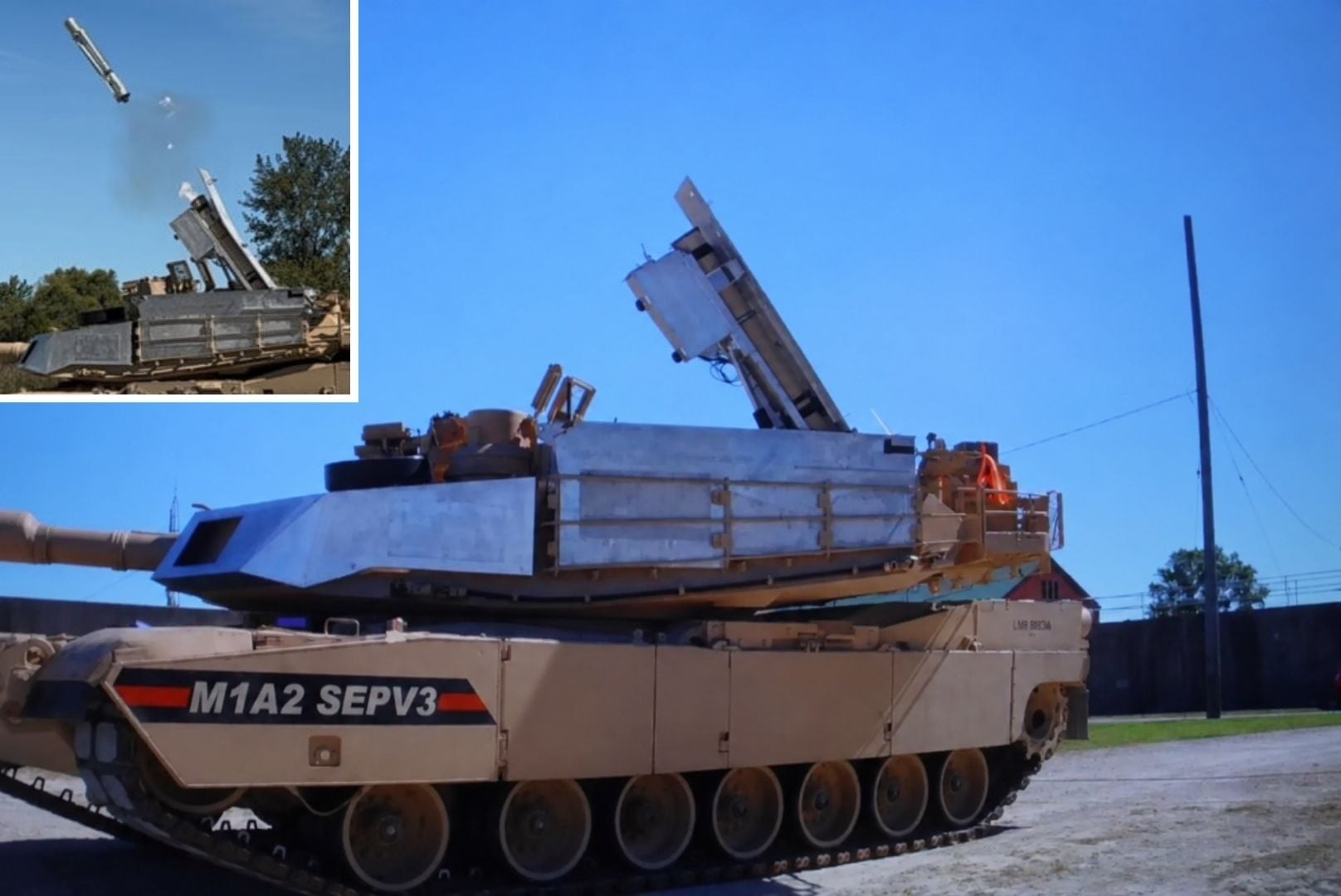
General Dynamics Land Systems (GDLS) will deliver four PERCH 2.0 loitering munition prototypes to the US Army’s 1st Brigade, 1st Cavalry Division at Fort Hood, Texas, by the end of October 2026, and the Army purchased three of them. Soldiers will integrate the kits on M1A2 Abrams tanks for experimentation, Scott Taylor, GDLS director of US growth, told Breaking Defense in an interview published October 9, 2026.
PERCH, short for Precision Effects and Reconnaissance, Canister-Housed, is a bolt-on kit that lets Abrams tanks and Stryker vehicles launch AeroVironment (AV) Switchblade loitering munitions for beyond-line-of-sight (BLOS) reconnaissance and strike. GDLS unveiled the first version at the Association of the United States Army (AUSA) annual meeting in October 2025 and demonstrated it at the Army’s Machine Assisted Rugged Sapper (MARS) event at Fort Hood from October 26 to 30, 2025. PERCH 2.0 makes its public debut at AUSA 2026, which opens October 12 in Washington.
Abrams STS Contract Covers Three of Four PERCH Loitering Munition Prototypes
The program began as a company bet. GDLS funded the original PERCH through internal research and development (IRAD), shaped by reporting from the war in Ukraine, input from field commanders in Europe and talks with senior leaders of III Armored Corps, Taylor said. He described the effort as rapid development aimed at meeting the Army’s immediate needs. After the AUSA 2025 debut, the Army returned design feedback, and GDLS again drew on IRAD money to build the first PERCH 2.0 prototype.
Army evaluators rated the second iteration highly enough to request four prototypes in total. GDLS then pushed the service to share the cost. “We said, ‘Well, can you get some skin in the game?’” Taylor recounted. The Army bought three prototypes through the Abrams System Technical Support (STS) contract, a periodically updated engineering support vehicle, adding the PERCH 2.0 purchase in August 2026. A GDLS spokesperson told Breaking Defense that using the existing contract lets the company move quickly against emerging requirements.
Several details remain undisclosed. Neither GDLS nor the Army has released the value of the August modification, the unit cost of a PERCH 2.0 kit or the funding source for the fourth prototype, although Taylor’s account indicates the company paid for the first PERCH 2.0 build itself. The contracting route also shifted. In December 2025, GDLS executives said the company was negotiating a follow-on test deal and waiting to see whether the Army could fund it through its Transformation in Contact initiative, which buys systems outside programs of record for experimentation. The Abrams STS route required no new award and placed the work under the tank’s existing support structure.
Switchblade 300 Swap Trades Anti-Armor Reach for Magazine Depth
The Army asked for four changes after the first iteration, according to Taylor: improved BLOS capability, easier reloads, more storage space and the ability to launch without crews opening hatches. The original PERCH replaced the Abrams loader’s sponson box, bolted to existing attachment points without welding or cutting, carried one Switchblade 600 alongside three Switchblade 300 rounds and was operated from a tablet during the MARS demonstration. To gain storage, GDLS removed the Switchblade 600 and standardized on the smaller Switchblade 300.
The trade is considerable. Publicly available AV specifications list the Switchblade 600 at 15 kg (33 lb) for the munition and 29.5 kg (65 lb) as an all-up round, with more than 40 minutes of endurance, a demonstrated standoff beyond 40 km and an anti-armor warhead. The Switchblade 300 Block 20 weighs about 1.7 kg (3.7 lb), or 3.3 kg (7.2 lb) as an all-up round, flies for more than 20 minutes, reaches up to 30 km with an extended-range antenna and accepts either fragmentation or explosively formed penetrator (EFP) warheads. GDLS has not confirmed which Switchblade 300 block equips PERCH 2.0 or how many rounds the redesigned canister holds.
For the tank crew, the swap moves PERCH away from a single heavy anti-armor shot toward a deeper load of lighter rounds suited to reconnaissance, anti-personnel and light-armor engagements. Launching from under armor means crews no longer need to open hatches to fire, a priority the drone-saturated battlefield in Ukraine has made hard to ignore. GDLS has said future iterations will tie PERCH into the Abrams’ existing vehicle computers rather than a standalone tablet; whether PERCH 2.0 achieves that has not been disclosed.
Analysis: A three-prototype buy is modest, but it shows armored formations want organic BLOS reconnaissance and strike at the vehicle level rather than relying solely on brigade fires. Routing the purchase through an existing Abrams support contract also shows the Army can put a company-funded concept into soldiers’ hands roughly a year after its public debut. The limit is equally clear: experimentation money is not a program of record, and PERCH 2.0 must still demonstrate integration with Abrams fire control and a sustainable reload process before the Army weighs fleet-wide kits.
The next milestone is delivery to 1st Brigade, 1st Cavalry Division before the end of October, followed by Abrams integration and experimentation; no test schedule or evaluation criteria have been made public. The Army is also considering loitering munitions for the XM30 Mechanized Infantry Combat Vehicle, the Bradley replacement, where both contenders, American Rheinmetall’s Lynx and GDLS’ Wolf, offer options to carry them. Taylor did not say which munitions the Wolf could accept. Fort Hood results will shape whether PERCH reaches production.