The sixth French Navy Wildfire exercise ran off Toulon from September 28 to October 2, 2026, pitting six warships against repeated day and night attacks by single drones and swarms launched from sea and land. Wildfire 26.2 brought a Mistral-class amphibious helicopter carrier (PHA) into the counter-drone series for the first time and hosted the first at-sea firings of Naval Group’s Rampart modular launcher.
Organized by the training division of the Naval Action Force (FAN), Wildfire is a recurring series held about twice a year that blends technical experimentation with high-intensity warfare preparation. Its rationale is operational. In December 2023, the frigate Languedoc fired Aster 15 missiles at two drones inbound from Yemen, the first time a French warship used surface-to-air missiles in self-defense, and French frigates, embarked helicopters and fighters engaged Houthi drones repeatedly through 2024. Each engagement exposed the same tension between magazine depth, reaction time and cost per kill.
Inside the French Navy Wildfire Exercise: Six Ships Under Swarm Attack
An air defense frigate held tactical command of a force drawn from the FAN, French Naval Aviation and the Naval Fusiliers and Commandos Force. The surface group comprised a FREMM DA multi-mission frigate with reinforced air defense, a Jacques Chevallier-class fleet replenishment ship (BRF), a La Fayette-class frigate, both Horizon-class air defense frigates (FDA) and the PHA. The Navy has not named the individual hulls, but France operates only two Horizons, Forbin and Chevalier Paul.
Publicly available specifications show how unevenly defensive depth is spread across that group. Each Horizon carries the Principal Anti-Air Missile System (PAAMS) with 48 Sylver A50 cells for Aster 15 and Aster 30, plus two 76mm guns. The FREMM DA pairs the Herakles multifunction radar with 32 Aster cells. The 21,300-tonne Mistral-class ships rely on short-range Simbad launchers for Mistral missiles and machine guns, which makes the PHA one of the most exposed high-value units in the fleet against a saturating raid.
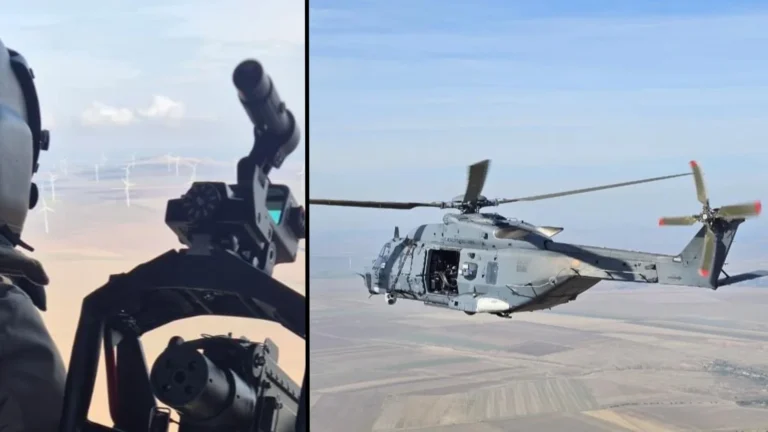
Helicopters from Flotillas 31F, 33F and 35F, which operate the NH90 Caïman Marine and AS565 Panther, flew alongside a Royal Navy AW159 Wildcat and an Atlantique 2 maritime patrol aircraft, whose role the Navy did not detail. Attacks began as ships sailed from Toulon, testing crew reaction in confined waters. Live-fire serials then continued through the most vulnerable phases of a deployment: replenishment at sea, with two ships locked on a parallel course, and a group transit through a strait, the profile escorts face at Bab el-Mandeb.
Rampart Launcher Makes First At-Sea Firings Aboard Mistral-Class LHD
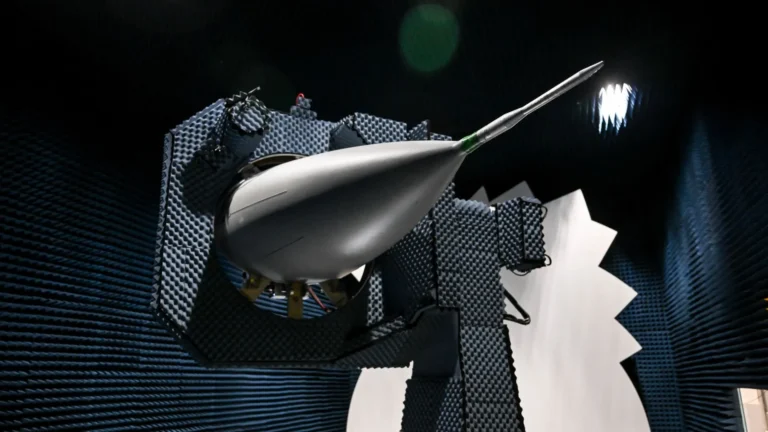
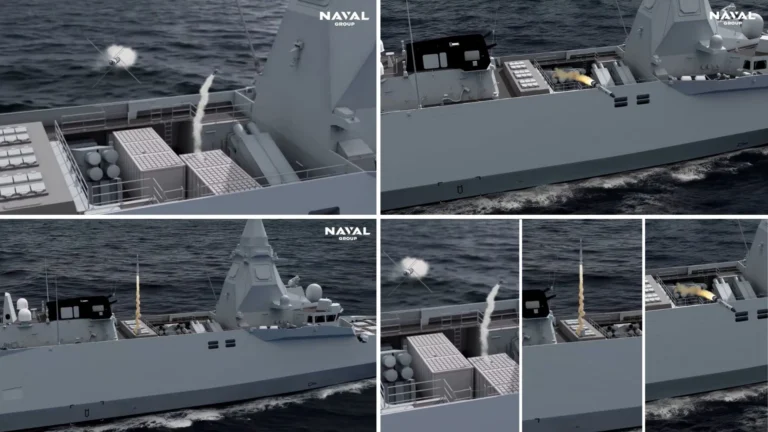
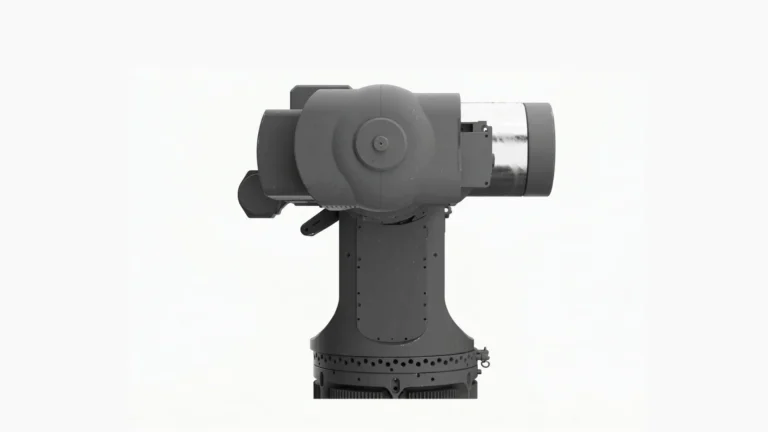
The PHA carried the most closely watched hardware: Naval Group’s Rampart, a stabilized multi-effector close-in weapon system fitted on the ship’s forward starboard sponson. During the exercise, the launcher fired a salvo of unguided Thales 68mm rockets at a surface target and a 68mm guided rocket at a target drone. A Polish Piorun very short-range air defense (VSHORAD) missile occupied one of Rampart’s four modules; it was not fired, but its seeker went active and locked onto the target UAV, validating the cueing chain for a future missile shot.
Rampart began as a self-funded Naval Group project unveiled in 2023 as the Multi-purpose and Modular Launching System (MPLS), took its current name at Eurosatory in June 2026 and completed land firings at the Canjuers range in May 2026. Naval Group gives an initial engagement envelope of about 8 km, with actual reach set by the loaded effector. The launcher can operate autonomously or plug into the host ship’s combat management system through Naval Group’s close-range engagement console, which covers detection, automatic tracking and weapon release.
The design is effector-agnostic. Naval Group has signed agreements to integrate the EDGE Group SkyKnight missile, with trials planned in the United Arab Emirates, and plans to test Thales Belgium 70mm rockets in Belgium in 2027. The company is targeting a first order by early 2027.
Interceptor Drones, Surface Drones and the Red Sea Cost Equation
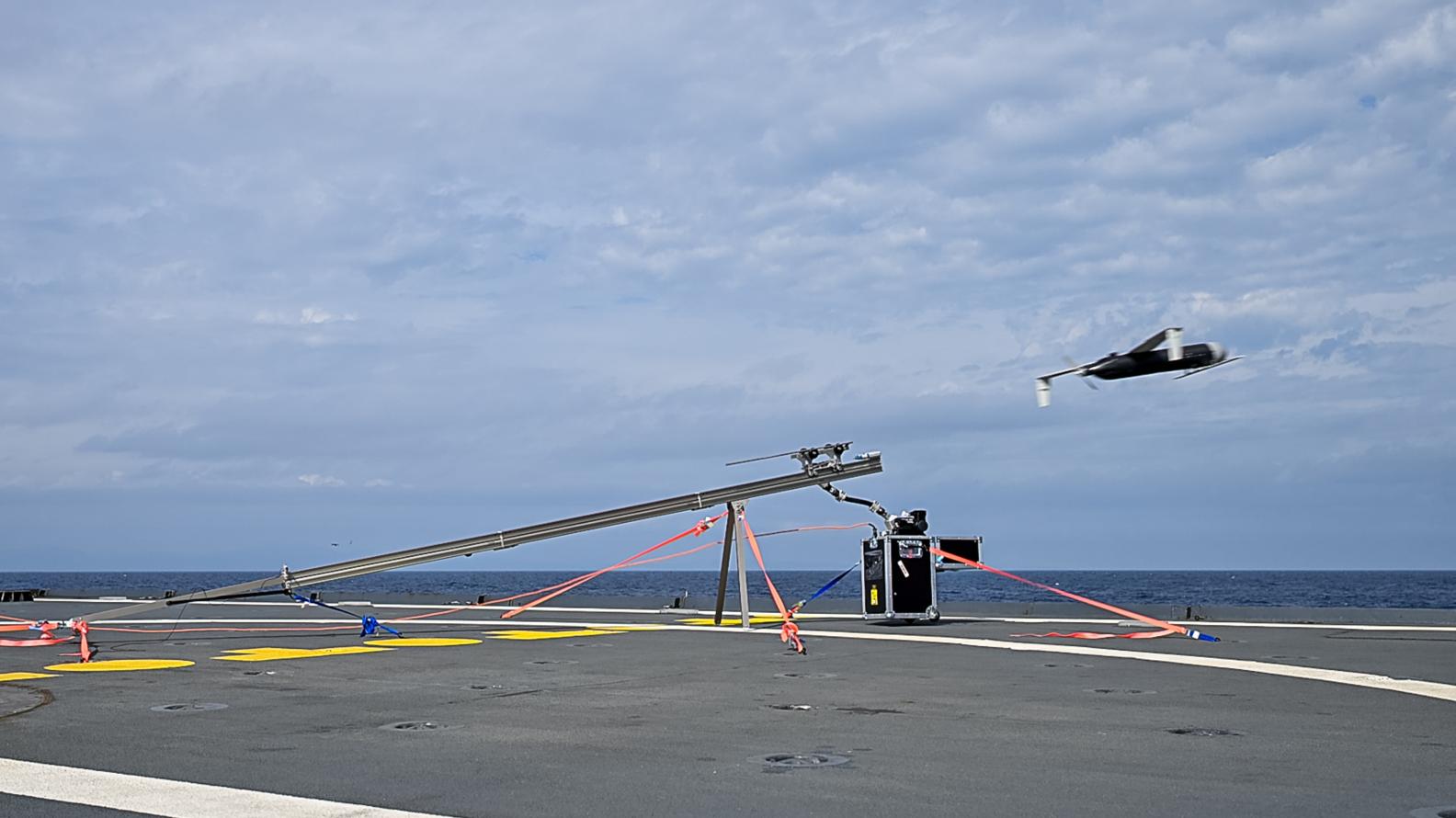
Beyond Rampart, the Directorate General for Armament (DGA) and several manufacturers fielded new hard-kill and soft-kill systems, interceptor drones built to destroy hostile UAVs, and uncrewed surface vessels, all employed under realistic tactical conditions. The Navy has not named the suppliers. Threat drones flew from the DGA missile test site on the Île du Levant. The model has precedent: equipment trialed during the 2024 edition reached a frigate deploying to the Red Sea without a full qualification cycle, and the 2025 Mediterranean iteration employed about 80 targets, including underwater drones.
Defense analysts estimate each Aster 15 at roughly €1 million, a price French commanders defended in 2024 by citing the value of the ships protected. Guns from 20mm to 76mm, helicopter door gunners and jammers offer cheaper kills but shorter reach and limited capacity against simultaneous threats. Guided rockets and interceptor drones target the middle tier, defeating one-way attack drones outside the inner layer at a fraction of a missile’s cost; publicly reported unit costs for comparable laser-guided rockets such as the U.S. APKWS sit in the tens of thousands of dollars.
Analysis: Bringing a PHA into Wildfire and making it Rampart’s first firing platform shows where the French Navy locates its counter-drone gap. Air defense frigates can absorb a raid with Aster and medium-caliber guns; amphibious ships and replenishment ships cannot, yet they are the units most likely to sit in a choke point or alongside another hull when an adversary launches cheap drones in volume. A deck-mounted launcher accepting rockets and VSHORAD missiles from several European suppliers would give those ships a credible inner layer without a major refit, and give NATO navies drawing the same Red Sea and Black Sea lessons a lighter European option.
Results will feed the FAN’s center of expertise, which turns exercise feedback into tactics and equipment recommendations. Open questions remain: which interceptor drones and soft-kill systems performed well enough to move toward procurement, whether the DGA funds Rampart before Naval Group’s early 2027 target, and when a live Piorun or SkyKnight intercept follows at sea.