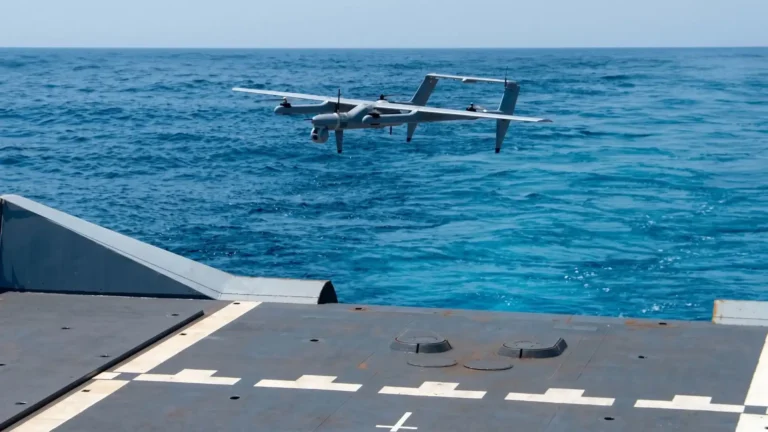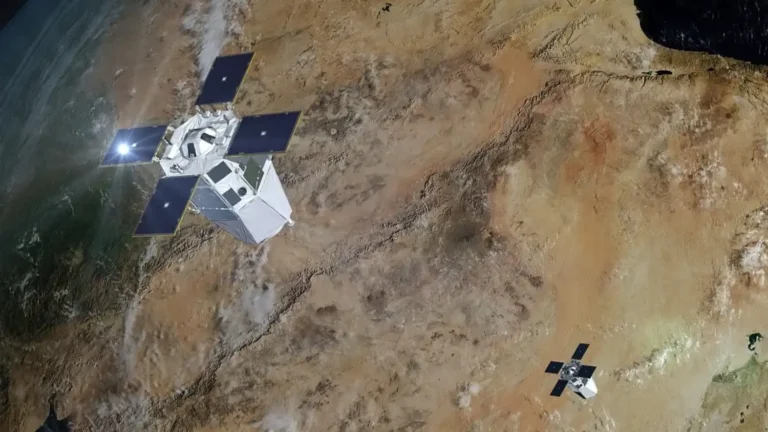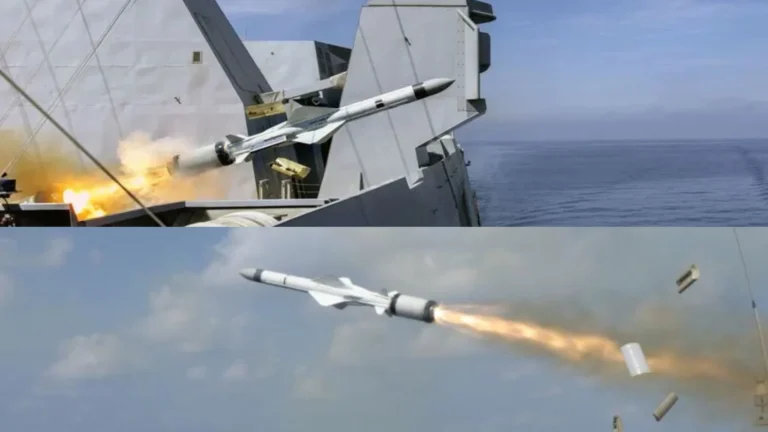
France is taking its SLAM-F unmanned mine countermeasures system offshore. Under Increment 2.1, launched this summer, the Direction générale de l’armement (DGA) has ordered chartered drone carrier vessels, known as Protée, to operate SLAM-F drones across all of France’s metropolitan maritime approaches, according to program director Chief Armament Engineer Mikaël in an interview released by the Ministry of the Armed Forces and Veterans Affairs on November 5, 2026.
SLAM-F, the Système de lutte anti-mines marines futur, replaces the French Navy’s Tripartite-class minehunters, sonar-towing vessels and diver support ships with a family of unmanned systems. It grew out of the Franco-British Maritime Mine Counter Measures (MMCM) program, contracted to Thales through the Organisation for Joint Armament Cooperation (OCCAR) in March 2015. The first operational module reached the Navy in December 2024, and on July 21, 2026, the DGA ordered about a dozen additional surface and underwater drones alongside the Protée charter.
SLAM-F Mine Warfare Drones Extend the Search to 300 Meters
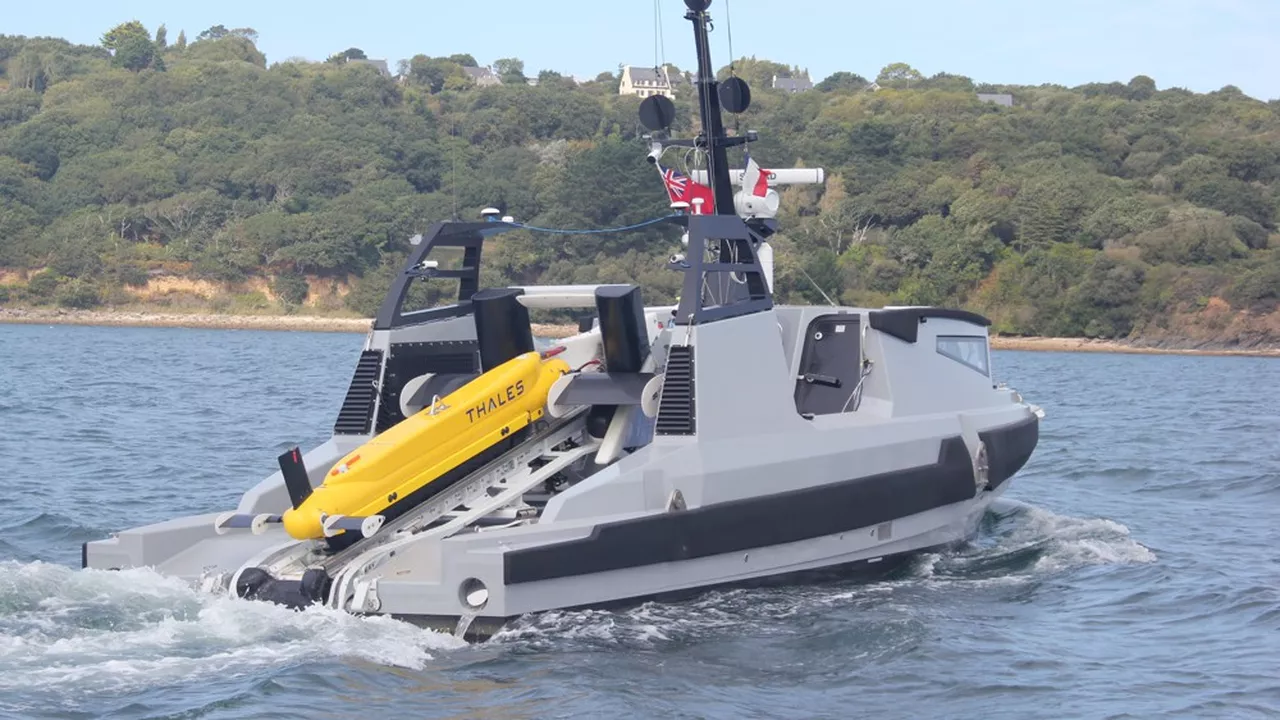
Each mine countermeasures module pairs two unmanned surface vessels (USVs) with two unmanned underwater vehicles (UUVs), according to the French Navy. Eight modules are planned. The drones survey the seabed and water column to detect and classify contacts, with the requirement to distinguish rocks, Second World War ordnance and mines down to 300 meters.
Autonomy drives the UUV design. The underwater drones are out of contact 99.9% of the time and must run missions from launch to recovery on their own, for nearly 20 hours on the longest sorties. An onboard supervision agent monitors vehicle health, battery state, sensors and mission plan in real time to safeguard the vehicle and its imagery.
The core sensor is a multi-view sonar developed by Thales with the DGA. Where a conventional sonar captures one image per pass, it records three simultaneously from different angles, cutting the passes needed per area and resolving contacts faster. Classification-aid algorithms help operators sort echoes. Once a suspect object is found, a USV deploys a remotely operated vehicle (ROV) to identify it and, if it is a mine, place an explosive charge. The decision to neutralize remains human. Crews supervise missions from shore-based operations centers such as Brest, or from deployable centers, watching USV video and sonar detections live and ordering revisits of suspect echoes.
Protée Charters and BGDM Motherships Built on the rMCM Design
The Protée vessels are chartered rather than Navy-owned and carry launch and recovery systems adapted to SLAM-F drones. They give the Navy an offshore base for operations supporting France’s strategic forces. The ministry has not disclosed the number of Protée vessels, their dimensions, charter costs or entry-into-service dates.
The next step is the acquisition of mine warfare vessels, or bâtiments de guerre des mines (BGDM), carrying militarized drones. Their design will be aligned with the Belgian-Dutch Replacement Mine Countermeasures (rMCM) mothership developed by Naval Group, for which France obtained a sublicense on February 20, 2025. Publicly available specifications indicate the rMCM ship displaces about 2,800 tonnes with a range exceeding 3,500 nautical miles; the French variant is reportedly lengthened. Earlier planning called for six BGDM, a figure the latest update does not confirm.
Analysis: The Protée charter is a bridging solution. It moves SLAM-F offshore years before the BGDM arrive and limits the capability gap as Tripartite hulls age out, but it anchors near-term effort on home waters and the deterrent. Expeditionary tasks such as reopening the Strait of Hormuz, which the program director cites as a reference case, depend on the militarized BGDM. Sharing a hull with Belgium and the Netherlands builds commonality across NATO’s northern European mine countermeasures community, though French ships will carry a different drone toolbox.
Key milestones to watch are the BGDM contract award and quantity, the size and activation date of the Protée flotilla, and deliveries of the remaining modules toward the eight planned.