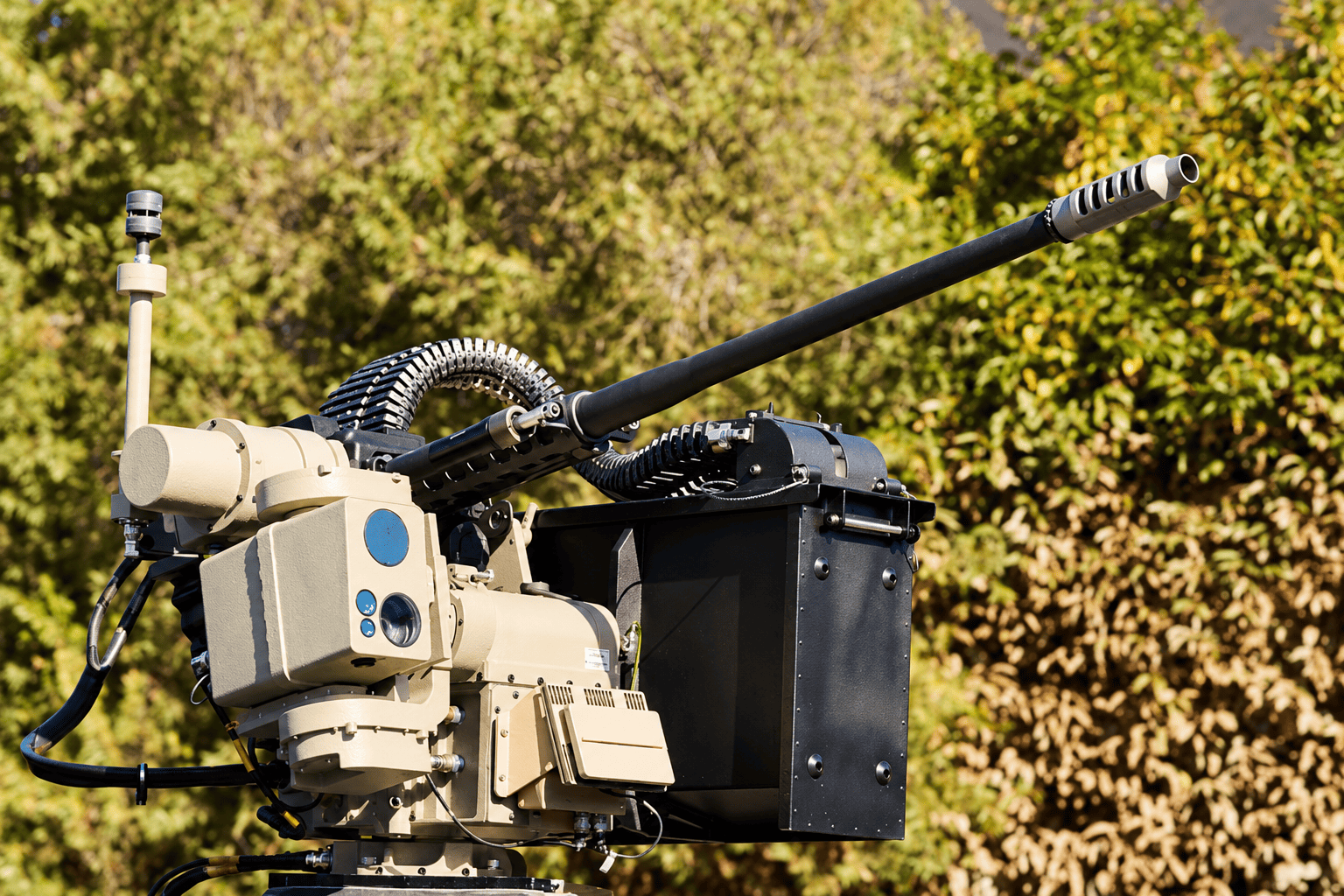
EOS Defense Systems USA will build the next generation of its Slinger counter-drone remote weapon system (RWS) at its Huntsville, Alabama facility, with US production set to begin in 2027, the company announced on October 7, 2026. The upgraded EOS Slinger is in the final stages of development and adds enhanced sensing and an autonomous kill chain built around selectable autonomy, intended to defeat drones that move faster than a human operator’s decision cycle.
The decision moves production of the company’s flagship counter-drone product closer to a US customer base that is buying counter-unmanned aircraft systems (C-UAS) at speed. Joint Interagency Task Force 401 (JIATF-401), established in August 2025 to replace the Pentagon’s Joint Counter-small Unmanned Aircraft Systems Office, had committed more than $600 million to new C-UAS capability by April 2026. Shawn Baerlocher, chief executive of EOS Defense Systems USA, said US customers need affordable counter-drone capability on timelines that match the threat.
Next-Generation EOS Slinger: Selectable Autonomy and Enhanced Sensing
EOS has disclosed only the outline of the new configuration. Like the current model, the next-generation Slinger is fully stabilized to fire on the move and engages both drones and ground threats from a single weapon station without reconfiguration. The company has not released the new variant’s sensor suite, armament, weight, autonomy modes, or unit cost.
Publicly available specifications for the fielded Slinger define the baseline. EOS lists total system weight at 376 kg with a Northrop Grumman M230LF 30x113mm chain gun and 150 rounds. The cannon fires lightweight 30mm proximity-fused, high-explosive fragmentation ammunition that detonates near a small, maneuvering airframe instead of requiring a direct hit. An Echodyne EchoGuard 4D radar with an active electronically scanned array cues a four-axis sighting system whose sensor head moves independently of the gun in azimuth and elevation, supported by a wind sensor. EOS rates single-shot engagements beyond 800 m and maximum engagement range at about 2,000 m. Alternative effectors include the M2 12.7mm heavy machine gun, the M134D minigun, the MAG-58, and a four-round pod for 70mm laser-guided rockets.
The current design has been in Ukrainian hands since late 2023, delivered under US-funded security assistance to counter Shahed-type one-way attack drones. The autonomy upgrade targets the constraint the hardware cannot solve: operator workload. An RWS that relies on a gunner to confirm and engage one track at a time saturates quickly against multiple inbound drones. Selectable autonomy implies the ability to shift between operator-controlled and automated engagement according to rules of engagement and threat density. Any automated mode offered to US customers will have to clear DoD Directive 3000.09, the department’s policy on autonomy in weapon systems.
Huntsville Production Builds on EOS Army and Northrop Grumman Contracts
EOS says domestic production will shorten supply chains, improve lead times, and lower costs for US and allied customers. The Huntsville subsidiary has served as the regional hub for parent company Electro Optic Systems (ASX: EOS) since 2018, and the group reports more than 3,500 remote weapon systems delivered worldwide since the 1990s. The line also sits next to Redstone Arsenal, home of the Army’s Program Executive Office Missiles and Space, which manages short-range air defense and counter-small UAS programs.
The site already carries a growing US workload. In December 2025, EOS signed a $22 million initial contract with General Dynamics Land Systems to supply an enhanced RWS for a US Army ground combat vehicle, with Huntsville manufacturing and follow-on production expected to extend past 2030. On March 31, 2026, the company announced two further US awards totaling $12 million: $5 million to develop and deliver RWS to the US Army from Huntsville, and $7 million to produce Slinger units for Northrop Grumman’s Agnostic Gun Truck, the M230LF-armed pickup configuration Washington funded for Ukraine in 2023.
Export demand has so far outpaced US orders and runs through Australian production lines. EOS booked a $42 million Slinger order from a Middle East customer on March 13, 2026, subject to export approvals in both Australia and the United States, and a $124 million order through Generation 5 Holding in the United Arab Emirates on June 19, 2026, with deliveries planned for 2027 and 2028 from Australia and the UAE. A US line removes one layer of that approval chain for American buyers and strengthens its case on Army programs with domestic content rules.
Analysis: The announcement is an industrial positioning move as much as a product launch. JIATF-401’s acquisition model rewards systems that can be produced and fielded quickly inside the United States, and a cannon-based kinetic effector firing proximity-fused 30mm rounds sits between costly interceptors and directed energy weapons that are not yet fielded at scale. A Huntsville-built Slinger gives EOS a domestic production argument against Kongsberg, whose Common Remotely Operated Weapon Station (CROWS) dominates the Army’s remote weapon inventory. The risk: EOS has committed to a production start date before publishing a single performance figure for the new system.
EOS says it will publish details on the next-generation Slinger and its production plans in the coming months. Open questions include whether the M230LF remains the primary effector, which sensors replace or supplement the EchoGuard radar, the production rate and launch customer for the Huntsville line, and how automated engagement modes will be validated for US use. Deliveries under the $7 million Northrop Grumman order, due in 2026, are the nearest indicator of the US Slinger business before the new line opens.