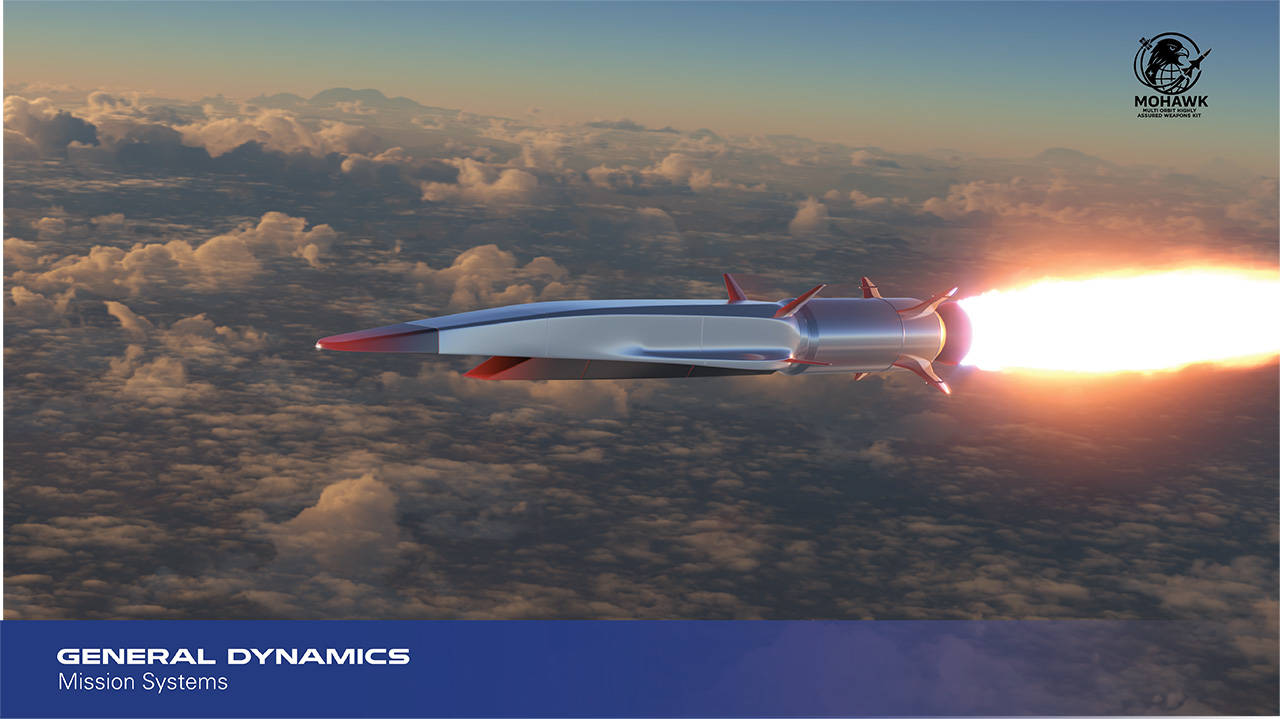
General Dynamics Mission Systems (GDMS) and the U.S. Army Combat Capabilities Development Command (DEVCOM) Aviation and Missile Center (AvMC) have flown the company’s Multiple Orbit Navigation (MO-Nav) software-defined receiver on a hypersonic flight, demonstrating radio frequency (RF) navigation without GPS aboard Stratolaunch’s reusable Talon-A test aircraft. GDMS announced the result on October 7, 2026, describing it as the first hypersonic flight demonstration of the receiver.
The test targets one of the most exposed dependencies in the U.S. precision strike inventory. Ukrainian assessments that surfaced in 2024 put the success rate of the GPS-guided M982 Excalibur 155mm projectile below 10 percent once Russian jamming intensified, with similar degradation reported for Guided Multiple Launch Rocket System (GMLRS) rockets. Matt Elliott, director of the GDMS Weapons and Navigation business segment, called GPS-denied technology “arguably one of the largest capability gaps across joint forces.”
How MO-Nav Delivers Hypersonic Navigation Without GPS
MO-Nav is a compact, single-board circuit card assembly that navigates on RF sources other than GPS. According to GDMS, it draws on multiple Global Navigation Satellite Systems (GNSS), signals of opportunity, and commercially provided position, navigation and timing (PNT) signals. GDMS has not identified which constellations or commercial services the receiver used during the flight.
The software-defined design is the central choice. In a software-defined receiver, signal processing runs in reprogrammable logic rather than fixed-function chips, so new waveforms, constellations or anti-jam algorithms can be loaded as software. GDMS argues this lets programs outpace evolving electronic warfare threats without new hardware insertions, a real cost lever for munitions that stay in inventory for a decade or more.
Hypersonic flight stresses any RF receiver. Above Mach 5, a vehicle imposes large, rapidly changing Doppler shifts, sustained acceleration and heavy thermal loads on its electronics, and at higher Mach numbers ionized flow around the airframe can attenuate incoming signals.
MO-Nav has already cleared a different extreme. GDMS previously fired the receiver in a cannon-launched artillery application, where it survived gun-launch loads and fed signal measurements to the munition’s mission computer, consistent with an architecture that fuses RF observations with inertial data. The company says MO-Nav is available for integration now, but it has not published size, weight and power figures or navigation accuracy.
Talon-A Reusable Testbed Brings GPS-Denied Receivers Into Flight
Stratolaunch’s Talon-A is an autonomous, rocket-powered, Mach 6-class test vehicle air-launched from the company’s Roc carrier aircraft or a modified Boeing 747-400. Publicly available specifications indicate a length of 28 feet (8.5 meters), a launch weight of roughly 6,000 to 6,500 pounds, and an Ursa Major Hadley liquid oxygen and kerosene engine rated at 5,000 pounds-force. After its hypersonic run, the vehicle lands autonomously on a conventional runway for reuse.
That reusability is the draw for developers such as DEVCOM AvMC. Talon-A flew its first reusable hypersonic mission in December 2024, and Stratolaunch reported more than 10 hypersonic flights by July 2026 across two carrier aircraft and two airframes. Recurring access to Mach 5-plus conditions moves components from ground rigs to flight data without waiting for a full weapon test.
MO-Nav is not the first GPS-independent navigation payload on the platform. Northrop Grumman flew its Advanced Hypersonic Technology Inertial Measurement Unit, built around a hemispherical resonator gyroscope, on Talon-A’s first two hypersonic flights. The GDMS receiver attacks the problem from the RF side: inertial sensors drift, and RF fixes from non-GPS sources can bound that drift. Neither GDMS nor the Army has disclosed the flight date, the airframe used, the peak Mach number, or whether GPS was actively jammed or simply excluded from the solution.
MOHAWK Adds Integrated M-Code for 2027 Hypersonic Demonstration
GDMS is building its follow-on receiver, the Multiple Orbit Highly Assured Weapons Kit (MOHAWK), on the MO-Nav architecture. The company lists increased spectral diversity, expanded constellation diversity and scalable anti-jam protection as the main additions. MOHAWK is also designed to host an optional integrated M-Code receiver, or to support a federated external M-Code GPS receiver with anti-jam and anti-spoof protected RF output.
M-Code is the encrypted military GPS signal built to resist jamming and spoofing. The U.S. Space Force’s Military GPS User Equipment (MGUE) Increment 2 effort, which awarded three Miniature Serial Interface contracts worth a combined $552 million in 2020, is developing small M-Code receivers for munitions and handheld devices. MOHAWK’s federated option would in principle let an integrator pair a multi-source receiver with one of those M-Code cards rather than choose between them.
GDMS and DEVCOM AvMC are co-investing to fly MOHAWK with integrated M-Code in a 2027 hypersonic demonstration, followed by demonstrations on precision-guided munition platforms in 2028. Neither party has disclosed the value of the co-investment or named a program of record for transition.
Analysis: The flight matters less as a speed milestone than as evidence for layered assured PNT. Inertial units, M-Code and multi-source RF receivers fail in different ways under jamming, and combining them forces an adversary to defeat several independent references at once. The software-defined element answers the core lesson of Ukraine’s electronic warfare fight: jammers adapt within months, while munitions stay in inventory for years. The approach carries its own exposure. Non-GPS constellations and commercial signals can also be jammed or spoofed, and GDMS has not explained how MO-Nav validates the integrity of the sources it accepts.
The next marker is the 2027 hypersonic flight of MOHAWK with integrated M-Code, followed by munition demonstrations in 2028. Before then, the open items are published performance data, starting with position accuracy under denial, and a funded transition path. Army budget lines for assured PNT in long-range fires will show whether the service intends to buy, not just test.