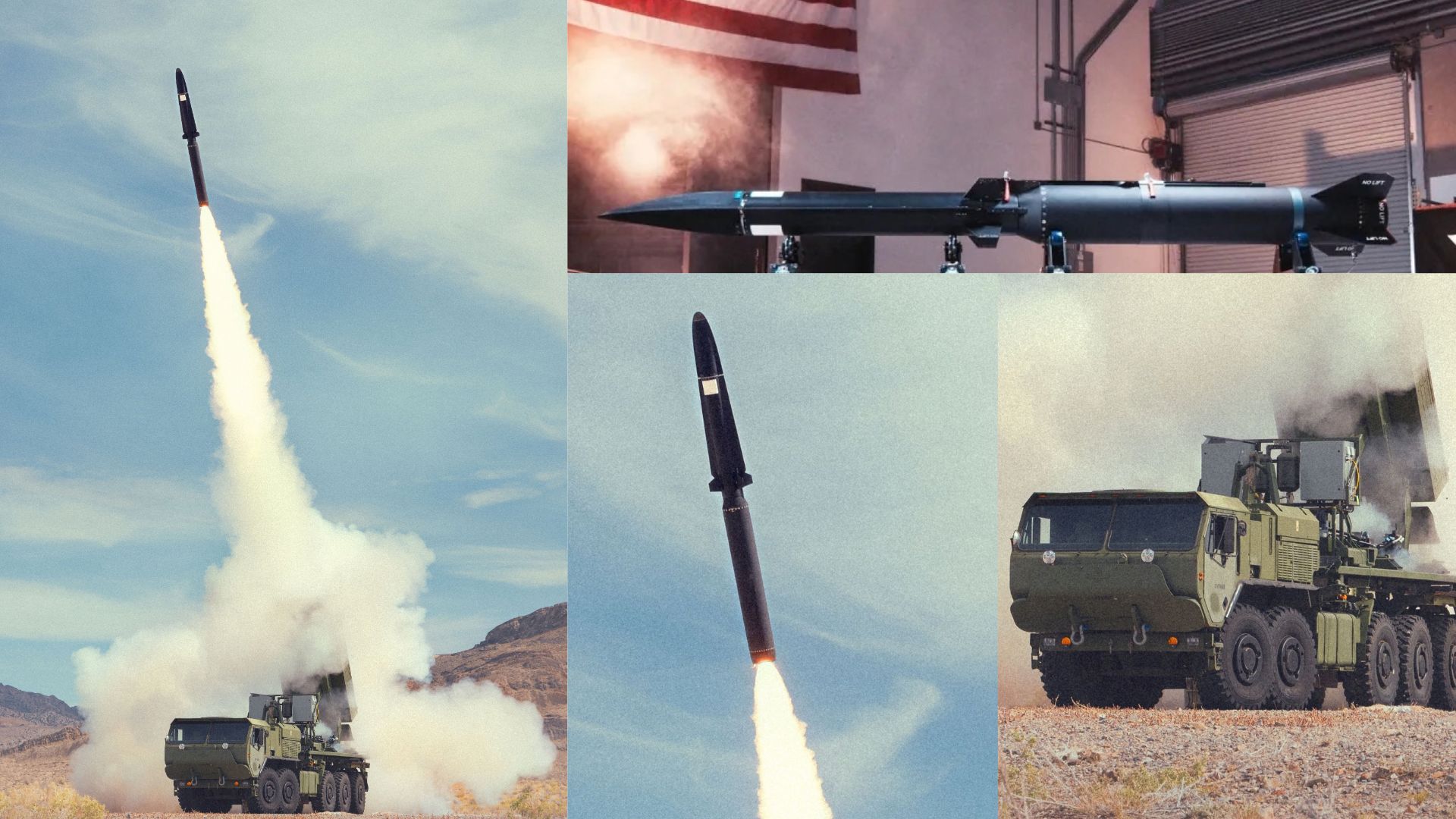
Castelion released an image on October 8, 2026, showing its Blackbeard hypersonic missile leaving a containerized launcher mounted on a heavy truck chassis, the clearest public view yet of the ground-launched variant the company is developing for the US Army. Designated Blackbeard GL (Ground Launch), the weapon is meant to put a low-cost hypersonic round into the Army’s High Mobility Artillery Rocket System (HIMARS) ecosystem.
The Army opened the effort in its fiscal 2026 budget, which allocated $25 million under Project HX3 and placed the program on the Middle Tier of Acquisition rapid prototyping pathway. Budget documents set the objective: roughly 80 percent of the capability of the planned Precision Strike Missile (PrSM) Increment 4 at a substantially lower price per round, against time-sensitive moving and hardened targets. The image arrives one week into fiscal 2027, when the Army plans a live-fire launch of a production-representative Blackbeard GL and its launcher pod.
Inside the Blackbeard Hypersonic Missile Ground Launch Configuration
The photograph shows the missile clearing an enclosed, box-shaped container carried on what appears to be an Oshkosh MKR18 Logistics Vehicle System Replacement (LVSR), a truck Castelion previously said it was converting into a flight-test launcher. The company has not disclosed when or where the shot took place, how many rounds the container holds, or whether the launch belonged to the Army’s planned demonstration series. The container’s apparent dimensions suggest a load of two to four missiles, an open-source estimate, not a confirmed figure.
The missile keeps the two-stage layout Castelion unveiled earlier in 2026: a booster topped by an upper vehicle whose shape is consistent with a hypersonic glide or maneuvering payload. The ground-launched model omits the cruciform tailfins fitted to the lower stage of the air-launched version but otherwise looks externally similar. Castelion has not published propulsion, warhead, mass, or dimension data. The company has pointed to a reach of just under 500 miles, a figure most relevant to air launch; fired from the ground without a strike fighter’s release altitude and speed, the GL variant will likely fly shorter distances. Army documents specify seeker-based terminal guidance.
The Army states that Blackbeard GL will not match the velocity or range of the Long Range Hypersonic Weapon (LRHW), known as Dark Eagle, which the service credits with roughly 1,725 miles of reach from a dedicated trailer-mounted launcher. Blackbeard GL instead fills the band between PrSM Increment 1, publicly rated at about 310 miles, and Increment 4, which Army planning puts beyond 620 miles. Packaging the round in a modified Multiple Launch Rocket System Family of Munitions (MFOM) pod makes it compatible with the M142 HIMARS and the tracked M270 without launcher modification.
From Project HX3 to HIMARS: The Army’s Blackbeard GL Roadmap
The Army’s sequence opens with a proof-of-concept flight of a fixed-fin version of the existing air-launched, extended-range Blackbeard from a modified government-furnished MFOM pod. Minimum viable product prototypes, a dedicated Blackbeard GL launcher pod, and a flight test using the HIMARS fire-control system follow, with initial deliveries to units reported for 2028. If the weapon proves effective and affordable, the Army intends to transfer it to the Program Executive Office for Missiles and Space. HIMARS is only the interim host; the Army envisions Blackbeard GL as the primary munition for the uncrewed Common Autonomous Multi-Domain Launcher (CAML), a potential HIMARS successor.
The industrial track is moving faster. In May 2026, the Pentagon committed to a two-year multi-year procurement of at least 500 Blackbeard missiles annually once testing and validation conclude, with options running to five years, and said it was seeking authority and funding for more than 12,000 rounds over five years. Castelion closed a $1 billion Series C round on August 19, 2026, at a $13 billion valuation, and is building Project Ranger, a 1,000-acre production campus in Sandoval County, New Mexico. Company executives have placed unit cost in the hundreds of thousands of dollars; the Congressional Budget Office estimated in 2023 that an LRHW-class missile would cost about $41 million.
The Navy’s air-launched variant leads the program. Awards of $49.9 million in February, $105 million in April, $23.4 million in June for 50 early operational capability pre-production rounds, and $90 million in August preceded a production delivery order worth up to $200 million on September 15, 2026. An F/A-18E/F Super Hornet flew a developmental test carrying two Blackbeards on September 18, 2026, and the service targets early operational capability in 2027.
Analysis: The image says more about logistics than about the missile. A hypersonic round packaged in an MFOM-compatible canister would let any HIMARS or M270 battery fire hypersonic shots without the bespoke launcher, crew specialty, and reload chain that Dark Eagle requires. Sharing the Navy’s airframe and factory also gives the Army a production base it does not fund alone. The cost sits in the magazine: HIMARS carries one pod per reload, so each Blackbeard pod displaces six Guided Multiple Launch Rocket System (GMLRS) rounds or two PrSM, and commanders in a Pacific contingency will trade shot count against speed on each reload.
The next public marker is the production-representative Blackbeard GL and launcher-pod live fire planned in fiscal 2027, which began October 1, 2026. Ground-launched range, rounds per pod, the Army variant’s unit cost, and whether Congress funds the 12,000-round goal remain open. The Army has not said whether it will buy under the Pentagon’s multi-year framework or its own line.