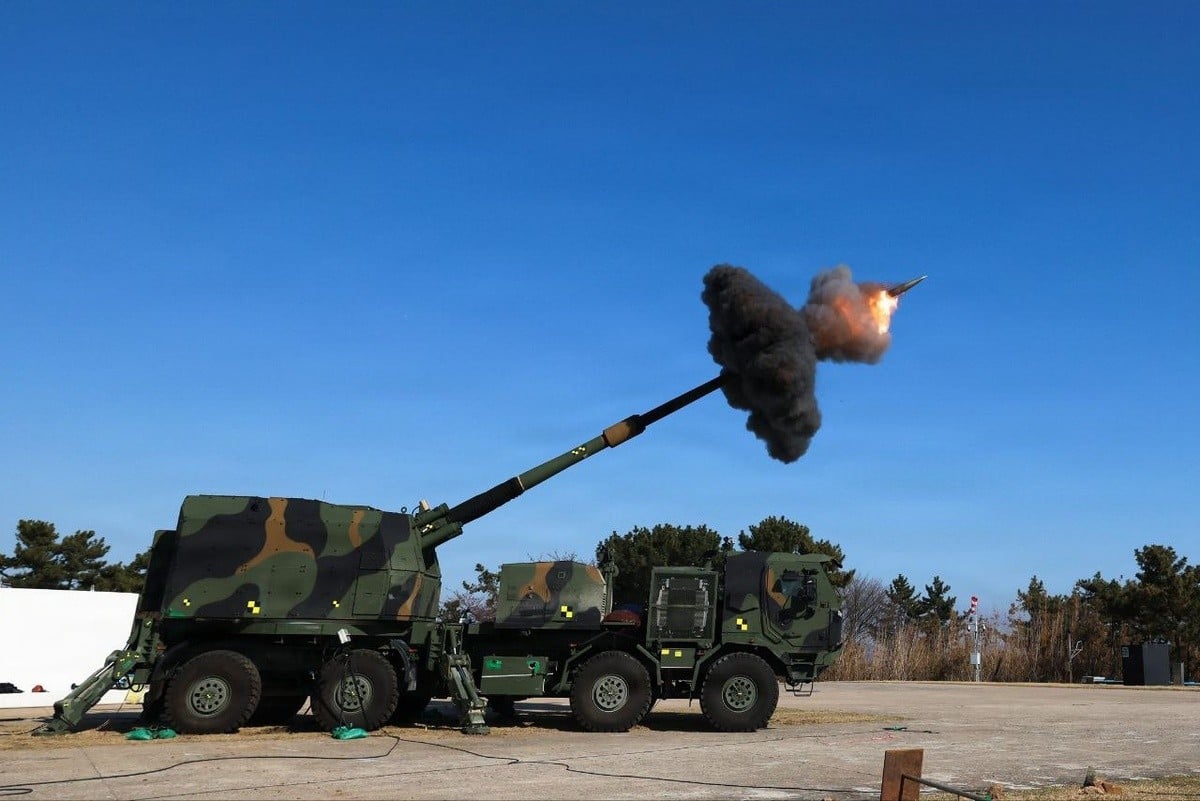
The U.S. Army has taken delivery of its first Mobile Tactical Cannon (MTC), a wheeled 155mm self-propelled howitzer built by Hanwha Defense USA to replace the M777 towed howitzer, less than a year after first soliciting industry. Brig. Gen. Robert J. Mikesh Jr., the Army’s portfolio management executive for offensive fires, disclosed the delivery on October 8, 2026, ahead of the Association of the United States Army (AUSA) annual meeting, Defense News first reported.
The delivery puts hardware behind a program rebuilt after the Army’s last cannon effort failed. The service halted the XM1299 Extended Range Cannon Artillery (ERCA) in 2024 after its 58-caliber XM907 tube showed excessive barrel wear, then pivoted to mature systems already in production. The M777, in service since 2005, must be towed, emplaced and hand-loaded, a profile that combat in Ukraine has shown to be highly exposed to counter-battery fire and drone-cued strikes.
Mobile Tactical Cannon Contract Grows From Six to Nine Prototypes
The Army announced the Other Transaction Authority (OTA) prototyping agreement with Hanwha Defense USA, the Arlington, Virginia-based subsidiary of South Korea’s Hanwha Aerospace, on August 18, 2026. The initial award, valued at $100.3 million, covers six prototypes, with options for 12 more that bring the ceiling to $262.9 million over an estimated four-year period of prototyping, testing and Soldier experimentation. On September 24, 2026, the Army exercised options for three additional vehicles, raising the number under contract to nine, according to Hanwha Defense USA chief operating officer Mike Smith. The first prototype was due before the end of 2026, the other five within a year of award.
Hanwha’s K9 Mobile Howitzer (K9MH) beat wheeled entrants that included Rheinmetall’s RCH 155 and BAE Systems’ Archer, and the award is the company’s first major U.S. Army contract. Mikesh said the Army deliberately skipped a clean-sheet design in favor of “mature and available technologies,” opening the field to foreign vendors on the condition that the winner onshore production within two years. Hanwha is standing up an integration and test site in Opelika, Alabama, under a three-year lease, with components initially shipped from South Korea for final assembly there.
The Army has not disclosed the delivery date, the receiving unit or the test location. Officials said operational experiments will assess performance, reliability and supportability under realistic combat conditions; the first vehicle was displayed at an Army Modernization Day event on Capitol Hill earlier this month.
Inside the K9MH: Autoloader, Three-Person Crew, and 8×8 Mobility
The K9MH draws on the K9 Thunder family, in South Korean service since 1999 and operated in variant form by 10 other countries; Hanwha says more than 2,500 K9s have been fielded worldwide. Rather than simply swapping tracks for wheels, Hanwha mated the unmanned, automated turret of the K9A2 to a third-generation Tatra Force 8×8 chassis with an armored forward cab. Publicly available specifications indicate a combat weight near 40 tonnes and a CN98 155mm/52-caliber cannon.
Automation is the core of the design. A dual-feed autoloader handles projectiles and modular propellant charges separately, carrying 40 rounds and 192 charges onboard and sustaining eight to nine rounds per minute, with multiple-round simultaneous impact (MRSI) capability. Manufacturer figures put both firing preparation and displacement at under 30 seconds. The crew drops to three, all inside the protected cab, against five on the tracked K9 and a larger detachment on the M777. On roads, the 8×8 reaches about 100 km/h with a range of roughly 700 km.
Range is where the gap with the M777 is widest. The towed gun reaches under 24 km with conventional ammunition and up to 40 km with the M982 Excalibur guided round, while the K9’s 52-caliber tube is credited with more than 60 km, depending on ammunition. The trade-off is weight: at roughly 40 tonnes, the K9MH cannot be sling-loaded under a CH-47 Chinook or carried by a C-130, two transport options the 4.2-tonne M777 gives light formations today.
From Stryker Brigades to 70 km Fires: The M777 Replacement Roadmap
Army budget solicitations show fielding will begin with Stryker Brigade Combat Teams, followed by Mobile Brigade Combat Teams and Infantry Brigade Combat Teams. The Hanwha award covers only the wheeled requirement; the Army issued a separate solicitation in late August 2026 for a tracked variant aimed at heavier formations, and Hanwha has said it will compete for it.
The fiscal 2027 budget request assigns the MTC a second role as a test platform for the 155mm Artillery Propulsion Modernization project, which pursues new propelling charges, modular charges, ignition systems, propellants and packaging. The stated objective is to engage artillery targets out to 70 km, the same range goal ERCA was meant to reach through a longer barrel. Army leaders have said they want a production-ready MTC fielded by 2031.
Analysis: The MTC inverts the ERCA model. Instead of developing a new cannon to win range overmatch, the Army is buying a mature foreign gun, forcing production onshore and pushing the 70 km goal into ammunition and propulsion, where it can iterate without redesigning the howitzer. That compressed solicitation to delivery into under a year, but shifts risk to the industrial phase. Opelika is an integration and test site, not a full-rate line, and open-source estimates put the eventual M777 replacement requirement near 500 guns. Scaling from nine prototypes will require domestic sources for barrels, autoloaders, fire control sets and heavy 8×8 chassis, the last derived from a Czech Tatra design. The program also embeds South Korean artillery technology in the U.S. industrial base at a moment when allied production capacity has become a strategic asset.
Near-term milestones include delivery of the remaining initial prototypes by mid-2027, the start of Soldier experimentation and decisions on the nine options still available. The Army has yet to publish a production quantity, unit cost or domestic-content threshold for a follow-on contract. The tracked-variant award will show whether Hanwha can position the K9 family across both halves of the Army’s cannon fleet before the 2031 fielding target.