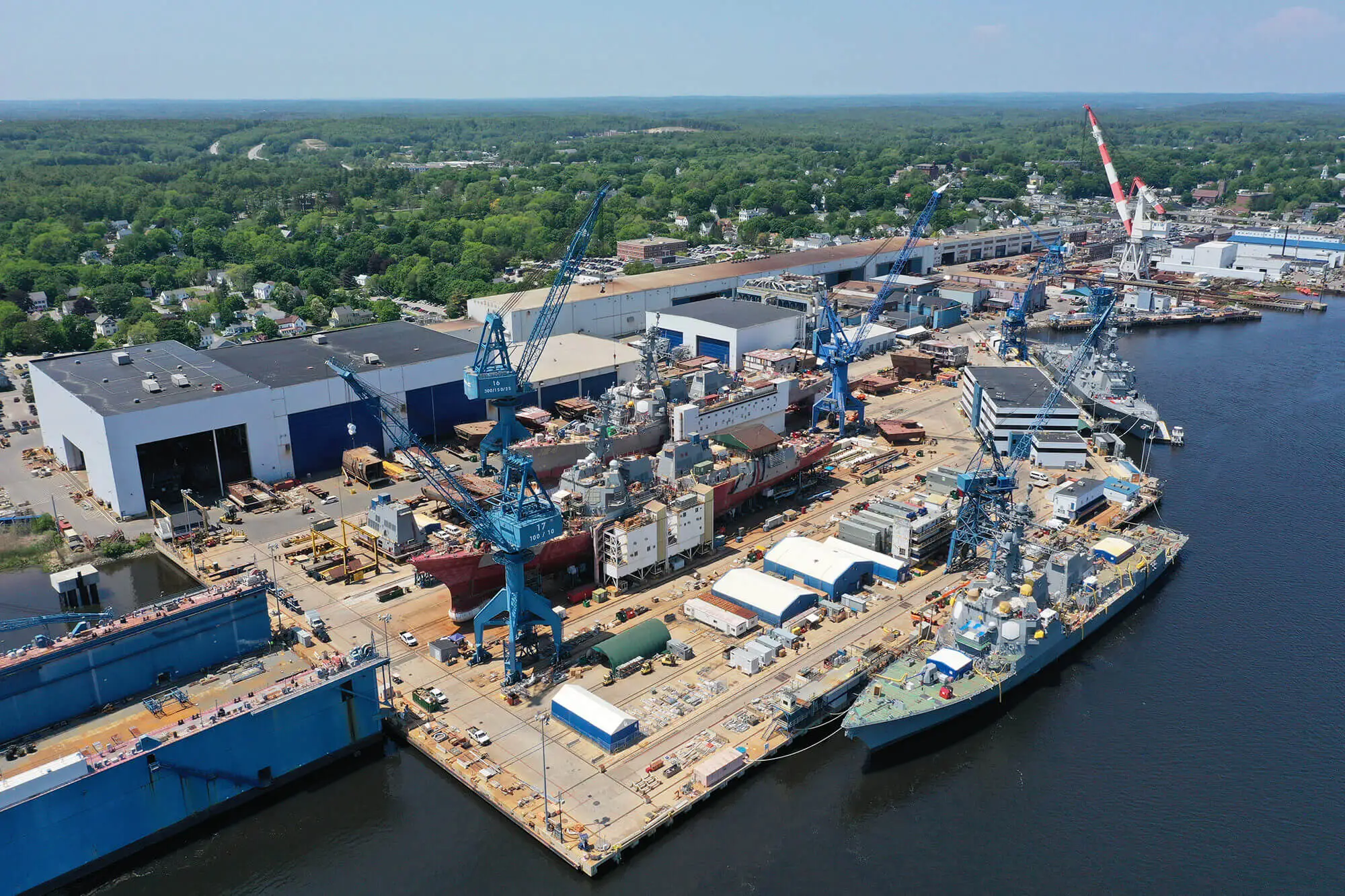
The Department of War has certified that General Dynamics Bath Iron Works (BIW) in Bath, Maine, has the production capacity and stability to build a second Arleigh Burke-class (DDG 51) guided-missile destroyer, the department announced on October 12, 2026. The finding, issued after a multi-phase due diligence review of the shipyard, clears the way for an additional hull at BIW only if Congress provides the money.
The certification lands in the middle of a dispute over the fiscal 2027 shipbuilding budget. The Navy’s FY2027 request funds a single Flight III DDG 51 at roughly $3.3 billion, down from two destroyers in FY2026 and three in FY2025. According to the service’s shipbuilding justification books, that lone ship, DDG 150, is slated for HII’s Ingalls Shipbuilding in Pascagoula, Mississippi, leaving BIW without a new destroyer on contract for the year. Acting Secretary of the Navy Hung Cao told lawmakers in May that the backlog at Bath drove that choice. The department’s review now addresses that rationale directly.
What the Bath Iron Works Capacity Review Examined
According to the department, the review assessed five areas at the Bath yard: production throughput, schedule adherence, quality assurance benchmarks, supply chain resilience, and workforce optimization. It concluded that operational and managerial improvements implemented across the facility make an additional DDG 51 at BIW feasible and strategically advantageous for the fleet. The department did not publish the underlying metrics, delivery forecasts, or the thresholds the shipyard had to meet, so the scale of the improvement cannot be independently assessed.
The backlog under review is substantial. In May 2026 testimony, Cao said BIW holds 11 destroyers on contract, seven of them in construction and four not yet started. Navy budget documents show the yard taking about 7.5 years from start of fabrication to delivery per hull. Senator Susan Collins (R-Maine), who chairs the Senate Appropriations Committee, said in the same budget cycle that the yard is approaching a production rate of 1.5 ships per year.
Deputy Secretary of War Steve Feinberg framed the decision as conditional. “After a rigorous review, Bath Iron Works has proven it has the capacity and stability to support construction of a second destroyer,” he said, while adding that the shipyard “must continue this momentum to fully resolve legacy production challenges.” The wording endorses a trajectory, not a completed turnaround.
Flight III Arleigh Burke Specifications and Fleet Role
Any second FY2027 hull would be built to the Flight III configuration, the current production standard for the class. Publicly available specifications indicate a length of 509.5 feet (155.3 meters), a beam of about 66 feet, and a full-load displacement of roughly 9,700 long tons. Propulsion comes from four General Electric LM2500 gas turbines driving two shafts at about 100,000 shaft horsepower, for speeds above 30 knots.
The defining change is the Raytheon AN/SPY-6(V)1 Air and Missile Defense Radar, a four-face active electronically scanned array built from 37 Radar Modular Assemblies per face and integrated with the Aegis Baseline 10 combat system. To power and cool it, Flight III ships carry upgraded electrical generation, which open-source data list as three 4-megawatt Rolls-Royce AG9160 generators, along with added cooling capacity. The 96-cell Mk 41 Vertical Launching System accommodates Standard Missile-2, -3 and -6 interceptors, Evolved SeaSparrow Missiles, and Tomahawk land-attack missiles.
That combination keeps the class at the center of the Navy’s integrated air and missile defense mission, a role DDG 51s have performed repeatedly against Houthi missile and drone attacks in the Red Sea since late 2023. With the DDG(X) next-generation destroyer still unresolved and the Navy’s FY2027 shipbuilding plan stating that the BBG(X) battleship is not a destroyer replacement, the DDG 51 line remains the only large surface combatant in serial production for the foreseeable future. Each hull added or dropped therefore shifts the fleet’s air defense capacity for decades.
Congress Holds the Funding Key for a Second FY2027 Destroyer
The certification neither funds nor awards a ship. The department stated that building the additional destroyer depends on Congress securing the necessary funding. The House Armed Services Committee has already moved in that direction: its FY2027 National Defense Authorization Act chairman’s mark, released May 26, 2026, authorized $500 million in incremental funding for a second Flight III destroyer, and the committee’s final bill added $1 billion for a second DDG through an amendment from Representative Jared Golden (D-Maine).
Collins, who has pressed the Navy to sustain procurement of no fewer than two destroyers per year, said she had advocated for a second destroyer in this year’s budget and worked with the administration through its review, including repeated visits to the shipyard. “This certification will help keep our Navy strong and support BIW as a steady source of good-paying Maine jobs,” she said, citing the yard’s 6,800 employees.
Analysis: The certification removes the Navy’s own stated reason for leaving BIW out of FY2027, moving the decision from industrial feasibility to budget arithmetic. That matters because a one-ship year opens a gap at the steel-cutting stage, which reaches the supplier base and the workforce long before it appears in delivery schedules. The department’s hedged wording also sets a performance test. At roughly 7.5 years from fabrication start to delivery, adding a hull to a yard still working down an 11-ship backlog only adds fleet capacity if throughput keeps improving. In a two-shipyard industrial base with little slack, the department is betting that a stable demand signal will produce faster ships rather than a longer queue.
The next decision point is the final FY2027 defense authorization and appropriations legislation, where lawmakers must settle whether a second destroyer is funded, in full or incrementally. If the money materializes, the Navy would still need to place the hull on contract at BIW, with the current DDG 51 multiyear procurement running through FY2027 and a follow-on buying strategy yet to be defined. The department has not said which performance milestones it will track at Bath, or whether the certification carries reporting conditions.