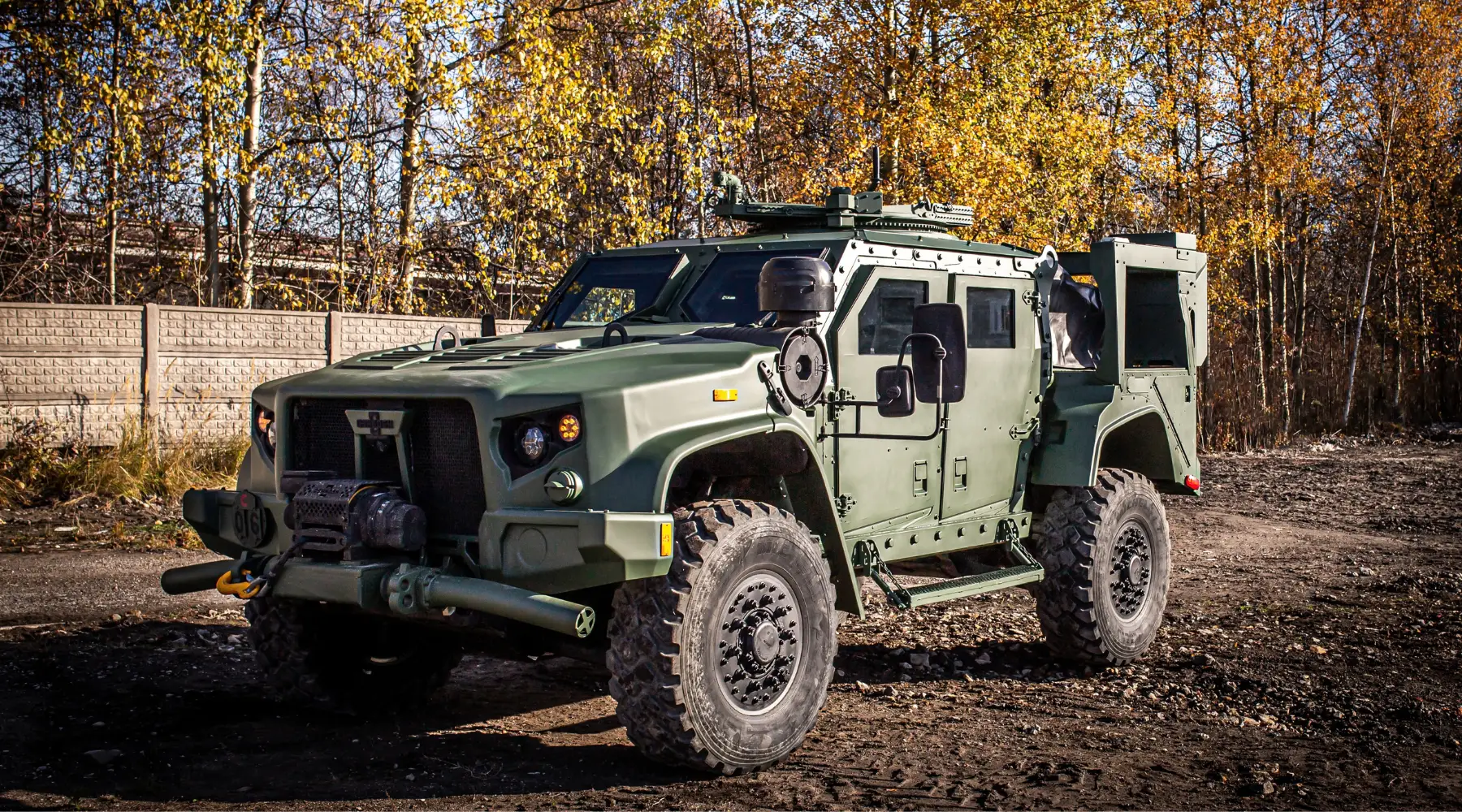
Oshkosh Defense has begun production of the first Dutch Expeditionary Patrol Vehicle (DXPV) prototype, known as the Kaaiman, for the Netherlands Ministry of Defence (MoD), the company announced on October 13, 2026. Built by Oshkosh Defense Europe B.V. and Oshkosh Defense LLC on the company’s active Joint Light Tactical Vehicle (JLTV) line, the prototype moves the program from contract to hardware about 16 months after the Dutch MoD signed for 150 vehicles for the Korps Mariniers, the Royal Netherlands Marine Corps.
The Kaaiman answers the Future Littoral All-Terrain Mobility Patrol Vehicle (FLATM-PV) requirement, a project the Dutch Defence Ministry notified to parliament in 2021 to partially replace the Mariniers’ aging BV206D, Viking and Land Rover fleets with a single light all-terrain patrol vehicle. The initial agreement, signed in Doorn on June 25, 2025, covers 150 vehicles with deliveries scheduled to begin in 2028; the Dutch Materiel and IT Command (COMMIT) put its value at EUR 150 million to 200 million. A follow-on order announced on January 13, 2026, valued by Oshkosh at $25 million to $30 million, added an undisclosed number of vehicles and two DXPV training kits.
DXPV Kaaiman: Littoral Enhancements on a JLTV Baseline
The DXPV is not a clean-sheet design. Oshkosh describes it as a JLTV derivative carrying customer-driven enhancements for expeditionary and littoral missions: improved mobility, corrosion protection optimized for maritime environments, modular protection options, environmental upgrades, integrated mission systems, and suspension improvements aimed at off-road performance. The company has not released dimensions, weights, powertrain data or a variant breakdown for the Dutch configuration.
Those choices track the FLATM-PV tender published on the TenderNed portal on May 4, 2024, which called for an unarmoured all-terrain vehicle able to operate in extreme littoral conditions, with high saltwater fording capability and enough power margin to add weapons or sensors later. The 2021 requirement envisioned one vehicle in four variants (baseline patrol, command, reconnaissance and field repair), each carrying four personnel and their equipment. That split has not been confirmed for the Kaaiman.
The parent platform sets the performance envelope. Oshkosh rates the JLTV at 20 inches (50.8 cm) of wheel travel on its TAK-4i intelligent independent suspension, with a payload of 3,500 lb (1,588 kg) in four-door configuration and 5,100 lb (2,313 kg) in the two-door model. Publicly available specifications indicate the baseline JLTV uses a 6.6-liter turbodiesel V8 rated at roughly 340 hp; Oshkosh has not confirmed whether the DXPV retains that powerplant. The JLTV is cleared for lift by CH-47 and CH-53 helicopters and for carriage in C-130, A400M, C-17 and C-5 aircraft, a profile suited to a force deploying by sea and air.
For the Mariniers, corrosion protection and fording performance matter more than armor. Light amphibious units deploy from ships and landing craft, where saltwater drives lifecycle cost. The FLATM-PV project was explicitly aligned with the replacement of the Marine Corps’ landing craft, which places the vehicle’s dimensions and weight inside the constraints of the new Littoral Assault Craft. How the Kaaiman fits that interface has not been publicly detailed.
Oshkosh’s Export JLTV Line After the U.S. Army Pullback
Oshkosh frames the prototype as proof of the value of a warm production line. The company lost the U.S. Army’s JLTV A2 follow-on competition to AM General on February 9, 2023, a contract worth $8.66 billion for up to 20,682 vehicles, and at the time signaled it would close its JLTV line by the end of 2024. The U.S. government owns the JLTV technical data package, which made that recompete possible. In 2025, the Army moved to halt further JLTV purchases under its transformation initiative.
International Direct Commercial Sales kept the Oshkosh line running. The company remains the only original equipment manufacturer authorized to sell the JLTV directly to allied governments, and it lists Lithuania, Slovenia, Montenegro, North Macedonia, Mongolia, Belgium, Slovakia, Brazil, Romania, Israel and the Netherlands as end users. Oshkosh says it has delivered more than 24,000 JLTVs since 2015.
The same production operations are building JLTV-based Counter-Unmanned Aircraft System (C-UAS) vehicles for what Oshkosh describes as an urgent customer need; the customer has not been named. “Because we’re building on a mature platform from an active production line, we can move from concept to prototype much faster than traditional vehicle development,” said Jeff Heggemeier, Vice President and General Manager at Oshkosh Defense.
Analysis: The Kaaiman shows the JLTV’s center of gravity shifting from a single U.S. buyer to a portfolio of European derivatives. For the Netherlands, buying into a fielded platform trades design freedom for schedule certainty and logistics commonality with allies: Belgium, a close Dutch operational partner, already operates the JLTV, as do several NATO eastern flank members. For Oshkosh, each tailored export variant extends the line’s life and builds a configuration library (littoral, C-UAS, hybrid-electric) for the next buyer. The risk sits on the Dutch side: a fleet supported by a direct-sales line, rather than by U.S. program-of-record volume, depends on that export pipeline staying healthy through the 2030s.
Next milestones are prototype completion and Dutch qualification testing, where saltwater fording, corrosion resistance and landing craft compatibility will be the critical trials. Series deliveries remain scheduled from 2028. Open questions include the number of prototypes, the test timeline, the final variant mix, the size of the January 2026 follow-on order, and whether the combined buy reaches the 179 vehicles set out in the 2021 requirement.