Kongsberg Gruppen will build a manufacturing and sustainment facility in Poland dedicated to counter-unmanned aerial systems (CUAS), the Norwegian defense group announced on October 13, 2026. The plant will produce and maintain the systems Kongsberg is supplying under Poland’s SAN CUAS program. The company plans to sign the construction contract before the end of 2026 and to begin building immediately afterward.
The announcement turns a contractual pledge into an industrial project. When the Polish Armaments Agency signed the SAN CUAS contract on January 30, 2026, with Kongsberg Defence & Aerospace and its consortium partner, state-owned Polska Grupa Zbrojeniowa (PGZ), Kongsberg said it was preparing to expand its manufacturing capacity in Poland. The deal is worth about NOK 16 billion (roughly $1.6 billion) to Kongsberg and covers 18 counter-drone batteries, while Polish officials have valued the wider SAN program at around PLN 15 billion. Warsaw has accelerated drone defense spending since Russian unmanned aircraft violated Polish airspace in September 2025, prompting the first NATO engagement of hostile drones over allied territory.
Inside the Kongsberg Poland Factory: SAN CUAS Production and Sustainment
Kongsberg describes the site as a facility for both the manufacturing and sustainment of CUAS systems, intended to raise its production capability in drone defense. President and CEO Eirik Lie said the plant will be an integrated part of the group’s global manufacturing network, built “to serve Poland and other future European customers.” That framing positions the site as a potential export node rather than a domestic support depot alone.
Key details remain undisclosed. Kongsberg has not named the location, the investment amount, the projected workforce, or the components and subsystems the plant will produce. It has also not said what share of output is intended for customers outside Poland. These gaps matter: a final assembly and depot-level maintenance site carries different industrial weight than a facility building turrets, fire control electronics, or effector subassemblies.
The plant extends a Polish footprint that Kongsberg says dates back more than 15 years, including a sustainment center for the Naval Strike Missile (NSM) established at WZE, which supports the Polish Navy’s coastal missile units. In May 2026, Kongsberg also announced a partnership with PGZ subsidiary Mesko to integrate the Piorun man-portable air defense missile on Protector remote weapon stations for international markets, formalizing cooperation that began in early 2023.
Protector MCT30, 70mm Missiles, and the SAN CUAS Battery Design
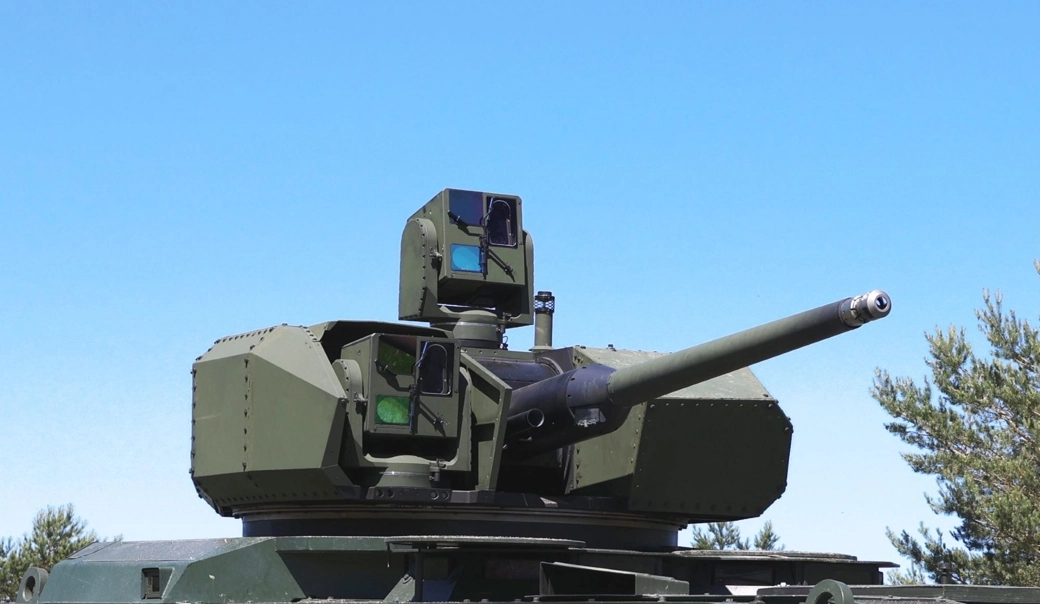
SAN CUAS is built on Kongsberg’s Protector family of weapon systems: the Medium Caliber Turret 30 (MCT30) and Protector remote weapon stations (RWS). Each battery combines effectors in a layered architecture, including 35mm, 30mm, and 12.7mm guns, missiles, and interceptor drones. Kongsberg has specified 70mm guided missiles as the primary RWS weapon, a lower-cost option against small and medium drones that would otherwise consume far more expensive surface-to-air interceptors. Publicly available specifications indicate the MCT30 is an unmanned turret mounting a 30x173mm chain gun with programmable airburst ammunition, which gives batteries a high-volume gun layer against swarms at short range.
Command and control comes from Advanced Protection Systems (APS), a Gdynia-based PGZ subcontractor whose architecture links sensors and effectors and integrates SAN with Poland’s national air defense network. Polish officials have described the full program as 18 batteries, 52 firing platoons, 18 command platoons, and 703 vehicles, roughly 400 of them based on the Jelcz truck platform and about 300 on the Legwan light vehicle. First component deliveries are scheduled for 2026, with the bulk of fielding expected in 2027. SAN sits alongside the Narew short-range air defense program, which relies on Common Anti-air Modular Missiles (CAMM), giving Poland a distinct counter-drone tier below its missile-based layers.
Analysis: The plant matters less as an employment story than as a throughput and sustainment story. Counter-drone systems are consumption-heavy: barrels wear, guided rockets and interceptors are expended, and turrets and sensors need recurring depot work. Placing repair and production inside Poland shortens the support chain for a front-line NATO state that would absorb the first waves of any drone campaign, and gives Kongsberg a Protector production base on the eastern flank, complementing its missile investments in Virginia and Australia. If the site serves other European buyers, as Kongsberg intends, it could anchor regional Protector CUAS demand, which is already expanding through orders such as Protector RS4 counter-drone stations for the Netherlands.
The next milestone is the construction contract, due before the end of 2026. Site selection, the investment figure, workforce targets, and the plant’s production scope remain the key unknowns, as does whether 70mm missile integration or interceptor drone assembly will be localized. How quickly the facility comes online relative to SAN deliveries will determine whether early batteries are sustained from Norway in the interim.