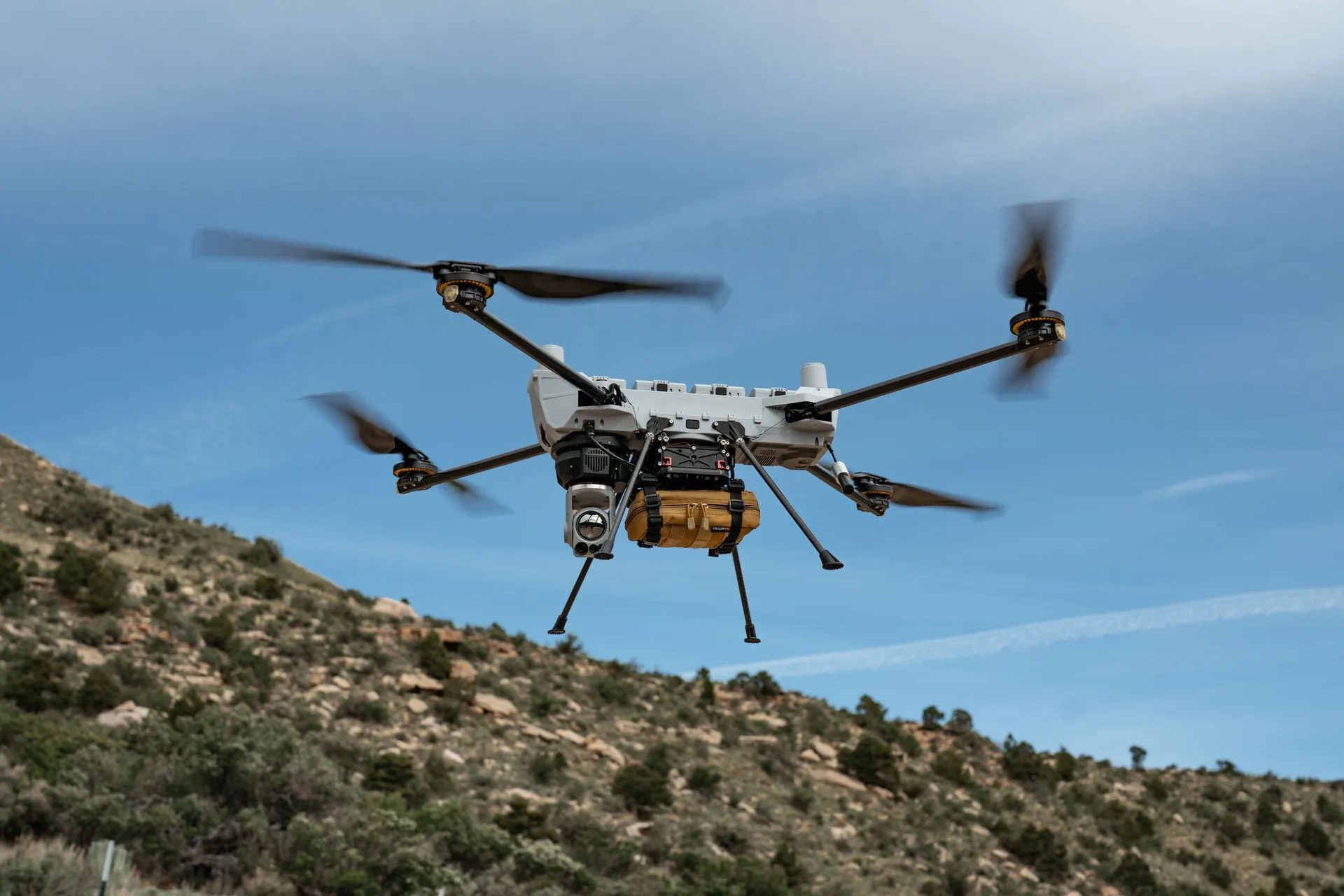
Huntsville, Alabama-based Performance Drone Works (PDW) and Revenant Technologies have signed a memorandum of understanding (MOU) to identify, evaluate and accelerate the U.S. integration and production of selected battle-proven Ukrainian defense technologies, the companies announced in Washington, D.C., on October 12, 2026. The non-binding framework, unveiled on the opening day of the Association of the United States Army (AUSA) 2026 annual meeting, initially covers unmanned systems, counter-unmanned aircraft systems (C-UAS), electronic warfare (EW), sensors and mission-critical components.
The deal targets a gap exposed by more than four years of full-scale war in Ukraine: Ukrainian developers refine airframes, payloads and countermeasures on short frontline feedback cycles, while U.S. programs move through qualification pipelines built for slower threat evolution. PDW, which supplies its C100 quadcopter to the U.S. Army, is positioning itself as the domestic industrial node for that know-how, backed by a conditional loan commitment of up to $820 million from the Department of War’s Office of Strategic Capital (OSC), announced in July 2026.
How PDW and Revenant Will Move Ukrainian Defense Technology Stateside
The MOU splits the work along a clear seam. Revenant contributes capability validation and selection, its relationships with Ukrainian developers, U.S. customer engagement and warfighter integration. PDW contributes systems engineering, supply chain localization, product integration, testing and scalable U.S. production. Candidate opportunities may include complete systems as well as critical components, with development and production decisions driven by customer requirements and technical readiness. Neither company has named a Ukrainian partner, a specific system or a contract value under the agreement.
Revenant, owned and operated by U.S. veterans, describes its model as compliant U.S. market entry for foreign technology firms, followed by demonstrations, program integration and onshore manufacturing. It says it only partners with firms fielding technically mature, combat-proven systems. The agreement also feeds ARENA, Revenant’s force-on-force training environment, in which U.S. units face an adversary equipped with uncrewed systems and the tactics developed in combat. “Our warfighters get the fight they need before the fight that counts,” said Revenant chief executive Brendan Reilly.
PDW’s contribution rests on Drone Factory 01, its 90,000-square-foot plant in Huntsville, where engineering, flight testing, systems integration, production and fulfillment sit under one roof. The company reported about 350 full-time employees in August 2026 and has acquired Vanteon to expand its communications, radio-frequency and embedded-systems capability. “The best solution for the warfighter will not always originate inside our company or our borders,” said PDW chief executive James Slider.
Kurbas Thermal Cameras and the $820 Million OSC Component Push
The Revenant MOU is not PDW’s only Ukrainian move at AUSA. On the same day, PDW signed a separate non-binding MOU with The Fourth Law and Odd Systems, two firms founded in Kyiv in 2023 by entrepreneur Yaroslav Azhnyuk, covering U.S. development, qualification and potential production of the Kurbas thermal camera family. Odd Systems says Kurbas is the most widely used Ukrainian-made thermal camera on the front line, supplied to more than 200 drone manufacturers and flown on platforms ranging from Shahed interceptors to strike drones.
Initial work centers on a U.S.-compliant, export-ready configuration of the Kurbas 640 family. Subject to evaluation and definitive agreements, PDW would become the primary U.S. manufacturing partner for Kurbas cameras requiring domestic production, for its own aircraft and other U.S. customers. The partners also intend to explore U.S. production of the sensor itself through Project Foundation, launched October 9 to mass-produce uncooled long-wave infrared (LWIR) microbolometers in Europe and the United States. Headquartered in Eindhoven, Netherlands, Project Foundation plans initial output in 2027. “Ukraine taught us the hard way that you can’t build drones at scale on components someone else controls,” Azhnyuk said.
The thermal deal maps directly onto the OSC commitment, which PDW says will fund domestic production of propulsion, power and control, and vision systems for its own C100 and AM aircraft and for other U.S. drone builders. The OSC has tied the loan to Executive Order 14307, Unleashing American Drone Dominance. Uncooled thermal cores are a known chokepoint for drone makers that must avoid Chinese supply under federal procurement restrictions, so a qualified, U.S.-built sensor line would reach well beyond PDW’s own fleet.
Regulatory Gates and Open Questions Before Any Production Decision
Both agreements stop short of production commitments: specific technology partnerships, manufacturing commitments and other commercial activities remain subject to evaluation, applicable regulatory requirements and separate definitive agreements. The OSC loan itself remains conditional on definitive documentation and financial close, and its interest rate, maturity and accompanying private capital have not been disclosed.
Regulatory exposure runs in both directions. Ukrainian developers need Kyiv’s export authorization to transfer military technology and manufacturing data, a step outside PDW’s control. On the U.S. side, systems entering Army inventory must clear cybersecurity, supply chain and airworthiness qualification. PDW has been through that process: the Army selected the C100 alongside Anduril’s Ghost X in September 2024 for the Company-Level Small Uncrewed Aircraft System Directed Requirement, which informs the future Medium Range Reconnaissance (MRR) requirement. Publicly available specifications describe the man-packable Group 2 quadcopter as carrying payloads in the 10- to 15-pound range, with reported endurance of up to 74 minutes.
Analysis: The PDW announcements invert the flow that has defined U.S.-Ukraine defense ties since 2022. Rather than American hardware moving east, combat-validated Ukrainian designs would move west into a U.S. industrial base that lacks equivalent frontline iteration. For PDW, the logic is also commercial: a qualified component business earns revenue even when a rival airframe wins the order. The weak point is conversion. Non-binding trade-show MOUs carry no funding, and both deals depend on Army C-UAS, EW and reconnaissance requirements that Ukrainian-derived products can meet, and on Kyiv clearing the transfers.
The next markers are the first named Ukrainian partners and systems under the Revenant framework, definitive agreements on the Kurbas 640, and financial close of the OSC loan. PDW is briefing customers and partners throughout AUSA, which runs through October 14.