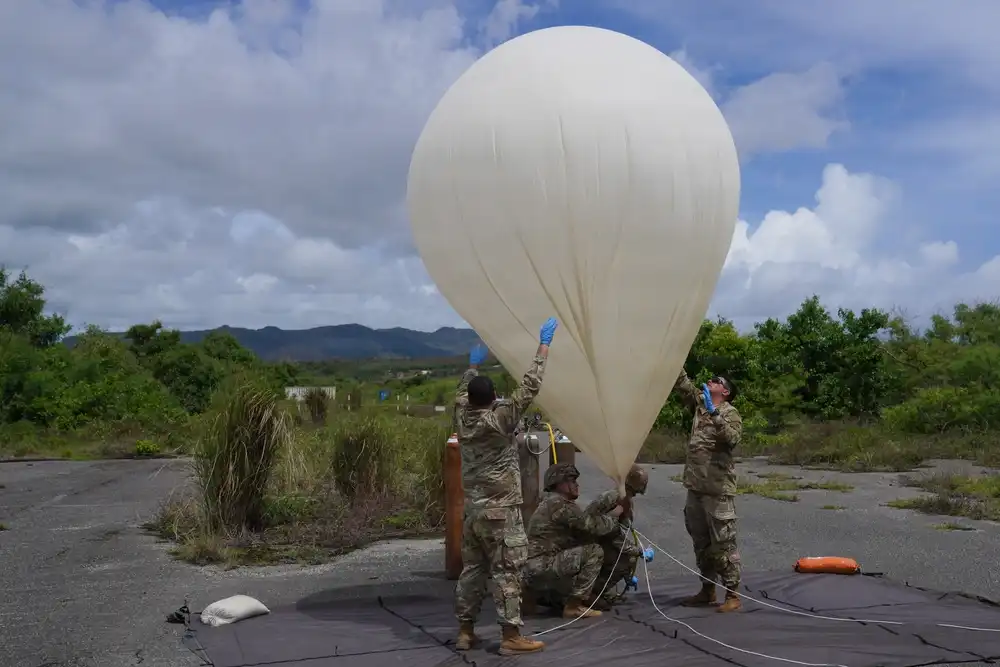
The US Army flew dozens of autonomous high-altitude balloons simultaneously in the Middle East to support US Central Command (CENTCOM) operations, after the service shelved a planned mass balloon demonstration over the Indo-Pacific. Andrew Evans, director of the Strategy & Transformation Office in the Army’s Deputy Chief of Staff for Intelligence (G-2), disclosed the deployment to Breaking Defense on October 12, 2026, at the Association of the United States Army (AUSA) annual meeting in Washington. He said the balloons accomplished their assigned missions but declined to say where they flew or what they did.
The redirect turned a controlled experiment into an operational test. In August 2025, Evans outlined plans to launch more than 100 stratospheric balloons over open water in the Indo-Pacific with the 3rd Multi-Domain Task Force. By November 2025 the concept had grown into a $3.5 million event called Swarming Worldwide Autonomous Reconnaissance in the Multi-domain System (SWARMS), with up to 200 balloons launched in waves and North American Aerospace Defense Command (NORAD) radars tracking the swarm. The plan excluded live intelligence collection and dissemination. CENTCOM offered no such buffer: the command opened Operation Epic Fury against Iran on February 28, 2026, and was still conducting strike waves in July. Evans did not link the balloons to that campaign.
How Army Balloon Swarms Moved From the Indo-Pacific to CENTCOM
Evans said the service was “asked to pivot and do some experimentation in combination with operations.” Instead of one massed launch over the Pacific, the Army fielded smaller swarms inside the CENTCOM area of responsibility.
The jump in scale matters more than the raw count. Earlier Army balloon trials, including launches by the 3rd Multi-Domain Task Force from Antonio B. Won Pat International Airport in Guam on June 10, 2024, typically put one or two balloons aloft at a time. Running dozens concurrently forces a unit to manage launch cycles, tracking, recovery, and data links as a fleet rather than as individual sorties.
The Army has not disclosed balloon numbers, vendors, altitudes, or payloads, but the envelope it is pursuing is public: the stratospheric band between roughly 60,000 and 100,000 feet, above most crewed aviation and well below orbit. Publicly available descriptions of steerable stratospheric balloons indicate little or no propulsion; they hold position by changing altitude to ride favorable wind layers, trading maneuverability for endurance measured in days or weeks.
In November 2025, Evans framed the 2026 effort as “operationalizing the stratosphere for a phase one-type conflict,” meaning dispersed, attritable swarms launched at the outset of hostilities or after a sudden crisis.
Storage, Contractors, and Airspace: Three Limits Exposed in CENTCOM
Evans identified three friction points from the deployment, none of them tied to the balloons’ performance in flight.
The first was logistics. Transporting the systems into the Middle East and storing them proved difficult, with temperature sensitivity a specific obstacle. The burden grows with every additional balloon a unit must stage for repeated launches from austere sites.
The second was manpower. Industry personnel supported the deployment, and the Army now has to decide which launch, flight management, and maintenance tasks soldiers should own. The service has started building that bench with a High-Altitude Basic Course at Joint Base Lewis-McChord, Washington, which trains soldiers on 16-gore balloons built by Urban Sky.
The third was airspace. Integrating many autonomous balloons into a region dense with coalition and civilian air traffic demanded extra coordination during launch and transit. The SWARMS plan had anticipated part of this problem by bringing in NORAD radars, both to track the balloons and to show how an adversary swarm would appear to US sensors. In CENTCOM, that deconfliction had to happen alongside live coalition air operations rather than over empty ocean.
Project Wallabee and the Search for Lighter Stratospheric Sensors
The balloons are only as useful as what they carry, and payloads remain the weak link. In June 2026, the G-2 and the Joint Staff J-7’s Warfighter Laboratory Incentive Fund program tested Project Wallabee, which paired an Urban Sky high-altitude balloon with a small autonomous target recognition sensor from Applied Intuition. Evans said earlier Army-funded payloads were too heavy and power-hungry for the thin, cold air above 60,000 feet.
Other units are widening the payload menu. During African Lion 2026 off Morocco, an Army landing craft launched low-observable micro high-altitude balloons carrying a Mach Industries launched-effects and satellite communications package; according to the Army, the balloons released one-way attack munitions that struck their targets. On September 21, 2026, soldiers from the 3rd Multi-Domain Task Force launched a micro high-altitude balloon during Exercise Orient Shield 26 in Hokkaido, Japan.
Evans ties these efforts to a layered sensing architecture spanning ground, airborne, stratospheric, and space-based assets, arguing that a single layer invites concentrated countermeasures. The stratospheric layer also offers a hedge for ISR and communications relay if satellites are degraded or denied.
Analysis: The CENTCOM lessons point to sustainment and force structure, not the balloons themselves, as the binding constraint on stratospheric mass. The case for swarms rests on cost: cheap, attritable sensors that saturate an area faster than an adversary can find and defeat them. That math only holds if a small Army team can stage, launch, and deconflict dozens of balloons without climate-controlled storage, contractor crews, and bespoke airspace arrangements for every wave. Each of those dependencies adds cost and footprint, narrowing the advantage over a single long-endurance aircraft. The Army got the stress test SWARMS had deliberately postponed, and the results argue for doctrine, a soldier training pipeline, and theater airspace procedures before any large procurement.
The service has not picked a solution. Evans said Army leaders still want persistent high-altitude sensing but are weighing additional balloon systems against solar-powered high-altitude aircraft and other long-endurance platforms. The November 2025 plan envisioned a follow-on event in 2027 to tackle live intelligence collection and dissemination; whether it proceeds, and in which theater, has not been announced. Fleet size, vendors, payloads, mission duration, and endurance figures from the CENTCOM deployment also remain undisclosed.