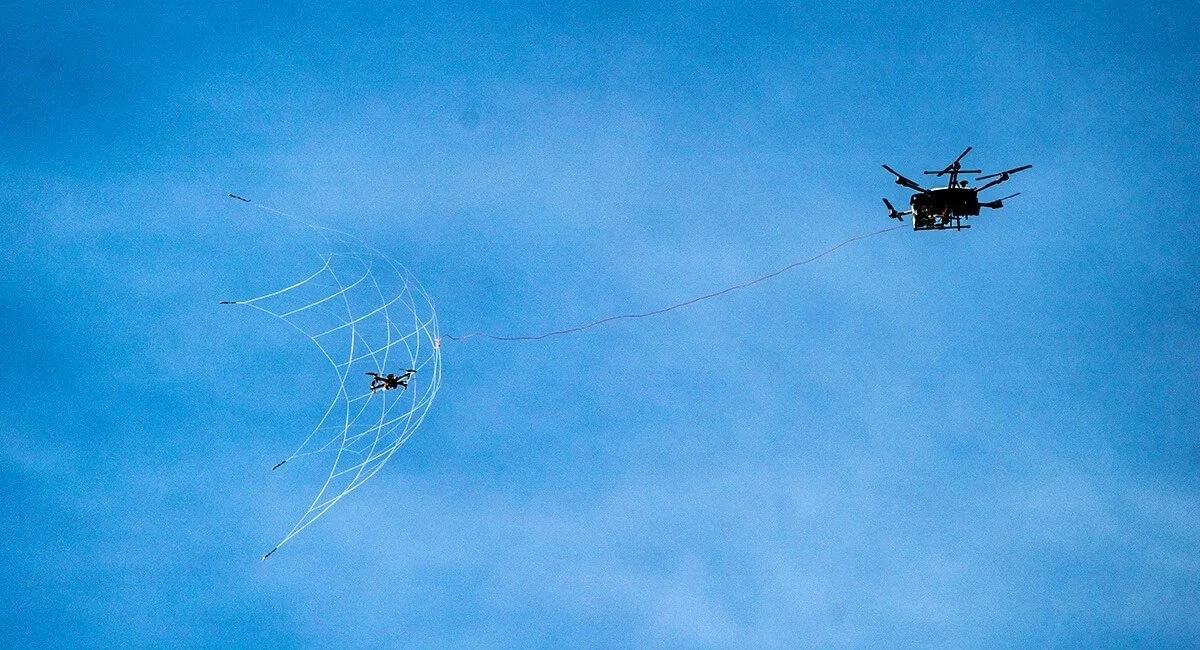
MBDA will now offer Fortem Technologies’ DroneHunter autonomous interceptors to its customers as an added layer within their existing air defense networks, under an expanded counter-uncrewed aircraft systems (C-UAS) partnership announced on October 12, 2026. The two companies will also jointly offer FireThorn, a co-developed autonomous interceptor armed with an MBDA warhead, which MBDA is displaying at booth 453 of the Association of the United States Army (AUSA) Annual Meeting and Exposition in Washington, D.C.
The agreement turns a 2024 technical collaboration into a commercial offer: that year, the Utah-based company’s DroneHunter was integrated into the C-UAS architecture of MBDA’s SKY WARDEN ground-based air defense system. It arrives as Russia’s mass use of Shahed-type one-way attack drones against Ukraine pushes interceptor drones into allied inventories. Ukrainian officials reported more than 2,500 jet-powered Shahed launches in August 2026 alone. Fortem also secured $25 million from Lockheed Martin on April 22, 2026, to at least double production in Lindon, Utah.
How MBDA Will Offer Fortem DroneHunter Within Existing Air Defense Networks
SKY WARDEN, which MBDA launched at the IDEX exhibition in Abu Dhabi in February 2021, centers on a command and control (C2) core that manages a networked set of sensors, soft-kill effectors, and hard-kill effectors. It addresses threats from Class 1 micro-drones to large tactical uncrewed aircraft, mounted or dismounted, standalone or within a layered air defense architecture. Its modular open architecture accepts new effectors as they mature, which is how DroneHunter entered it in 2024. Under the new agreement, MBDA moves from integrator to supplier, selling DroneHunter on top of the networks customers already operate.
DroneHunter F700 is a radar-guided multirotor interceptor. Fortem’s published specifications list a takeoff weight of 18 kg (40 lb) including battery, net guns, and radar, and a maximum speed of 25 m/s (56 mph) in attack and pursue modes. Ground-based TrueView radars and SkyDome Manager C2 software cue the interceptor, after which its onboard TrueView R20 radar handles terminal seeking. Defeat comes from a NetGun firing either a tethered net, letting DroneHunter tow the captured drone to a drop zone for forensic exploitation, or a net with a drogue parachute.
In attack mode, the F700 chases and captures a slower drone; against faster targets it switches to defense mode, positioning itself ahead of the inbound track rather than pursuing it. Publicly available data put the Shahed-136 cruise speed at roughly 185 km/h, about twice DroneHunter’s top speed, so net capture of a Shahed depends on geometry and early cueing rather than pursuit. Against jet-powered Geran variants, the net layer is not a realistic primary effector.
FireThorn Adds a Hard-Kill Layer With an MBDA Warhead
MBDA describes FireThorn as a fully autonomous interceptor designed to defeat one-way attack drones and other hostile uncrewed aircraft, explicitly naming the Iranian-designed Shahed, produced in Russia as the Geran, and the Russian Orlan reconnaissance drone. The design marries Fortem’s high-speed, radar-guided autonomous airframe with an MBDA warhead that the company states is NATO-approved, delivering kinetic rather than capture-based defeat.
Fortem first introduced FireThorn as a ground-launched, low-altitude defense munition and said in February 2025 that it had designed, built, and fielded the system in under six months. The MBDA link predates that announcement: at the Farnborough International Airshow in July 2024, MBDA displayed a Fortem quadcopter carrying an MBDA anti-air munition with a warhead weighing less than 3 kg. Neither company has confirmed that FireThorn uses that warhead.
MBDA and Fortem have not published FireThorn’s maximum speed, engagement range, endurance, warhead mass, fuzing method, launcher configuration, or unit cost. Those figures will determine whether FireThorn can reliably catch jet-powered Gerans, which fly substantially faster than the piston-engined Shahed-136. The NATO-approved warhead does remove one slow step, energetics qualification, between prototype and approved inventory item.
Hard-Kill and Net Capture: Matching C-UAS Effectors to Threat Density
MBDA frames the two interceptors as complementary: FireThorn as the hard-kill effector for high-threat engagements, DroneHunter as the low-collateral option for high-density environments such as bases, airports, and urban critical infrastructure, where fragmentation over friendly forces or civilians is unacceptable. A SKY WARDEN C2 node would assign effectors by target speed, classification, and what lies beneath the intercept point.
The model also addresses cost exchange. Missile-based short-range air defense, including MBDA’s own Mistral and VL MICA families, remains essential against cruise missiles and crewed aircraft, but firing them at drones costing tens of thousands of dollars is unsustainable against salvo-scale raids. Drone interceptors let operators reserve missiles for targets that justify them.
Fortem now sits inside two major Western C-UAS ecosystems. Lockheed Martin’s April investment ties its technology into the Sanctum counter-UAS suite in the United States, while the MBDA agreement positions it within European air defense networks. Jon Gruen, Fortem’s chief executive, said:
“Working with MBDA puts Fortem’s systems inside one of Europe’s most established air defence ecosystems, and gives allied forces a faster route to protecting troops, bases, and critical infrastructure.”
Analysis: By reselling DroneHunter rather than fielding its own net interceptor, MBDA, Europe’s largest missile manufacturer, is building a tiered counter-drone portfolio through partnership as much as in-house development. Its own 53 kg Counter Mass Interceptor, unveiled at Farnborough in July 2026, targets drones, helicopters, and cruise missiles; FireThorn and DroneHunter now fill the cheaper tiers beneath it. MBDA keeps the C2 and the warhead, where its pedigree carries most weight, and sources a mature airframe from a specialist. For allied forces, the gain is a single integrator offering effectors scaled to the threat. The open question is industrial: whether a US-designed airframe with European warhead content satisfies European buyers who increasingly favor sovereign supply chains.
MBDA has not named a customer for DroneHunter or FireThorn under the expanded agreement, nor said whether FireThorn will be integrated into SKY WARDEN as a native effector or offered alongside it. Production rates, pricing, and live-fire results against jet-powered Shahed variants remain undisclosed. Fortem’s Utah capacity expansion will determine how quickly either interceptor ships at the volumes the threat demands.