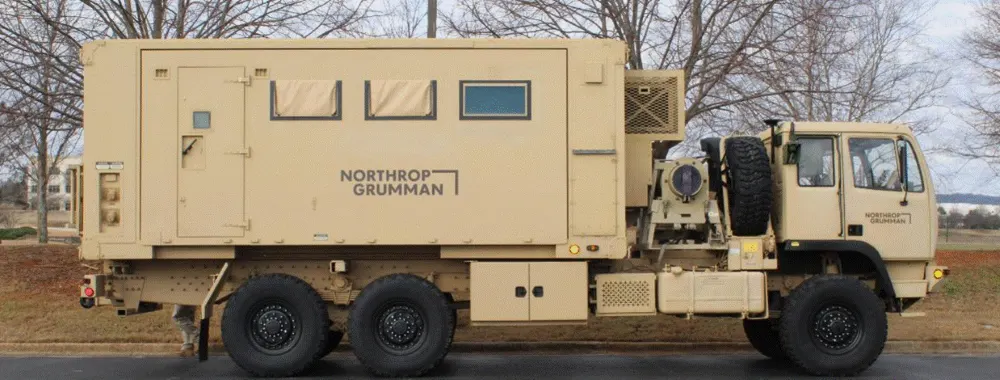
The U.S. Army has selected Northrop Grumman to build a new variant of the Integrated Battle Command System (IBCS) Integrated Collaborative Environment (ICE) that replaces the system’s tent-based workspace with a protected, expandable van, the company announced on October 13, 2026. Under the $21 million effort, Northrop Grumman will deliver two manufacturing prototypes to the Army by June 2027.
The award lands as the Army pushes its air and missile defense command-and-control backbone toward a smaller, more mobile footprint. IBCS entered full-rate production in spring 2023, and the service has since asked industry for approaches that make the architecture smaller, more agile, and harder to detect. The ICE is where battalion and battery staffs plan and fight the air defense battle, and it is the only major IBCS end item still built around a tent.
IBCS Expandable Van Replaces the Air Beam Tent Workspace
The current ICE pairs an air beam tent with an Environmental Control Unit that supplies power generation and air conditioning, housing IBCS servers and operator workstations. Publicly available descriptions characterize the ICE as a modular, electromagnetic interference-protected system carried on a Heavy Expanded Mobility Tactical Truck (HEMTT). Northrop Grumman delivered the first production ICE to the Army on December 19, 2023, and the service had accepted 13 units by June 2024.
The new configuration swaps the tent for an expandable van whose sides deploy outward from the shelter body once emplaced, enlarging the interior. Northrop Grumman states the design supports six operator workstations and four staff operation stations, giving a battery or battalion staff ten positions inside a single protected enclosure. Imagery released with the announcement shows the prototype shelter mounted on a 6×6 tactical truck.
A tent offers no protection to the crews working inside it and must be erected, environmentally conditioned, and struck before a unit can displace. An expandable van keeps workstations and servers installed and cabled in transit, which should compress setup and teardown timelines and let the command node move with the batteries it controls. The company has not disclosed setup times, van dimensions, weight, protection level, or the designation of the prime mover; none of those parameters appear in the announcement.
How the ICE Fits Into the IBCS Engagement Architecture
An IBCS set comprises three major end items. The Engagement Operations Center (EOC), designated S-280 by the Army and mounted on an M1085 long wheelbase truck from the Family of Medium Tactical Vehicles, hosts the battle management software, communications, and computing power. The Integrated Fire Control Network (IFCN) relay forms the communications mesh and links the sensors and effectors connected to the network. The ICE provides the collaborative workspace where operators and staff execute planning and defensive operations.
That architecture underpins the “any sensor, best shooter” concept: IBCS fuses tracks from multiple radars into a single fire-control-quality picture and assigns engagements to the most suitable interceptor, regardless of which system detected the threat. In Army live-fire testing, IBCS has paired Patriot launchers with the Lower Tier Air and Missile Defense Sensor (LTAMDS), replacing the platform-centric battery model in which each weapon system relies on its own radar and fire control.
The van program sits inside a broader effort to shrink IBCS. Northrop Grumman bought three Infantry Squad Vehicles from GM Defense at the end of 2025 to host an internally funded expeditionary IBCS variant built around sled-mounted servers. The company also cites automation to support decision-making and modernized software to accelerate capability updates, and says it has committed more than $10 million in internal investment and cost-sharing to reduce integration risk. Kenn Todorov, vice president and general manager for command and control and weapons integration at Northrop Grumman, said the investments are turning IBCS into “an ever-more capable combat multiplier for the warfighter.”
IBCS Production Ramp and the Polish Wisła Benchmark
The prototype award arrives as IBCS output scales. The Army awarded Northrop Grumman a $1.4 billion production contract in December 2021, approved full-rate production in spring 2023, and placed a $145 million fiscal year 2024 full-rate production order. The company’s Enhanced Production and Integration Center (EPIC) in Madison, Alabama, offers 175,500 square feet of covered production space sized for 96 EOCs, 96 ICEs, and 192 IFCN relays per year.
Poland remains the reference international customer. Warsaw’s Ministry of National Defense declared Full Operational Capability for its IBCS-enabled Wisła medium-range air defense system in December 2025, covering two Patriot batteries and making Poland the first U.S. NATO ally to fully operationalize the system. Wisła is set to expand to eight batteries, and a foreign military sale approved in September 2023 covers 93 EOCs and 175 IFCN relays for Wisła Phase II. More than 20 countries have formally expressed interest in IBCS. Whether the van variant will be offered to Poland or other export customers has not been announced.
Analysis: The van matters less as hardware than as a signal of where the Army sees IBCS vulnerability. In an “any sensor, best shooter” network, sensors and launchers can be dispersed and swapped, but the staff fighting the battle must physically sit somewhere, and that node is the hardest element to route around. The war in Ukraine has shown that static command posts with large thermal and electromagnetic signatures draw long-range fires and drone strikes. A protected shelter that emplaces and displaces quickly addresses that exposure for expeditionary and homeland defense units alike. At $21 million for two prototypes, however, this is a risk-reduction step rather than a fielding decision; the real indicator will be whether the Army funds a transition of its tent-based ICE fleet.
Northrop Grumman must deliver both manufacturing prototypes by June 2027, after which Army evaluation will determine whether the expandable van moves toward production. Key unknowns remain the procurement quantity, the unit cost relative to the tent-based ICE, and whether the Army will retrofit fielded battalions or introduce the van only in new production lots.