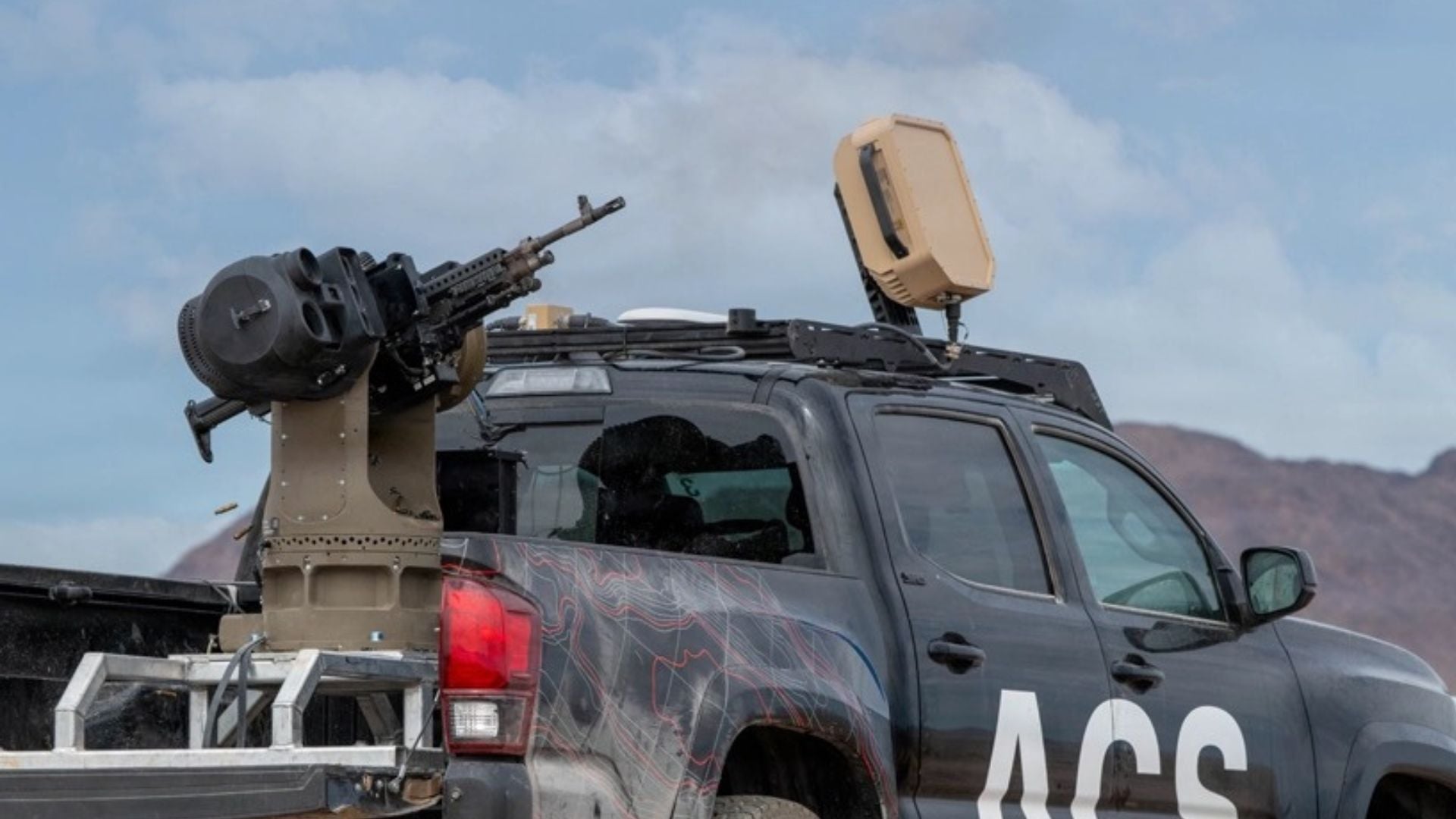
Echodyne and Allen Control Systems (ACS) signed a Strategic Collaboration Agreement on October 12, 2026, to integrate Echodyne’s EchoShield radar with ACS’s Bullfrog autonomous weapon station and jointly develop, demonstrate, and field counter-unmanned aircraft system (C-UAS) solutions for US and allied land and maritime forces. The companies said the initial integration is complete and will now move into further testing and Department of War (DoW) demonstration events.
The agreement follows a September 2026 round of awards from Joint Interagency Task Force 401 (JIATF-401), which established multiple-award indefinite-delivery/indefinite-quantity (IDIQ) contracts with 10 suppliers to support Domestic Shield, the DoW effort to protect risk-prioritized facilities and assets inside the United States, and the JIATF-401 C-UAS Marketplace. ACS received a $500 million base IDIQ award and Echodyne a $250 million base award with an ordering period of up to 36 months. Both figures are contract ceilings, not obligated funding, and neither company disclosed financial terms for the new collaboration.
Echodyne and ACS Integrate EchoShield Radar Into Bullfrog Fire Control
Bullfrog pairs computer vision, autonomous control, and precision robotics with existing weapons, most prominently the M240 7.62x51mm machine gun, to detect, track, identify, and engage drones. Feeding EchoShield track data into the station adds persistent positional awareness of the surrounding airspace, allowing Bullfrog to orient its sensors earlier, hold custody of maneuvering targets, and build firing solutions with more decision time. “Counter-UAS effectiveness begins with data quality,” said Echodyne chief executive Eben Frankenberg.
EchoShield is built on Echodyne’s patented Metamaterials Electronically Scanned Array (MESA) architecture. Company-published specifications describe a medium-range, software-defined pulse-Doppler radar operating in the Ku-band between 15.4 and 16.6 GHz, with a 130-degree azimuth by 90-degree elevation field of view, track accuracy better than 0.5 degrees in both axes, a 10 Hz update rate, and capacity for more than 1,000 simultaneous tracks. The unit measures roughly 43 by 33 by 19 centimeters, weighs 17.8 to 19.2 kilograms depending on datasheet version, and draws under 250 W in operation. Instrumented range is listed at 30 kilometers; practical drone tracking ranges depend on target size and were not specified.
Those parameters matter for a gun-based effector. A 10 Hz track refresh and sub-degree angular accuracy shrink the volume the electro-optical system must search before handing off to fire control. EchoShield is a commercial-off-the-shelf product built with commercial materials and supply chains, and its open interfaces push track data directly into Bullfrog and broader command-and-control (C2) networks.
Uncrewed Surface Vessels and On-the-Move Defense Shape the Roadmap
The companies named maritime operations as a priority. Bullfrog’s compact architecture allows installation on crewed and uncrewed platforms, and EchoShield is increasingly fitted to uncrewed surface vessels for maritime awareness and C-UAS tasks, where low power draw and on-the-move performance are prerequisites. The combined package is presented as a sensor-to-effector chain for distributed naval forces and coastal infrastructure, tracking both aerial and surface contacts.
ACS co-founder and chief executive Mike Wior said the partnership also enables on-the-move defense for troops while they maneuver. That aligns with the US Marine Corps’ July 2026 selection of Bullfrog for integration into the Light Marine Air Defense Integrated System (L-MADIS) under its Ground Based Air Defense program, through a prototype Other Transaction Agreement. ACS states Bullfrog is already deployed with the US Army and Navy, and the company closed a $200 million Series B at a $2.2 billion post-money valuation in May 2026 to expand production.
Analysis: The agreement targets the cost-exchange problem at the center of counter-drone planning. Pairing a commercially produced radar with standard-issue weapons and ammunition offers deep magazines and low cost per engagement compared with missile interceptors, which remain scarce and expensive against small drones. For gun-based defeat, the limiting factor has been track quality and engagement time rather than the weapon itself. If radar cueing measurably widens the engagement window, this class of system becomes a credible inner layer for Domestic Shield sites and maneuver units. The open question is reach: neither company has published an engagement envelope or probability-of-kill data for the combined system.
Echodyne and ACS will continue integrated testing and take part in DoW demonstration events under representative operational conditions. Results from those trials, task orders placed against the two JIATF-401 vehicles, and progress on the L-MADIS prototype will determine whether the pairing moves from demonstrator to fielded capability across fixed-site, mobile, expeditionary, and maritime missions.