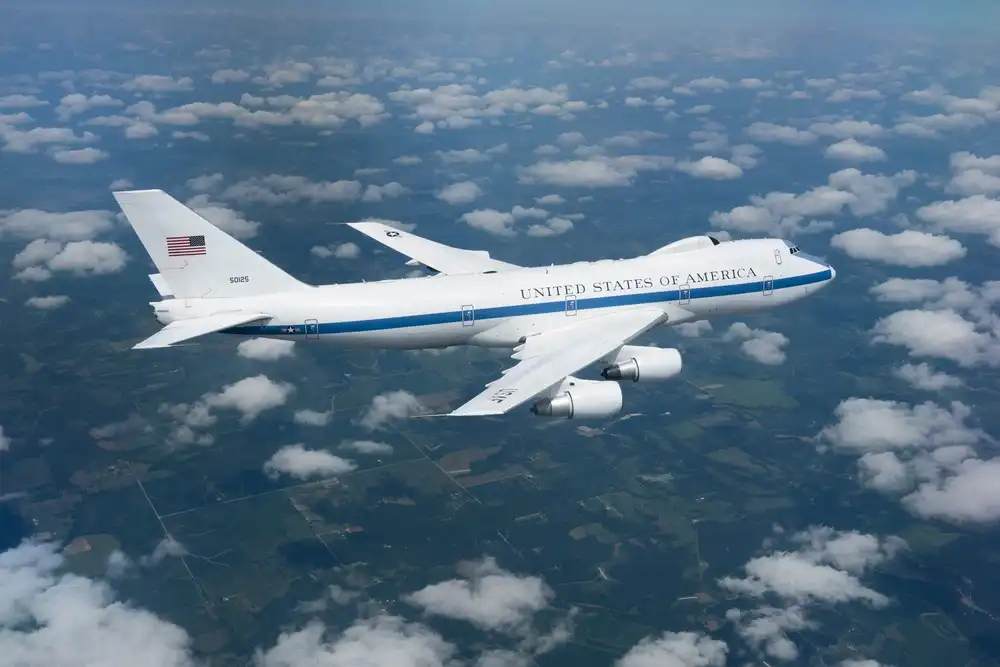
The Air Force Nuclear Weapons Center has awarded Raytheon an $8 billion maximum-ceiling contract to modernize, and restart production of, the Strategic Communications Terminals that connect national leadership to US nuclear forces. The sole-source, cost-plus-fixed-fee, indefinite-delivery/indefinite-quantity (IDIQ) contract, announced by the Department of War on October 13, 2026, covers terminal developmental modernization, production restart services and technical studies through October 12, 2036.
The award arrives as the Pentagon recapitalizes nearly every layer of its nuclear command, control and communications (NC3) architecture. On the space side, the Space Force selected Boeing in July 2025 for a $2.8 billion contract on the Evolved Strategic Satellite Communications (ESS) program, which will succeed the Advanced Extremely High Frequency (AEHF) constellation; the full ESS space segment is projected to reach $12 billion. Ground and airborne terminals must keep pace with that transition. The Air Force Nuclear Weapons Center (AFNWC) Strategic Communications Division at Hanscom Air Force Base, Massachusetts, already manages Raytheon’s AEHF terminal IDIQ, whose ceiling rose to $2.97 billion in March 2026.
What the $8 Billion Strategic Communications Terminals Contract Covers
Work will be performed at Raytheon facilities in Marlborough, Massachusetts, and Largo, Florida, the same two sites that have built the Air Force’s protected satellite communications terminals for more than a decade. AFNWC obligated $800,000 in fiscal 2026 research, development, test and evaluation funds at award, roughly 0.01% of the ceiling. As with any IDIQ vehicle, the $8 billion figure is spending authority for future task orders, not committed money. The cost-plus-fixed-fee structure indicates the government expects meaningful development risk in at least part of the work.
The announcement for contract FA2293-27-D-B001 does not identify which terminal families are covered, nor quantities, host platforms or the production line to be restarted. Those details have not been released. Three Raytheon programs managed by AFNWC are the most likely candidates:
- FAB-T Command Post Terminals (CPT): 84 airborne and ground terminals for the E-4B and E-6B fleets and for fixed and transportable command posts. By the end of 2022, 78 had been delivered and the program filed its final Selected Acquisition Report with deliveries above 90%.
- FAB-T Force Element Terminals (FET): nuclear-hardened airborne terminals for the B-52 and RC-135, placed on a $625 million sole-source production contract in June 2023.
- Global Aircrew Strategic Network Terminal (Global ASNT): a ground alerting system for bomber, tanker and reconnaissance wing command posts, with 90 fixed and transportable terminals scheduled for fielding by the end of 2023 under contracts worth about $600 million, including spares and support equipment.
FAB-T and Global ASNT: Terminal Capabilities Behind Nuclear C3
The Family of Advanced Beyond Line-of-Sight Terminals (FAB-T) provides survivable extremely high frequency (EHF) satellite links for strategic nuclear and non-nuclear command and control, operating with both legacy Milstar and AEHF satellites. The CPT integrates Presidential and National Voice Conferencing (PNVC) equipment, and FAB-T users include the president, the secretary of defense and combatant commanders. The CPT replaces Milstar-era terminals on the E-4B and E-6B and at fixed and transportable command posts, while the FET brings the same AEHF connectivity to bomber and reconnaissance aircraft.
Global ASNT serves a different link in the chain, delivering Emergency Action Messages to nuclear aircrews. It combines AEHF, very low frequency, low frequency and UHF alerting paths over multiple redundant pathways, in terminals hardened against high-altitude electromagnetic pulse and designed to keep operating through power failures and other disruptions.
The program history carries a warning. Boeing held the original FAB-T prime contract but struggled to mature its design, and the Air Force shifted CPT production to Raytheon in 2014. A February 2023 report to Congress from the Space Force’s senior acquisition executive still described FAB-T as more than a decade behind its original schedule. Restarting production on lines that had largely delivered their planned quantities will test whether those lessons hold, particularly for requalifying nuclear-hardened components.
Analysis: The contract formalizes Raytheon’s position as the near-exclusive supplier of US strategic satellite terminals. The company holds FAB-T, Global ASNT and the AEHF terminal IDIQ and, on the Navy side, builds the Navy Multiband Terminal. That concentration gives the government continuity on certified hardware, but it leaves AFNWC with limited cost leverage on a cost-plus vehicle running to 2036. The pairing of developmental modernization with production restart is the most telling element: it suggests the Air Force needs both new terminal baselines, likely tied to the ESS transition, and additional units from lines it had treated as complete. That reading is an assessment; the service has not confirmed it.
The first task orders will reveal the scope the announcement leaves blank. Key unknowns include terminal quantities, whether orders extend to the Survivable Airborne Operations Center replacing the E-4B and the Navy’s E-130J successor to the E-6B, and how terminal upgrades will be synchronized with the ESS launch schedule. Final fiscal 2027 appropriations will indicate how quickly AFNWC intends to draw on the $8 billion ceiling.