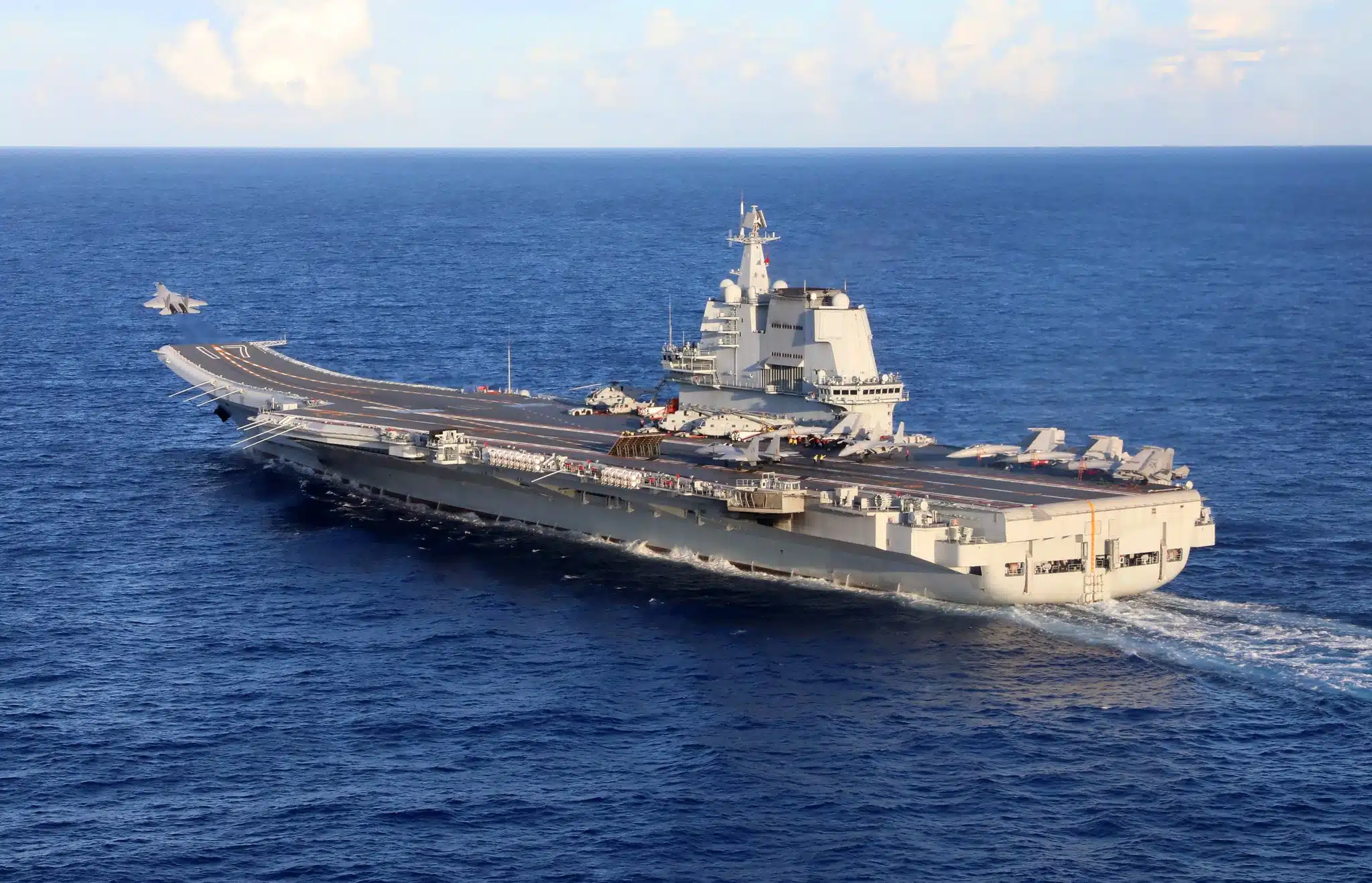
The People’s Liberation Army Navy (PLAN) sent the aircraft carrier Liaoning and its task group into the western Pacific on October 14, 2026, for training it described as part of its annual routine plan. The service said the drills aim to test and improve combat readiness, comply with international law and practice, and are “not directed at any specific country or target.” Beijing disclosed neither the operating area, the escort composition, nor the expected duration.
The sortie is the Liaoning’s second western Pacific deployment of 2026, about four months after the carrier returned to its Qingdao homeport on June 22. It lands in a dense week. Chinese maritime authorities have closed five zones across the Bohai Sea, Yellow Sea, East China Sea, and South China Sea for exercises and live fire from October 12 to 17, following Taiwanese President Lai Ching-te’s National Day address on October 10. Beijing has linked neither activity to the speech. On October 19, Japan and the United States open Keen Sword 27, an expanded bilateral exercise reaching into the southwestern island chain near Taiwan.
Liaoning Carrier Group Returns to the Western Pacific After Four Months
The spring cruise sets the baseline. The Liaoning entered the western Pacific on May 19 with, according to Japan’s Joint Staff Office, the Type 055 cruiser Wuxi (104), the Type 052D destroyer Kaifeng (124), the Type 054B frigate Luohe (545), and the Type 901 fast combat support ship Hulunhu (901). Japanese tracking placed the group in the Philippine Sea east of Luzon, where it logged about 170 fixed-wing and helicopter takeoffs and landings between May 26 and 28. Chinese state media said the cruise included live-fire, air defense, anti-ship, and long-range rescue drills.
The PLAN cited more than 40 days of far-sea training across the South China Sea and western Pacific, with the group returning to Qingdao on June 22. In June 2025, the Liaoning trained alongside the carrier Shandong for about 20 days.
Friction with Japan has followed recent sorties. In December 2025, J-15 fighters from the Liaoning twice illuminated Japan Air Self-Defense Force F-15s with radar over international waters southeast of Okinawa. In June 2026, Beijing accused Japanese ships and aircraft of harassment through close-range tracking and surveillance of the carrier group.
J-15 Air Wing and STOBAR Limits Define the Liaoning’s Reach
The Liaoning is the former Soviet Varyag, a Kuznetsov-class (Project 1143.6) hull bought incomplete from Ukraine in 1998 and commissioned on September 25, 2012. Publicly available specifications indicate a length of about 305 meters, a full-load displacement near 60,000 tonnes, and steam turbines driving four shafts to roughly 30 knots. Aircraft launch from a 14-degree ski-jump and recover on arresting wires, a short takeoff but arrested recovery (STOBAR) layout.
The air wing centers on the Shenyang J-15, a twin-engine fighter derived from the Sukhoi Su-33, with open-source estimates putting the complement at up to 24 aircraft. Z-18 helicopters cover anti-submarine warfare, search and rescue, and airborne early warning. Self-defense rests on HHQ-10 short-range surface-to-air missiles and Type 1130 30mm close-in weapon systems, cued by a Type 346 active electronically scanned array radar.
Those figures carry operational weight. The ski-jump caps takeoff weight, forcing J-15 crews to trade fuel against ordnance, and helicopter early warning offers a far shorter detection horizon than the fixed-wing KJ-600 the catapult-equipped Fujian is designed to operate. The Liaoning’s value lies less in strike power than in sustained flight operations, escort integration, and routine presence beyond the first island chain.
Keen Sword 27 Brings Anti-Ship Missiles to Islands Near Taiwan
The Liaoning’s time at sea is likely to overlap with Keen Sword 27, scheduled from October 19 to 29. Japan’s Joint Staff Office lists about 45,000 Self-Defense Forces personnel, 6,100 vehicles, 40 vessels, and 260 aircraft, up from about 33,000 personnel in 2024. Around 12,000 US troops are reportedly expected, bringing the total near 57,000. Admiral Tateki Tawara of the JSDF Joint Operations Command and Admiral Stephen Koehler of US Pacific Fleet will direct the exercise.
Allied forces will rehearse moving anti-ship missiles, air defenses, and communications networks onto islands near Taiwan. The US Marine Corps is bringing its Navy-Marine Expeditionary Ship Interdiction System (NMESIS) to Yonaguni, about 110 kilometers from Taiwan; the system fires the Naval Strike Missile, with a publicly cited range near 185 kilometers. Australia, Canada, France, Germany, the Netherlands, New Zealand, and the Philippines are listed as participants.
Analysis: The Liaoning cannot contest a US carrier strike group on equal terms, but the pattern matters more than the platform. Two Pacific sorties in five months, the latest coinciding with coastal live fire and a major allied exercise, normalize PLAN carrier presence in the western Pacific. Keen Sword 27 rehearses the counter: dispersed missile units along the Ryukyu chain holding PLAN surface groups at risk as they move between the East China Sea and the Pacific. A carrier operating beyond that chain during the exercise gives Beijing a look at allied emitters and dispositions, and pulls Japanese destroyers and patrol aircraft into shadowing duty at a busy moment.
The next indicators will come from Japan’s Joint Staff Office releases on escort composition, transit route, and flight tempo. Also worth watching: whether the Shandong or Fujian sails concurrently, whether the Liaoning stays at sea through the October 29 close of Keen Sword, and whether the close-range encounters of the past year recur.