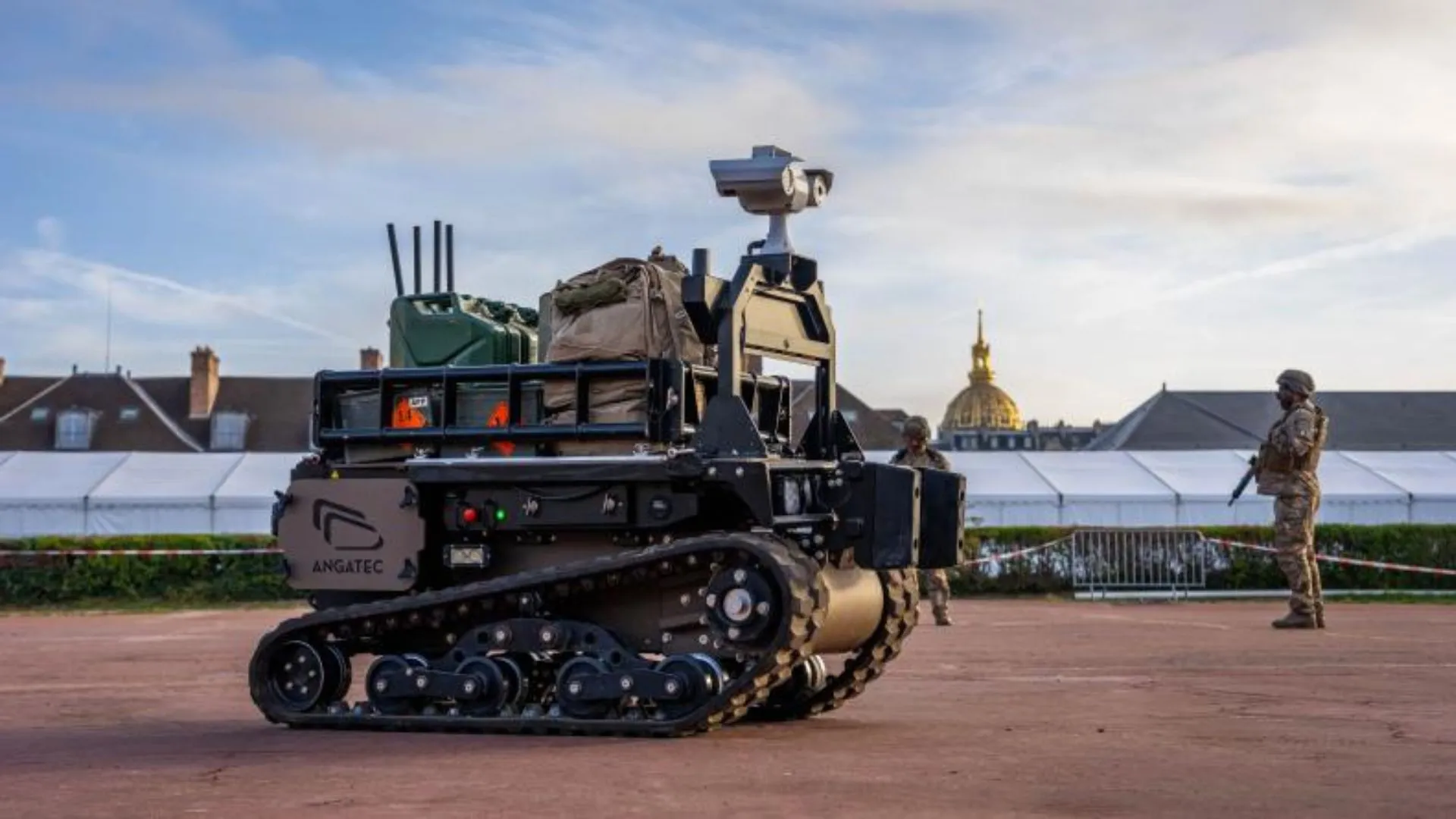
The French Army opened its annual Army Presentation (Présentation de l’armée de Terre, PAT) at the École Militaire in Paris on October 14, 2026, under a single theme: the division in combat. Organized by the Future Combat Command (Commandement du Combat Futur, CCF) and running through October 15, the event laid out how a French division is expected to absorb an initial shock, sustain a prolonged engagement, adapt, and win in high-intensity warfare.
The theme tracks the Army’s central readiness target: a combat-ready division, deployable within 30 days in 2027, followed by a corps-level headquarters fully able to command in coalition by 2030. The first step was reached in 2025 with a combat-ready brigade of 8,000 soldiers, and 2026 has been dedicated to building up the fires and logistics that turn brigades into a division. General Jacques de Montgros, who became Army Chief of Staff (CEMAT) on July 26, 2026, after leading the Directorate of Military Intelligence (DRM), opened the event.
French Army Division 2027: Two Brigades, Fires, and Logistics
The Army defines the division as the command echelon that directs several brigades and coordinates their support and sustainment assets, synchronizing their effects to keep the maneuver coherent, often within a multinational framework. In its 2027 configuration, the division brings together a command post, combat support, and combat service support around two brigades, a force cited in French parliamentary debate at about 19,000 troops.
That structure underpins France’s ambition to serve as a framework nation, commanding a multinational force in high-intensity combat. The ambition is concrete in 2026: on July 1, France took command of the land and logistics components of NATO’s Allied Reaction Force for one year, with the 3rd Division headquarters leading the land component. In 2025, the 1st Division deployed about 1,050 personnel to Mailly-le-Camp for Warfighter 25, a US-led command post exercise focused on interoperability with allied partners.
The PAT translated the concept into a walk-through. A static display traced each phase of a divisional deployment, from the assembly of forces to deep operations. New this year, a reconstructed trench parapet manned by soldiers in combat posture illustrated the realities of close combat. The CCF also screened an immersive film, shot during the ORION 2026 exercise, through 600 virtual reality headsets. ORION 26, the largest joint exercise ever held in France, engaged 26,000 personnel between January and April 2026 and culminated in a division-level operation in open terrain in the Champagne region.
Drones, Robots, and SCORPION Vehicles Reshape the Divisional Fight
The technology zone paired live drone flights with a robotics area and displays on artificial intelligence, data exploitation, and the SCORPION program. The Army presented these tools as a way to accelerate decision-making and improve force coordination, stressing that they are still being integrated and complement rather than replace human and materiel capabilities.
SCORPION remains the backbone of the division’s medium armored segment. The program fields the Griffon 6×6 multirole armored vehicle (VBMR), the Serval 4×4 light multirole armored vehicle (VBMR-L), the Jaguar 6×6 armored reconnaissance and combat vehicle (EBRC), and the renovated Leclerc main battle tank, networked through the SCORPION Combat Information System (SICS) for collaborative combat. Publicly available specifications put the Griffon in the 24.5-tonne class, with two crew and eight dismounts under a remotely operated 12.7 mm or 7.62 mm weapon station. Planned 2026 deliveries include 110 Griffon, 190 Serval, 30 Jaguar, and 20 Griffon MEPAC 120 mm mortar carriers, as the combined Griffon and Serval fleet grows from about 1,500 toward 3,000 vehicles. The Army sees each remote weapon station as a potential counter-drone shooter once paired with AI-assisted fire control.
Robotics follows the same logic. The Army’s Pendragon project, run jointly by the Ministerial Agency for Defense Artificial Intelligence (AMIAD) and the CCF, aims to field a first robotic combat unit by summer 2027, built around about fifteen ground robots and some sixty aerial drones. A captain is to assign the unit offensive, defensive, or area-control missions through a collective AI layer, while the final decision to fire remains with a human. The PAT material did not identify which robotic or drone systems were on display.
Analysis: The PAT’s message is less about new platforms than about echelon. Paris is betting that its weight inside NATO depends on delivering a complete division, with fires, logistics, and connected command posts, rather than on adding contact units. The open question is whether enablers such as deep strike, layered counter-drone protection, and war-reserve munitions mature fast enough to give the 2027 division real endurance. A division that deploys in 30 days but cannot sustain or regenerate would fall short of the absorb, endure, and adapt logic the Army placed at the center of this year’s presentation.
The next milestone is the 2027 readiness date for the combat-ready division, followed by the 2030 corps command objective. Deep fires are only partly settled: in June 2026, the Ministry entered exclusive negotiations with MBDA and Safran for their Thundart system to succeed the Unitary Rocket Launcher (LRU), with a range of at least 150 km and entry into service targeted around 2030. Very long-range land strike options remain undecided. Upcoming budget hearings should show how General de Montgros reprioritizes the plan he inherited.