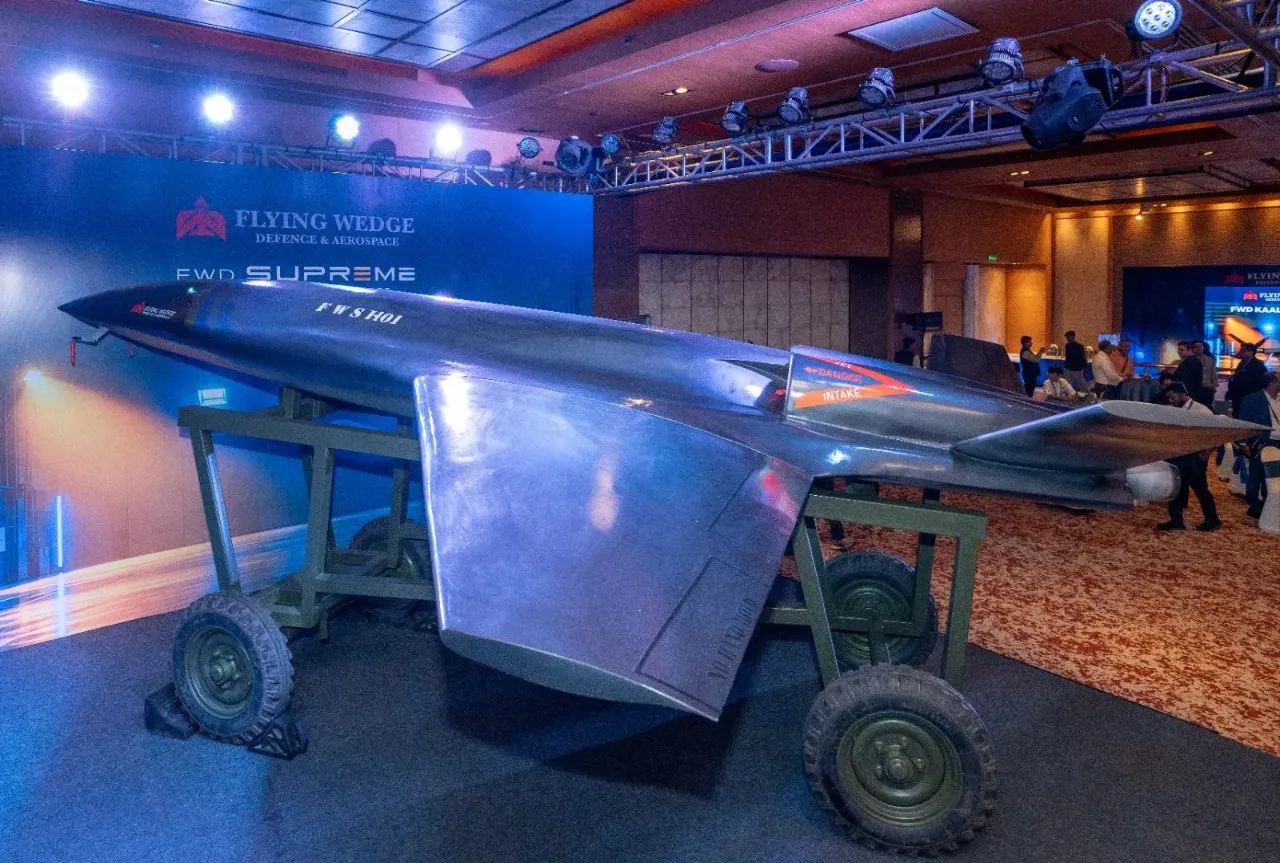
Bengaluru-based Flying Wedge Defence & Aerospace (FWDA) presented a full-scale static prototype of its FWD Supreme combat drone in New Delhi on October 13, 2026, positioning the AI-piloted aircraft as an Indian answer to the loyal wingman programs advancing in the United States, Australia and Turkey. The company says the larger Supreme Heavy variant is designed for a range of about 1,500 km, a top speed of Mach 0.85 and a payload of up to 350 kg. None of these figures has yet been demonstrated in flight.
The airframe on display is not meant to fly. Its role is to fix the size, shape and intent of the program while FWDA prepares the 250 kg Supreme Lite technology demonstrator for its maiden flight. A. Anbarasu, the Ministry of Defence’s acquisition chief, attended the unveiling, but no government contract or funding has been announced, and founder and CEO Suhas Tejaskanda has confirmed the program is seeking private investment.
Founded in 2022, FWDA describes the FWD Supreme as an aircraft that flies and takes mission decisions through onboard artificial intelligence with minimal human input, rather than a remotely piloted drone steered from a ground station. Intended missions cover reconnaissance, electronic warfare, strike and the escort of crewed fighters.
FWD Supreme Combat Drone Design Targets: Range, Speed and Payload
In its initial configuration, the Supreme Heavy is a flying wing measuring roughly 10 m in both length and span, with an internal weapons bay and propulsion delivering 5 kN of combined thrust. Takeoff weight is planned between 1,000 and 1,500 kg, a bracket the company has not yet closed. FWDA quotes cruise speeds of 500 to 600 km/h, a maximum of Mach 0.8 to 0.85 and endurance above two hours.
At the upper weight figure, the 350 kg payload would represent about 23% of takeoff mass, and static thrust-to-weight would sit near 0.34, rising to roughly 0.51 at 1,000 kg. Chief Technology Officer Girish G. Dixit, who previously worked on the LCA Tejas, has said the Heavy’s detailed design is 50% complete.
For GPS-denied airspace, the company plans visual odometry, estimating the aircraft’s position from successive camera images. Satellite communications and secure aircraft-to-aircraft links would share positions, sensor data and task assignments across a formation, and FWDA is working with the Indian Institute of Science in Bengaluru on encryption. Link range, latency and resistance to jamming have not been disclosed.
Mobbing Doctrine: 15 to 20 AI-Piloted Wingmen per Fighter
FWDA calls its operating concept the Mobbing Doctrine. Rather than committing one expensive fighter against a high-value target, 15 to 20 autonomous aircraft would accompany a single crewed jet, splitting reconnaissance, electronic warfare, decoy and strike tasks across the group. “The future of air superiority will not be achieved by a single fighter aircraft,” Tejaskanda said when presenting the concept.
Cost sits at the center of the pitch. FWDA targets $3 million to $4 million for a basic FWD Supreme and no more than $5 million with added sensors and weapons, against the $100 million it uses as a benchmark for a conventional fighter. Twenty aircraft at full advertised payload would carry 7,000 kg of mission equipment, and the company says a formation should remain combat-effective after losing four or five airframes.
Autonomous flight and autonomous combat are separate thresholds. The concept depends on automated task allocation, collision avoidance and links robust enough that no pilot has to manage 20 aircraft by hand, as well as reliable target identification and weapon-release authorization under electronic attack. None of these functions has been tested in the air.
Funding is the other constraint. FWDA puts total development cost at about $100 million, including $10 million for the Lite, and has not received government funding. Industrial targets call for 90% domestic content on the Supreme Lite and 65% on the Heavy, rising to 80-85% if an Indian engine such as DRDO’s Manik turbofan is adopted, although the company has not confirmed that Manik meets the Heavy’s thrust and integration requirements.
What Comes Next for the Supreme Lite Demonstrator
Two small configurations have completed taxi trials covering ground handling, steering, braking and propulsion response, but neither has achieved sustained flight. FWDA had targeted a first flight in the third quarter of 2026, a deadline that lapsed on September 30. No firm date has been announced, although Tejaskanda indicated at the October 13 unveiling that the Supreme Lite could fly within six to eight weeks. Flight testing under India’s Centre for Military Airworthiness and Certification (CEMILAC) is planned.
At home, the FWD Supreme enters a field already occupied by DRDO’s Ghatak unmanned combat aircraft, whose SWiFT demonstrator first flew on July 1, 2022, and which India’s Defence Procurement Board recommended for a 60-unit acquisition on March 3, 2026. Hindustan Aeronautics Limited’s CATS Warrior loyal wingman remains in development. Abroad, General Atomics’ YFQ-42A has been flying since August 2025, Boeing’s MQ-28 Ghost Bat had logged more than 150 test sorties by June 2026, and Turkey’s Bayraktar Kizilelma completed a beyond-visual-range missile engagement in November 2025.
Before any path to military qualification or production, FWDA must fly the Lite, finish the Heavy’s design, validate propulsion and multi-aircraft autonomy, and integrate weapons. The full-scale prototype shown in New Delhi states the ambition; the Supreme Lite’s first flight will provide the program’s first hard evidence.