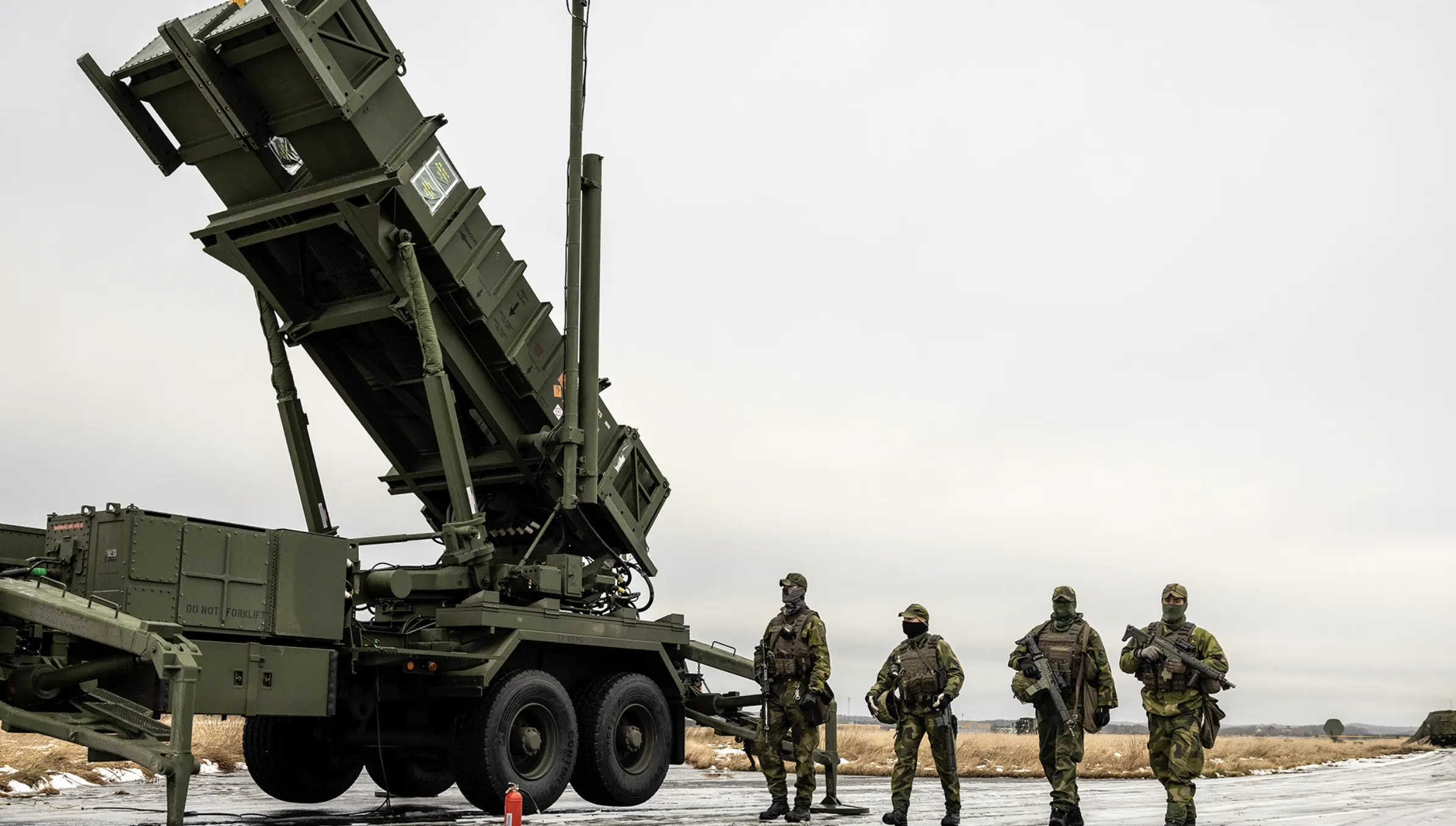
Airbus Defence and Space networked Swedish Patriot batteries and German IRIS-T SLM fire units through a single German command post during NATO exercise Spartan Arrow 2026 on Crete, the company announced on October 14, 2026. For the first time, both systems reported to the German Air Force Surface-to-Air Missile Operations Centre (SAMOC) at the NATO Missile Firing Installation (NAMFI), and Swedish crews completed what Airbus describes as their first independent Patriot live firing through the networked architecture, a shot the company says completes NATO certification and validation of Sweden’s Patriot systems.
On October 6, Stockholm announced it will deploy Patriot and roughly 100 personnel to Rzeszów in eastern Poland from December 1, taking over protection of the logistics hub that moves about 18,000 tonnes of materiel to Ukraine each month, a task the Netherlands currently performs. The mission can run up to seven months. Colonel Sofia Westermark, commander of the Air Defence Regiment, called it the most complex operation Sweden has conducted as a NATO ally. Crete was the final rehearsal inside an allied command network.
How Airbus SAMOC Tied Swedish Patriot to German Air Defenses
SAMOC is the battle management layer of German ground-based air defense: a mobile battle management, command, control, communications, computers and intelligence (BMC4I) node that handles mission planning, threat evaluation, weapon assignment and engagement monitoring for a cluster of surface-to-air units. Developed by Airbus predecessor EADS, it has served the Luftwaffe since 1999, with series production for the German missile wings running from 2004 to 2006. It exchanges data with airborne early warning aircraft, national radars and allied units over NATO tactical data links and military message handling. Hungary ordered its own SAMOC in December 2018 to coordinate its national air defense assets.
On Crete, SAMOC sat above three different weapon systems. Swedish Patriot covered the upper tier, the Luftwaffe IRIS-T SLM the medium band, and the German Army Light Air Defence System (LeFlaSys), built around the Ozelot weapon carrier and Stinger missiles, the short-range layer against drones. Airbus says the network engaged drone and cruise missile threats in real time, and that the first IRIS-T SLM live firing by an all-German crew was coordinated through SAMOC. Andreas Reinecke, head of Defence Digital & Cyber at Airbus Defence and Space, said effective air defense today is “the result of a seamlessly integrated overall capability, not the performance of individual products.”
Each of those systems brings its own fire control: Patriot through its Engagement Control Station, IRIS-T SLM through its own operations center. SAMOC works one level higher. Its value lies in building a single air picture across national and service boundaries, assigning each track to the shooter best placed to engage it and preventing two batteries from spending interceptors on the same target. Against mixed raids of one-way attack drones and cruise missiles, that pairing decides whether a high-end Patriot round is expended on a target a Stinger or IRIS-T SLM could have handled. Airbus has not disclosed whether SAMOC passed engagement orders directly to the Swedish fire units or coordinated them through Swedish national command, which targets each system engaged, or how many interceptors were fired.
Swedish Patriot Certification Clears the Path to Rzeszów
Sweden designates Patriot as Luftvärnssystem 103 (LvS 103). The US State Department approved a foreign military sale of four Configuration-3+ fire units in February 2018 at an estimated $3.2 billion, with PAC-3 Missile Segment Enhancement (MSE) and Guidance Enhanced Missile-Tactical (GEM-T) interceptors. The Air Defence Regiment (Lv 6) in Halmstad declared initial operational capability in December 2021, received its fourth and final fire unit in December 2022, and confirmed full operational capability at the turn of 2026 after a large-scale test of the sensor-to-shooter chain across Army and Air Force command systems. In wartime the batteries fall under the Chief of the Air Force.
That test proved national integration. Crete tested allied integration, the requirement Sweden has carried since joining NATO on March 7, 2024. Sweden has also joined the NATO Support and Procurement Agency coalition buying up to 1,000 GEM-T missiles from COMLOG, the Raytheon and MBDA joint venture in Schrobenhausen, Germany.
The certification claim rests on the Airbus account. Neither the Swedish Armed Forces nor NATO had published separate confirmation of the certification as of October 15, and no engagement results have been released.
Analysis: The milestone on Crete is the network, not the missile. European ground-based air defense is a patchwork of Patriot, IRIS-T SLM, NASAMS and SAMP/T batteries, and its combat value depends on whether one nation’s command node can task another nation’s shooters without bespoke integration. A German command post fighting Swedish Patriot beside German IRIS-T SLM is a working template, and Sweden, which has also ordered IRIS-T SLM for delivery from 2028, will soon operate both systems itself. The industrial contest is moving to the same layer: Airbus SAMOC on one side, Northrop Grumman’s Integrated Battle Command System (IBCS), which Poland selected for its Wisła Patriot program, on the other. A Swedish battery trained in a German network and deploying to a country that runs Patriot under IBCS puts that interoperability question on an operational footing.
Airbus says the bandwidth, response time and jamming resistance data gathered on Crete will feed NATO’s development of networked command and control, though it has published no figures. The next test is live: the Swedish Patriot unit is scheduled to assume the Rzeszów mission on December 1. Whether NATO formally publishes the Swedish certification, and how SAMOC absorbs Sweden’s own IRIS-T SLM units once they arrive, remain the open questions.