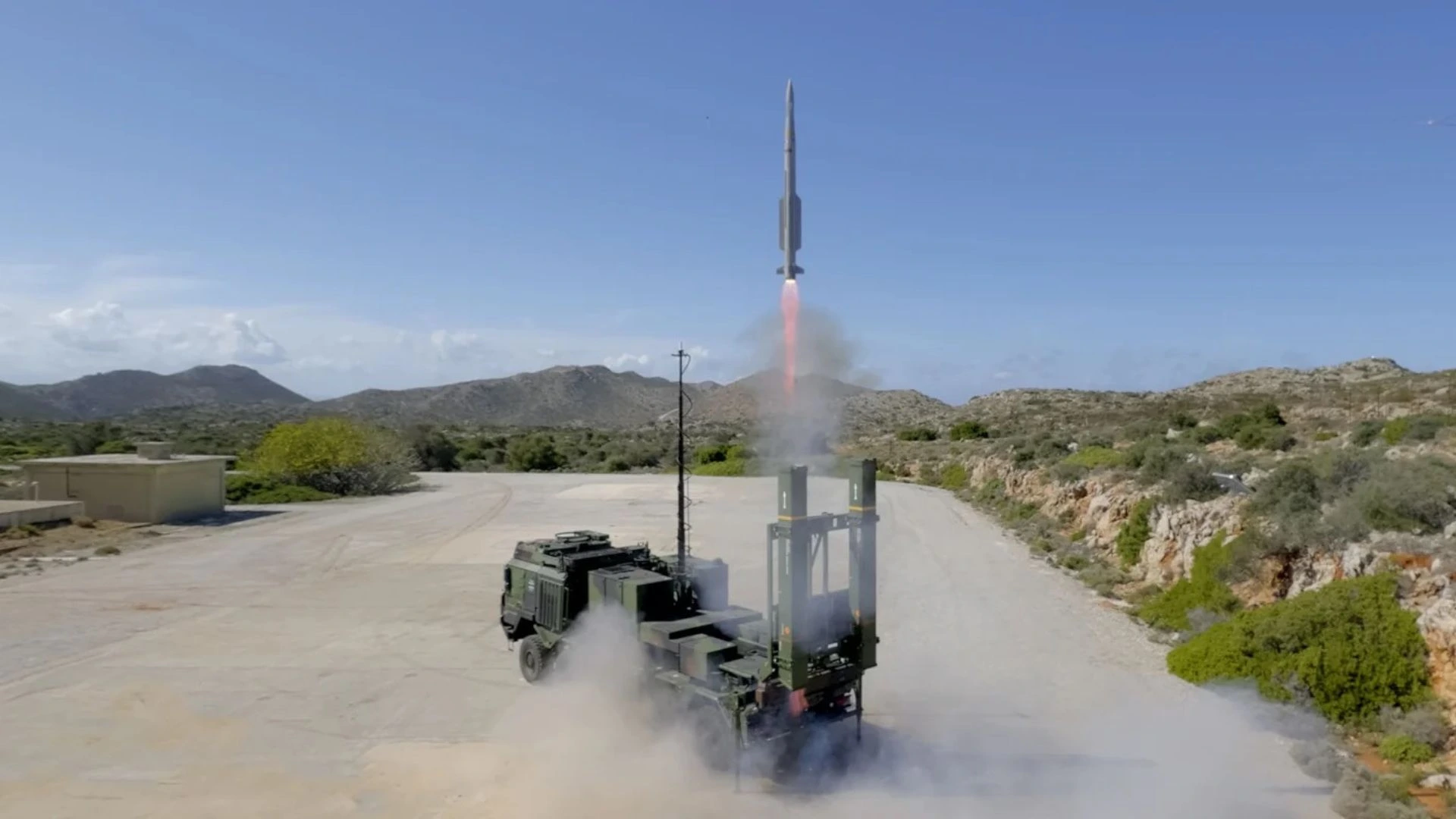
The German Air Force (Luftwaffe) has passed the system certification firing for Diehl Defence’s IRIS-T SLM ground-based air defense system, live-firing the interceptor for the first time in mid-October 2026 at the NATO Missile Firing Installation (NAMFI) on Crete. Air Defense Missile Group 61 fired the certification shot during the Spartan Arrow 2026 exercise, then fought the system in a tactical scenario alongside German and Swedish Patriot batteries and German Stinger missiles on the light air defense system (LeFlaSys).
The shot caps a three-year acquisition sprint. The Bundestag budget committee approved six fire units for up to €950 million on June 14, 2023, and the Federal Office of Bundeswehr Equipment, Information Technology and In-Service Support (BAAINBw) signed with Diehl on June 22, 2023, for 216 missiles, 72 of them training rounds. The Luftwaffe declared initial operating capability at Todendorf on September 4, 2024, but the system then underwent further qualification, including adaptation to NATO interfaces, before the unit formally took it into service in February 2026. Crete was the gate to fielding a medium-range layer the Bundeswehr had lacked for years.
How the IRIS-T SLM Certification Firing Unfolded on Crete
The trial exercised the complete fire unit as one kill chain: the Hensoldt TRML-4D radar, the Common Tactical Operations Center (CTOC) command post and a launcher with IRIS-T SLM interceptors. Neither Diehl nor the Bundeswehr has disclosed the target type, engagement range or number of missiles fired. Diehl CEO Helmut Rauch said “the successful system certification firing confirms that IRIS-T SLM delivers reliable performance and a very high hit rate in operation.” Lieutenant Colonel Björn Klarl, the unit’s commander, said his soldiers “quickly mastered the new system, acquired the necessary expertise, and carried out the launch safely and precisely.”
Spartan Arrow 2026 brought roughly 650 German and Swedish personnel and about 300 vehicles to NAMFI, according to the German Defense Ministry; Defense Minister Boris Pistorius visited on October 14. The scenario mirrored the layered architecture Berlin is building, with Patriot in the upper tier, IRIS-T SLM in the medium band and LeFlaSys for short-range point defense. The exercise also marked the return of LeFlaSys, built around the Ozelot weapon carrier, to the Army, which had handed it to the Luftwaffe in 2012 when it disbanded its air defense branch.
The Swedish presence carried weight. Stockholm signed for seven IRIS-T SLM fire units worth about SEK 9 billion on June 24, 2025, with deliveries from mid-2028 to mid-2030. Established under a 1964 agreement and in use since 1968, NAMFI remains the only European range where German ground-based air defense units can live-fire at representative distances.
Inside the IRIS-T SLM Fire Unit: TRML-4D Radar, CTOC and Interceptor
Each German fire unit pairs a radar and command post with three launchers carrying eight missiles apiece, giving 24 interceptors ready before reload. Radar and launchers are remotely controlled from the command post, which cuts crew numbers and lets the unit disperse emitters and shooters. Under the 2023 contract, Airbus Defence and Space supplies the command and weapon-employment system, Rheinmetall MAN Military Vehicles the trucks and Rohde & Schwarz the radios.
The TRML-4D is a C-band (NATO G-band) gallium-nitride active electronically scanned array radar. Hensoldt specifies a 250 km instrumented range, simultaneous tracking of more than 1,500 targets, track ranges beyond 120 km against fighters and beyond 60 km against supersonic missiles, and a minimum range under 200 m. That spread matters against raids mixing slow one-way attack drones with fast cruise missiles.
Publicly available specifications indicate the interceptor uses a 152 mm motor, wider than the 127 mm air-to-air IRIS-T it derives from, with thrust-vector control, a jettisonable nose fairing, GPS-aided inertial navigation with datalink midcourse updates and an imaging infrared seeker for the terminal phase. Vertical launch gives 360-degree coverage. Diehl now quotes an effective system range of up to 60 km and an interception altitude of up to 20 km; as recently as December 2025, the company cited 40 km.
Germany’s IRIS-T SLM Expansion and the European Sky Shield Order Book
Air Defense Missile Group 61 is slated to field five fire units, with the sixth assigned to training, and to complete conversion by mid-2027. A Finance Ministry paper in October 2025 outlined 665 additional missiles worth about €1.26 billion, and the budget committee approved further interceptor purchases on December 17, 2025. A confidential document reported in October 2025 pointed to 14 more fire units worth €3.18 billion, which would bring the fleet to 20, while reported military planning cites up to 50 systems in total across the Luftwaffe and the Army’s rebuilt air defense branch; the Defense Ministry has confirmed neither figure. On September 23, 2026, lawmakers also funded a maritime adaptation of IRIS-T SLM for the F125 frigates.
Rauch said ten nations now rely on the system. Open-source procurement records point to Germany, Ukraine, Egypt, Estonia, Latvia, Slovenia, Bulgaria, Switzerland, Denmark and Sweden, with most European orders placed through the European Sky Shield Initiative (ESSI) via BAAINBw-managed contracts. Ukraine has operated IRIS-T SLM in combat since October 2022.
Analysis: Ukraine settled the technical question years ago; Crete settles the institutional one. Germany now has a live-fire-proven medium-range layer built to plug into NATO integrated air and missile defense beside Patriot, and a widening ESSI user group sharing the same interceptor, radar and Todendorf training pipeline. The constraint shifts to depth. Twenty-four ready rounds per fire unit, and 216 missiles bought with the first six units, will not sustain the drone-and-missile salvos Ukraine absorbs. Diehl’s interceptor output, more than launcher deliveries, will determine how much airspace the expanded fleet can actually hold.
Diehl says the Luftwaffe has completed the required operational certification; the Defense Ministry describes the shot as a milestone toward the system’s operational testing and technical certification. Next milestones include completion of deliveries to Air Defense Missile Group 61, a formal declaration of full operational readiness and Bundestag decisions on the larger follow-on buy. The Bundeswehr has not released engagement data from Crete, and Diehl has not detailed what underpins its 60 km figure. Sweden’s first deliveries in 2028 will show how quickly ESSI partners convert common contracts into interoperable units.