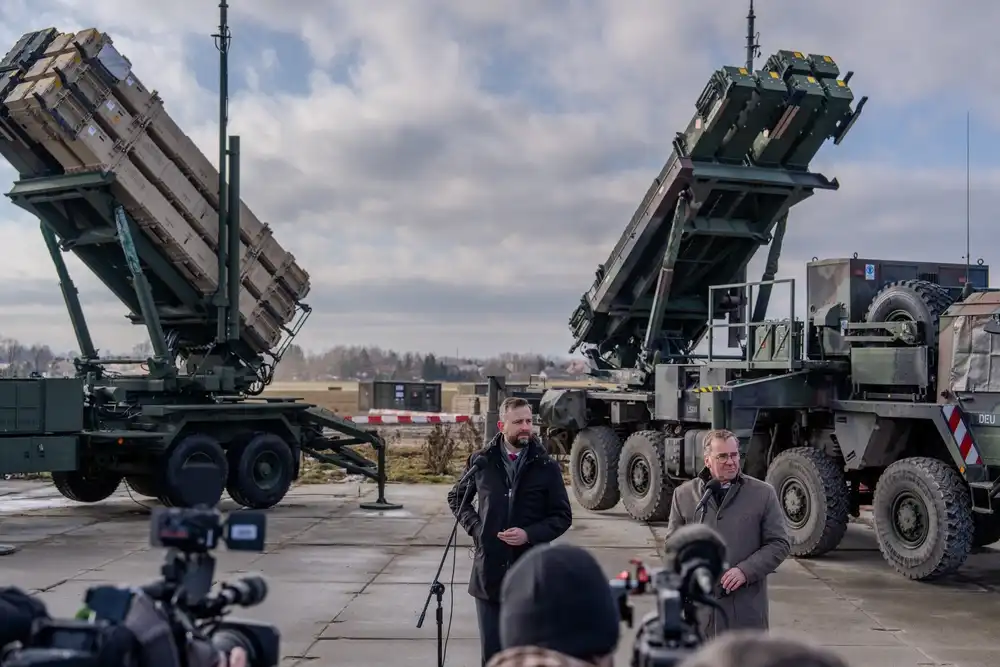
The German Bundestag’s Budget Committee approved four Bundeswehr procurement proposals on October 14, 2026, clearing the replacement of Patriot fire units handed to Ukraine, 40 deployable Patriot maintenance containers, a framework for net-launcher counter-drone systems, and encrypted airborne radios for the NH90 helicopter fleet, according to the Federal Ministry of Defense (BMVg).
Each project exceeds the €25 million threshold above which the committee must separately approve major defense procurements. Internal ministry planning foresees nearly 150 such proposals in 2026, after a record 103 in 2025. The package addresses two pressures that have shaped German air defense planning since 2025: a Patriot inventory thinned by successive transfers to Kyiv, and repeated drone overflights of military sites that Berlin treats as part of a hybrid threat campaign.
Patriot Fire Units Return Through US Foreign Military Sales
The largest item replaces the Patriot fire units Germany transferred to Ukraine in 2025. The BMVg will reacquire them through the US government under the Foreign Military Sales (FMS) process. Patriot covers the lower tier of German air and missile defense, engaging aircraft, cruise missiles, and tactical ballistic missiles. The order covers two Raytheon-built fire units, each comprising an engagement control station, launchers, a radar, and a power generation unit. The program is valued at around €650 million, according to people familiar with the committee submission, with deliveries set to begin before the end of 2026 and conclude in 2028.
Two terms stand out. Berlin is to prepay the full net value of roughly €560 million, excluding import VAT, once the agreement is signed, a mechanism designed to move Germany ahead of other customers in the production queue. Norway will contribute more than €300 million, over half of the total cost, under an August 2025 pledge by Oslo. Most of the remaining funding comes from Einzelplan 60, the federal general finance budget, rather than the defense budget, Einzelplan 14.
The committee also approved 40 deployable repair containers, known as Einsatzcontainer Instandsetzung (ECI), with an option for 14 more. The total is reported at around €90 million, of which about €70 million covers the firm order, with CONDOK GmbH named as contractor and delivery of the firm batch in 2030. Per the ministry, the containers will sustain field repair capacity for the Luftwaffe’s Patriot air defense missile groups in mobile operations and help Germany meet NATO capability targets.
Net-Launcher Drones for Base Defense and Encrypted NH90 Radios
The counter-drone purchase targets small and micro drones used for reconnaissance and sabotage against Bundeswehr installations in Germany and abroad. The ministry describes net-launcher drones as a proven base protection tool, typically operated alongside jammers and detection radars, and notes that net capture allows engagement in urban terrain.
The contractor is ARGUS Interception GmbH of Rotenburg an der Wümme, Lower Saxony, according to people familiar with the program. The seven-year framework agreement is worth more than €1.1 billion and covers about 450 complete systems, each pairing interceptor drones with surveillance sensors. An initial call-off of several dozen systems, valued at roughly €165 million, is due for full delivery in 2027.
The core effector is the A1-Falke, a quadcopter weighing under 25 kg. According to manufacturer figures, it carries integrated net launchers, tracks targets with radar, lidar, and depth cameras, and can carry captured drones weighing up to several kilograms to a safe drop point, preserving them for forensic analysis. The intercept runs automatically, but a human operator authorizes and can abort each engagement. The Bundeswehr already fields an earlier configuration, as do the Federal Police and several state police forces.
Each service branch has stood up counter-drone Rapid Reaction Elements, which the ministry says have already supported Belgium and Denmark. In November 2025, a Luftwaffe advance team deployed to Belgium after drone sightings closed Brussels and Liège airports.
The fourth approval is a call-off under an existing contract for NH90 airborne radios, enabling encrypted tactical communications between helicopters, ground stations, and other aircraft. The ministry did not disclose the radio type, quantity, or value.
Analysis: The Patriot deal shows that Germany’s binding constraint in ground-based air defense is now production slots, not funding. Paying the full net price upfront and drawing on Norwegian money and the general finance budget keeps Ukraine-related replenishment from crowding out the Bundeswehr’s own expansion. The ARGUS framework points elsewhere: buying hundreds of non-kinetic interceptors signals that Berlin treats base protection against cheap drones as a mass requirement, suited to peacetime airspace where shooting drones down over populated areas carries legal and collateral risk.
Next come signature of the FMS agreement, which triggers the prepayment, and execution of the ARGUS framework contract, with Patriot deliveries due to start before year-end. The configuration of the replacement fire units and the scale of later ARGUS call-offs remain undisclosed.