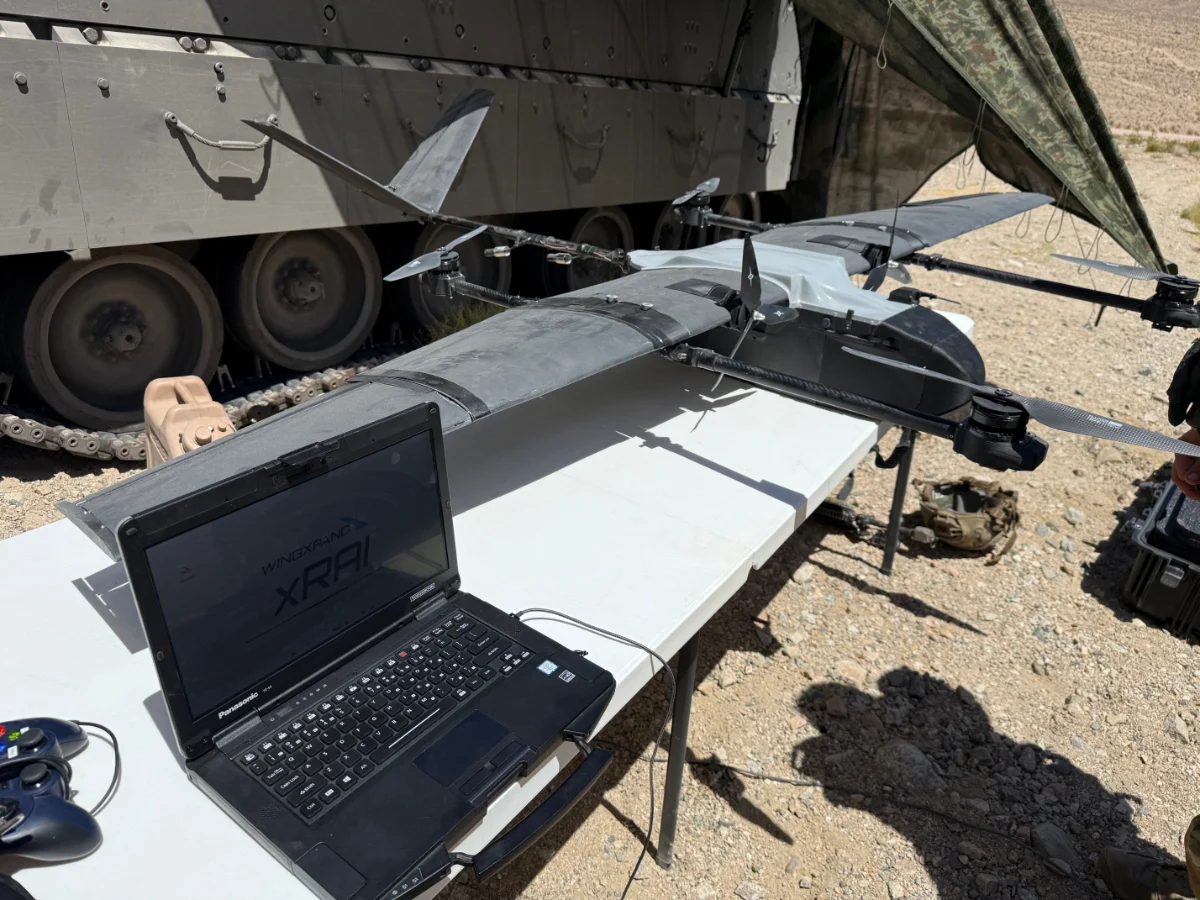
WingXpand has unveiled xPAIR, a removable autonomy core that the company says can move between its xRAI fixed-wing aircraft, xTRAIL ground vehicle and xSAIL watercraft, running one artificial intelligence (AI) threat-detection library, communications stack and payload set. The Schaumburg, Illinois-based firm introduced the patent-pending system on October 13, 2026, and says it is U.S.-built and compliant with the National Defense Authorization Act (NDAA).
The launch targets a market reshaped by the Pentagon’s July 10, 2025, memorandum “Unleashing U.S. Military Drone Dominance,” which reclassified Group 1 and Group 2 drones as consumables, gave colonel-level (O-6) commanders authority to buy them, and set a goal of low-cost drones in every squad by the end of 2026. Decentralized buying widens the supplier base but multiplies dissimilar vehicles and training pipelines. WingXpand’s answer is to standardize the computer rather than the vehicle.
How the WingXpand xPAIR Core Moves Between Air, Ground and Sea
xPAIR separates a robot’s processing and autonomy layer from its hull. Operators install the module in the xRAI for wide-area overhead surveillance, in the xTRAIL to push close reconnaissance forward without exposing a soldier, or in the xSAIL to reach areas accessible only by water. Every host draws on the same library of AI threat detections, autonomy routines, resilient communications and multi-mission payloads, controlled through a single user interface.
The operational case rests on three claims. Units could add ground or maritime vehicles without a new equipment baseline or separate operator training, because detection models and controls stay constant. The core fuses data from multiple vehicles into one real-time operating picture, letting a small team cue a ground vehicle onto a contact first flagged from the air. And production can scale around one common processing unit while the mix of air, ground and sea platforms follows demand, rather than building dedicated computers for an uncertain fleet composition.
“Our military doesn’t need another autonomous system built for one narrow mission,” said James Barbieri, WingXpand’s co-founder and chief executive, who argues that a common core lets autonomous vehicles adapt as missions change.
Critical parameters remain undisclosed: the module’s processor, mass, power draw, environmental rating, datalink waveform and field swap time. WingXpand has released no specifications for xTRAIL or xSAIL, no system pricing and no named military customer for xPAIR. A company representative has said the Department of War, state governments and Fortune 50 companies are adopting the technology, without identifying them, and the firm’s world-first claim remains unverified.
From xRAI to xPAIR: Airframe Specs, Raytheon Work and Contracts
The aerial host is the most mature of the three vehicles. The xRAI is a hand-launched, belly-recovered fixed-wing uncrewed aircraft system (UAS) whose telescoping wings collapse into a backpack. Publicly available specifications for its original configuration list a 2.13 m (7 ft) wingspan that retracts by 60% in under two minutes, a carbon fiber and Kevlar composite structure, a 4.5 kg maximum takeoff weight, a 0.9 kg payload, two hours of endurance, a 1,830 m (6,000 ft) service ceiling, a 29-knot cruise speed and tolerance for 44-knot gusts. A vertical takeoff and landing (VTOL) kit followed in November 2024, and the company lists xRAI pricing from $14,900.
Those figures place the xRAI between the two Group 1 aircraft that long defined Army small UAS. Publicly available specifications indicate the RQ-11B Raven spans about 1.4 m with 60 to 90 minutes of endurance, while the RQ-20B Puma 3 AE spans 2.8 m, weighs about 6.8 kg and flies up to 2.5 hours. The xRAI’s folding wing aims for near-Puma endurance at closer to Raven portability.
The AI layer that xPAIR carries grew out of that airframe. Under a U.S. Army contract, WingXpand has worked with Raytheon, an RTX business, to integrate infrared (IR) sensors and an IR AI threat-detection algorithm into the aircraft, with the aim of improving standoff for tactical units. Federal procurement records show about $9.9 million across 14 awards between February 2023 and June 2025, largely Small Business Innovation Research (SBIR) work, including a $2 million Phase II award in April 2025 for xPOD, a modular multi-mission payload for Army Special Forces. The company has also announced contracts with U.S. Special Operations and the U.S. Navy, the latter teaming it with Ranken Technical College on drone maintenance and workforce development. It won the Army’s xTechSpecialForces competition, was selected as one of six approved drone providers for the State of Montana, and says xPAIR has been demonstrated with several U.S. Special Forces teams and at Army events.
Analysis: xPAIR applies the modular open systems logic the Pentagon demands of major platforms to the bottom tier of the robotics market. For Special Operations Forces (SOF) teams and light infantry units that cannot carry a separate kit per domain, one core and one interface could compress training and sustainment, and a shared detection library would let a contact classified from the air pass to a ground or surface vehicle without software translation. The constraints are concrete. A team with one core for three hulls fights in one domain at a time; the fused multi-vehicle picture needs a core in every active vehicle. A single core design also concentrates cyber and electronic warfare exposure. Without published swap times and an interface open to third-party vehicles, xPAIR is a proprietary family architecture, not a cross-vendor autonomy standard.
Next markers are xTRAIL and xSAIL specifications, swap-time data and a first contract naming a unit or program for xPAIR. The larger test is whether SBIR-funded xRAI and xPOD work transitions into production funding as the services chase the end-2026 squad-level drone target with budget lines still written domain by domain.