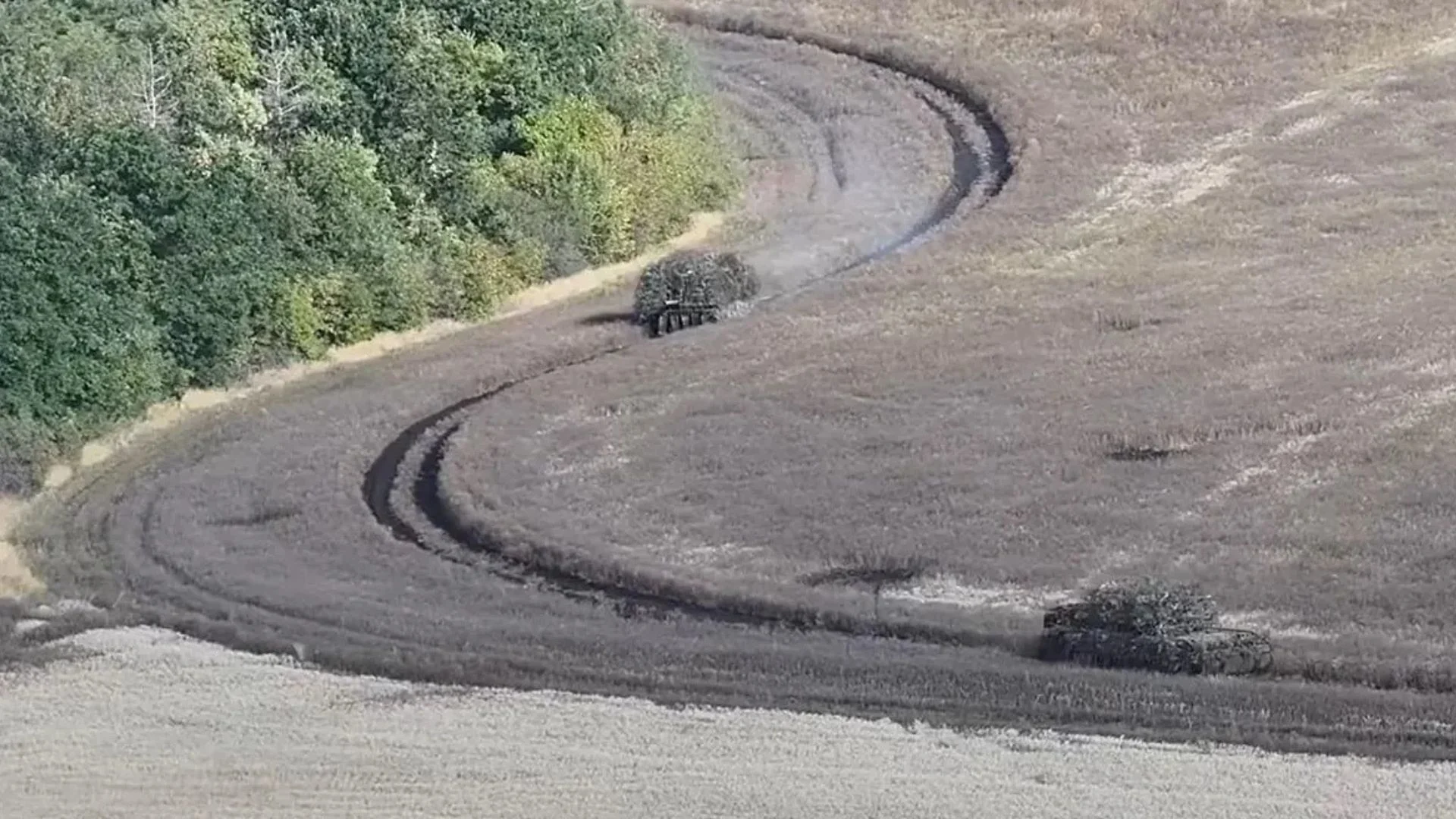
Ukraine’s 475th Separate Assault Regiment has put a tank and an M2 Bradley infantry fighting vehicle back into direct-fire combat in northeastern Kharkiv Oblast, protecting both with improvised “hedgehog” standoff armor and an escort of first-person-view (FPV) interceptor drones and Vampire heavy bomber drones. Footage the regiment released on October 11, 2026, shows the two vehicles advancing near Anyshchyne under repeated Russian drone attack, engaging Russian positions and withdrawing under their own power.
The engagement tests whether armor can still operate on a front where drones have pushed both armies into largely dismounted fighting. A recent Russian attempt to break that pattern, an armored assault near Dobropillia with tanks fitted with upgraded Arena-M active protection systems, ended with the vehicles destroyed under massed drone strikes. Ukraine, meanwhile, is pressing localized counteroffensives. The 3rd Army Corps under Brigadier General Andriy Biletskyi reported 176 square kilometers retaken in Operation Vivaldi around Lyman by the end of September, a total the corps raised to 277 square kilometers and 16 settlements on October 14, when it announced the completion of the operation’s fourth phase. Turning those gains into breakthroughs demands protected direct fire.
Hedgehog Tanks Under Drone Escort: How the Anyshchyne Assault Worked
The regiment, known as CODE 9.2, grew from a reconnaissance platoon formed in 2022 within the 92nd Mechanized Brigade, through an attack-drone company stage, into an independent assault regiment in August 2025. In the Anyshchyne footage, the Bradley leads and lays down covering fire while the tank follows to engage the target directly. A reconnaissance drone watches the route, and Vampire heavy bombers fly ahead to locate Russian fighting positions and drop munitions on them before the armor arrives.
The critical moment comes when a Russian FPV drone closes on the vehicles. A Ukrainian FPV interceptor knocks it off its terminal trajectory, then pursues and destroys it. The escort is not airtight: Russian drones, including a Molniya-type fixed-wing drone, still reach the vehicles, but both absorb the hits on their standoff armor, remain mobile and pull back. Forbes reported that the push expanded Ukrainian-controlled ground by more than 3 kilometers, and Ukrainian open-source geolocation places the fight roughly 5 kilometers north of positions that Russian maps mark as captured.
The Vampire, built by Kyiv-based SkyFall, explains both the strength and the ceiling of the escort. Publicly available specifications indicate a six-rotor airframe that lifts up to 15 kilograms of thermobaric, shaped-charge or fragmentation munitions, carries bispectral thermal cameras for night work and operates out to about 20 kilometers. Endurance of roughly 23 minutes caps how long any single bomber can loiter over an advancing vehicle.
Hedgehog Armor Trades Turret Traverse and Mobility for FPV Standoff
Hedgehog armor was first spotted on Russian tanks in autumn 2025 and has since been copied by Ukrainian units. Crews reportedly unravel cut steel cable into wire strands and mount the bristles on a cage frame around the hull and turret. The goal is to snag an incoming drone or force its warhead to detonate away from the main armor. A Ukrainian brigade spokesperson has acknowledged that it offers little against larger, faster loitering munitions such as the Lancet; it is built against small FPV shaped charges.
The protection carries real costs. The cage appears to lock the tank’s turret, forcing the crew to slew the entire hull onto the target and turning it into a de facto assault gun. On the Russian side, one tank driver has reported a drivetrain component failing within 10 kilometers, blaming the strain of the added bulk.
Ukraine’s Bradleys include M2A2 Operation Desert Storm-Situational Awareness (ODS-SA) vehicles. Publicly available specifications indicate a 600-horsepower Cummins VTA-903T diesel, a 25 mm M242 Bushmaster chain gun and a twin BGM-71 TOW launcher, giving the vehicle both suppressive and anti-armor fire. The tank’s model remains unconfirmed: some open-source reporting identified an M1A1 Abrams, which the footage does not settle.
Small Armored Packets: Lessons From the September 30 Vilkhuvatka Raid
Anyshchyne was not the regiment’s first attempt. On September 30, CODE 9.2 sent tanks fitted with added anti-FPV protection against Russian infantry holding buildings in Vilkhuvatka, a village in the Kupiansk district roughly 9 kilometers from the Russian border. According to the regiment, FPV drones, reconnaissance UAVs and Vampire bombers escorted the column; the tanks crossed light mines without damage, fired directly into the occupied buildings and returned to their positions despite several FPV attacks on the way out.
Both operations used two or three vehicles at most, and that ratio is the core of the method. Every additional vehicle stretches the column, multiplies the approaches the escort must watch and raises the number of interceptor pilots and bomber crews required. Russia’s larger armored columns, which must disperse to avoid bottlenecks, have proven far harder to protect.
The limits are structural. Each interceptor that kills a Russian drone is expended, opening a gap until a replacement arrives, and Vampires must cycle back to rearm. Hedgehog armor raises the number of hits a vehicle can absorb without making it immune. For a regiment reportedly short of infantry, protected direct fire also reduces the number of assault troops it must commit.
Analysis: The decisive variable is local drone superiority, not the spikes. Standoff armor buys seconds against FPV warheads; the escort decides whether those seconds suffice, and Dobropillia showed that even an active protection system saturates under massed drones. The Kharkiv raids recast the tank as a direct-fire node inside a drone network. For NATO armies still planning armored maneuver around company-sized formations and vehicle-mounted protection, the implication is that counter-drone escort must be organic to the armored element, not an attached afterthought.
Scalability remains the open question. Two-vehicle raids have produced gains measured in single kilometers, and Ukraine has yet to show it can sustain escort coverage over a battalion-sized assault. Russia already fields hedgehog armor and uses drones to open corridors for infantry, so it will likely copy the escort model.