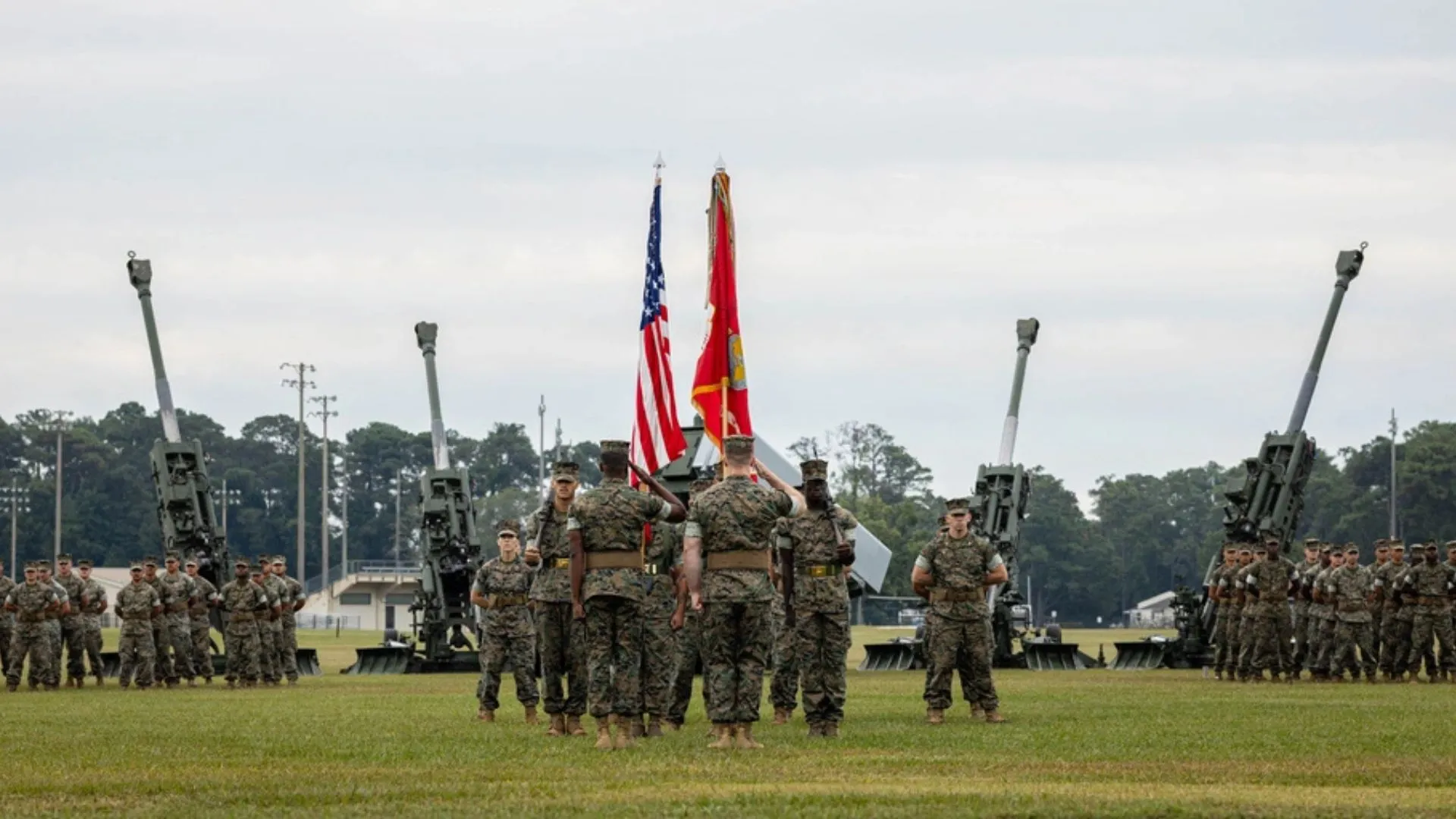
The U.S. Marine Corps redesignated 1st Battalion, 10th Marine Regiment (1/10) as a Medium-Range Missile Battalion on October 9, 2026, at Marine Corps Base Camp Lejeune, North Carolina. The change converts a 2nd Marine Division (2nd MARDIV) artillery battalion into the first Marine Corps battalion organized around the Navy-Marine Expeditionary Ship Interdiction System (NMESIS), the Corps’ ground-based anti-ship launcher.
The conversion carries NMESIS beyond the Pacific. The Marine Corps fielded its first six launchers to the 3rd Marine Littoral Regiment (MLR) in Hawaii in 2023, and that regiment formally received the system in November 2024; the 12th MLR on Okinawa formally received it in June 2026. Both regiments belong to III Marine Expeditionary Force (III MEF). The 1/10 redesignation places the capability with II MEF on the East Coast under Force Design, the March 2020 restructuring that reorients the Corps toward naval expeditionary warfare and sea denial.
How the NMESIS Missile Battalion Fights: Launcher, Missile, Range
NMESIS pairs a launcher unit carrying two Naval Strike Missiles (NSM) with the Remotely Operated Ground Unit for Expeditionary Fires (ROGUE-Fires) carrier, an Oshkosh Defense derivative of the Joint Light Tactical Vehicle (JLTV) built without a crew cab. The carrier moves in teleoperated or leader-follower mode, so no Marine rides the launcher during emplacement. The launcher is not considered autonomous: its fire control system is separate from the vehicle’s self-driving software, and a Marine plans the mission and fires the missile. Raytheon and Norway’s Kongsberg jointly manufacture the NSM, and Kongsberg signed a $404.4 million agreement in September 2026 to produce launchers and weapon control systems for the Marine Corps.
Publicly available specifications indicate the NSM measures about 3.96 meters with its booster and weighs roughly 400 kilograms at launch. A jettisoned solid rocket booster gets the missile airborne before a Microturbo TRI-40 turbojet sustains high-subsonic cruise near Mach 0.93. Guidance combines GPS-aided inertial navigation, terrain-reference navigation and a passive imaging infrared seeker with an onboard target library, so the missile discriminates targets without emitting radar energy. A titanium-cased blast-fragmentation warhead of 120 to 125 kilograms uses a void-sensing fuze. For a launcher hiding along a coastline, a passive terminal seeker removes one cue that adversary electronic support systems hunt for.
Range figures vary by source. The Marine Corps credits the missile with an effective range of more than 130 nautical miles against surface ships and fixed land targets; earlier service and program statements cited more than 100 nautical miles, or 185 kilometers. Marines from 1st Battalion, 12th Marines validated the system during Large Scale Exercise 2021 with an NSM shot at a surface target off Hawaii. The 3rd MLR deployed NMESIS to the Philippines for Balikatan in April 2025, and a Japan Air Self-Defense Force C-130 airlifted a launcher to Ishigaki Island, in Japan’s southern Nansei chain east of Taiwan, during Resolute Dragon 25 in September 2025.
Why 2nd Marine Division Is Adding Missiles Without Retiring Cannons
Lt. Col. Joseph Mozzi, commanding officer of 1/10, described NMESIS as the Corps’ emerging ground-based anti-ship capability and a future “ground based long-range precision fires platform.” He said the Marine Corps identified a land-based sea denial capability as a crucial step in helping maritime component commanders fight for sea control.
Col. William Soucie, commanding officer of 10th Marines, framed the change as additive. NMESIS is a complement to, not a replacement for, cannon artillery, he said, and the regiment will keep howitzer capability in another battalion while 1/10 delivers fires to units ashore and at sea. Soucie said the system lets the regiment support maneuver at sea as well as on land, a mission set far beyond the reach of its M777A2 155 mm towed howitzers.
The Marine Corps selected 1/10 partly because it sits in the service-retained force rather than in standing combatant command assignments, which gives the II MEF commanding general, and the Marine Corps as a whole, greater flexibility to employ it in a crisis. The battalion traces its lineage to November 1940 and has fielded M777A2 howitzers and, since 2021, organic High Mobility Artillery Rocket System (HIMARS) launchers in Romeo Battery.
Several details remain undisclosed. The Marine Corps is building toward 18 launchers per battery, a structure it expects to complete in fiscal year 2033, but has not stated how many NMESIS launchers 1/10 will receive, how its batteries will be organized, whether Romeo Battery’s HIMARS stay with the battalion, or when the unit will reach initial operational capability.
Analysis: The redesignation moves ground-based anti-ship fires out of the Pacific stand-in force niche and into a division artillery regiment, turning NMESIS from a littoral specialty into a general fires capability. It also hands II MEF, the Corps’ East Coast force with longstanding ties to Europe and NATO’s northern flank, a missile already common among allies: several NATO navies fire the NSM, and Poland operates it in a land-based coastal role. That commonality could ease combined targeting and logistics if the battalion ever deploys to Europe, although the Marine Corps has named no theater. The binding constraint is industrial. With full 18-launcher batteries not expected before fiscal year 2033, every new NMESIS unit competes with the two Pacific regiments for a finite supply of launchers and missiles.
The next markers are delivery of the battalion’s first launchers, a first live NSM shot by an East Coast unit and an initial operational capability date the Marine Corps has yet to announce. The service calls 1/10 the start of artillery battalion modernization, leaving open which battalions follow and how the Corps will fund their launchers alongside the Pacific regiments.