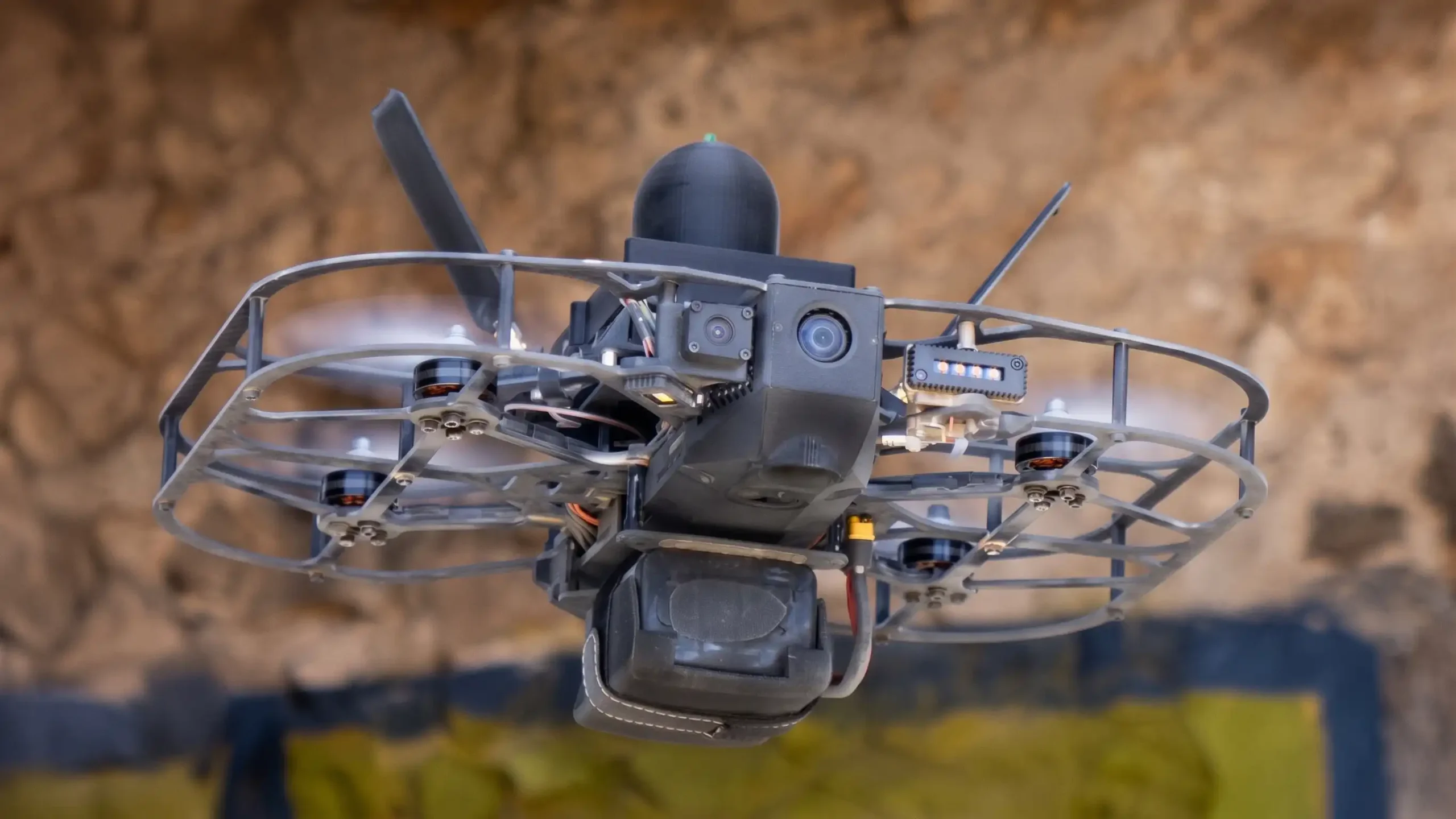
The U.S. Department of War has awarded XTEND AI Robotics a $40.5 million order for 6,000 STRIKER small uncrewed aircraft systems under the Drone Dominance Program (DDP), the company announced on October 13, 2026. The order follows XTEND’s third-place finish in the Close Quarters Battle (CQB) mission area of Gauntlet II, the program’s second competitive fly-off.
The award is one of several production orders now flowing from Gauntlet II. The DDP, a $1 billion initiative jointly managed by the Defense Innovation Unit (DIU) and the Test Resource Management Center (TRMC), with Naval Surface Warfare Center (NSWC) Crane Division as contracting authority, aims to build a U.S.-based supply chain for low-cost one-way attack drones. Gauntlet I, held at Fort Benning, Georgia, produced orders for roughly 30,000 drones. The program plans to order 60,000 systems from the top five performers in each Gauntlet II mission area.
How XTEND Earned a Drone Dominance Program Production Order
Selection began with a qualifier at Camp Grayling, Michigan, from June 8 to 19, 2026, where 49 companies flew approximately 79 drone designs across long-range strike and confined-space assault missions. Nineteen companies advanced. Before Gauntlet II, each had to deliver 120 drones fitted with lethality payloads within roughly five weeks, paired with one or more lethality providers.
Gauntlet II ran in August 2026 at Fort Carson, Colorado. Evaluators tested find-fix-finish performance either at 15-kilometer stand-off ranges in the Deep Strike lane or inside confined environments in the CQB lane, with part of the testing repeated at night. Additional lanes assessed controlled kinetic engagement and electronic warfare (EW) resilience, with drones flown against counter-unmanned aircraft systems (C-UAS). Scores combined event performance, military operator evaluations, and demonstrated production and supply chain capacity.
Results published on September 15, 2026, ranked Neros first in CQB, followed by ORQA US, XTEND, Vector and ModalAI. XTEND delivered and flew 120 STRIKER systems at the event. Its 6,000-unit order sits alongside 14,000 drones ordered from Neros, valued by that company at more than $100 million, and a 7,000-drone, $38 million order for ORQA US.
Aviv Shapira, XTEND’s co-founder and chief executive, said:
This $40.5 million order for 6,000 STRIKER systems is a significant milestone for XTEND and reflects the trust being placed in our technology and our ability to deliver at scale.
STRIKER Design for Confined and GNSS-Denied Close Quarters Battle
STRIKER is an indoor mission platform built for tactical operations inside buildings and other confined spaces where global navigation satellite system (GNSS) signals are degraded or unavailable. It runs on XTEND’s proprietary XTEND Operating System (XOS), which pairs onboard AI-enabled autonomy with operator control. Company material cites one-to-many operations, in which a single operator manages several aircraft, mesh-networked coordination between drones, interchangeable payloads and rapid deployment.
Those features target the core CQB problem. Inside structures, satellite signals attenuate, radio links break at walls and corners, and first-person-view (FPV) pilots face heavy workload. Onboard autonomy and mesh relaying aim to keep the aircraft navigating and connected while lowering the training burden on operators.
XTEND has not published airframe dimensions, weight, endurance, range or warhead data for STRIKER, and the order announcement does not identify the lethality payload. Nor does it break down unit cost: the headline figures imply an average of $6,750 per system, but it is unclear whether that covers munitions, ground control equipment, spares or training.
STRIKER also features in XTEND’s U.S. Special Operations Command (USSOCOM) Modular Kinetic Lethal Drone (MKLD) offering, whose Phase III award, announced on September 23, 2026, is separate from the DDP order.
Analysis: The order shows the DDP working as designed: a competitive fly-off converted within weeks into production volume, with quantities spread across five CQB vendors rather than concentrated on a single design. For XTEND, which began trading on the New York Stock Exchange on September 4, 2026, after combining with JFB Construction Holdings, the award is a production test as much as a commercial win. The program scores supply chain capacity alongside flight performance, and Phase 3 pricing guidance reportedly lowers the CQB unit target to $3,000 from $3,500. Vendors that miss delivery schedules at falling prices risk ceding volume to the other four finishers.
As a Gauntlet II top performer, XTEND advances directly to Gauntlet III in the CQB mission set of DDP Phase 3, which opened on September 28, 2026, bypassing the open solicitation and Pitch & Fly stages. Entry is conditional on first fulfilling a 400-system production order, and Gauntlet III results will determine whether any Phase 3 orders follow. Gauntlet III is expected roughly six months after Gauntlet II, with a final Gauntlet IV about six months later. Delivery schedules for the 6,000 STRIKER systems and the receiving units have not been disclosed.