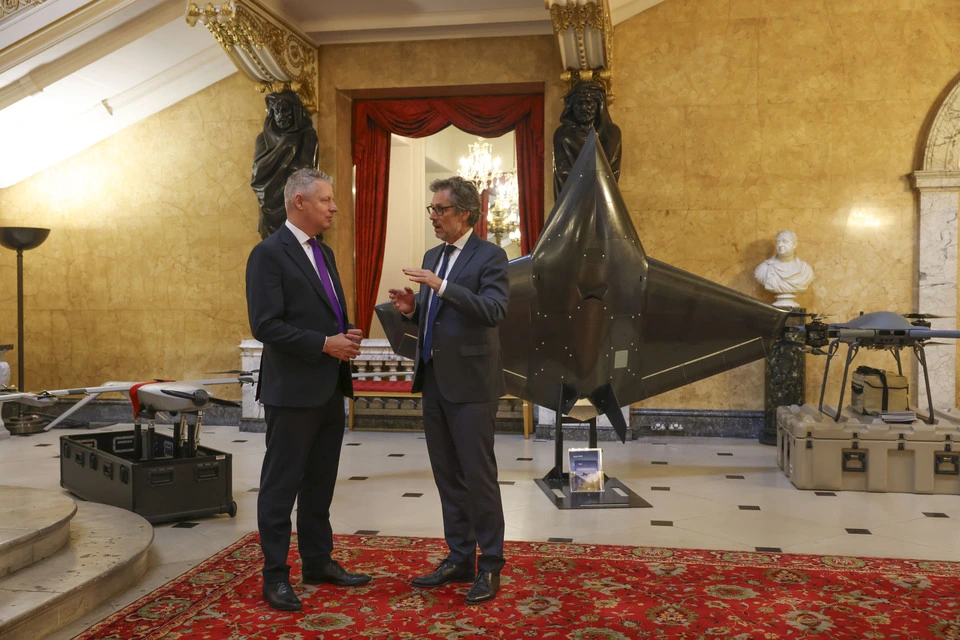
Britain and Germany reviewed joint capability programs and advanced defense-industrial cooperation at ministerial talks at Lancaster House in London on October 15, 2026, with the Deep Precision Strike long-range missile effort among the flagship items on the agenda. Minister for Defence Readiness and Industry Luke Pollard hosted Jens Plötner, Germany’s State Secretary for Armament, Innovation and Cyber, at the UK-Germany Ministerial Group on Equipment and Capability Cooperation (MECC), with national armaments directors Rupert Pearce and Vice Admiral Carsten Stawitzki in attendance.
The session follows a March 16 MECC round in Berlin devoted to Deep Precision Strike and rests on two layers of bilateral architecture. The Trinity House Agreement, signed in London on October 23, 2024, set out cooperation across the air, land, maritime, cyber and space domains. It sits under the Kensington Treaty, signed in July 2025, whose ratification Prime Minister Andy Burnham and Chancellor Friedrich Merz finalized in Berlin on October 8, 2026. Pollard said the two countries are “strengthening our forces, our industrial bases and our resilience in lockstep.”
Deep Precision Strike Leads the UK-Germany Long-Range Fires Agenda
Deep Precision Strike (DPS) is the bilateral effort to field a family of stealthy cruise and hypersonic missiles with a range beyond 2,000 km, with entry into service expected in the 2030s, according to the UK Ministry of Defence. Initial work prioritizes a ground-launched capability, while air- and sea-launched variants remain under study. The initiative is nested within the European Long-Range Strike Approach (ELSA) and remains open to additional partners.
Publicly available specifications put the UK’s air-launched Storm Shadow at roughly 250 km and Germany’s Taurus KEPD 350 at more than 500 km. A 2,000 km ground-launched weapon based in Germany would hold air bases, logistics hubs and command nodes across western Russia at risk.
London has put money behind the ambition. The Ministry of Defence said in February 2026 it would spend more than £400 million in the 2025-26 financial year on hypersonic and long-range weapons, a line that also funds the Stratus program with France and Italy to replace Storm Shadow. The October 16 readout disclosed no DPS contract, prime contractor, workshare split, propulsion choice or cost estimate.
Industry joined a follow-on panel at the German Embassy in London, where Dr Philipp Kerth, co-founder and chief executive of Munich-headquartered Hypersonica, sat alongside Alex Zino, Director Business Development and Future Programmes at Rolls-Royce. Hypersonica flew a prototype hypersonic test vehicle from Andøya Space in Norway in February 2026, reporting speeds above Mach 6, and targets a fielded strike capability by 2029. Rolls-Royce partners with Germany’s MTU Aero Engines in the Eurojet consortium that builds the EJ200 engine for the Eurofighter Typhoon.
Trinity House Agreement Delivery Widens From Artillery Barrels to Space
The most tangible industrial output of the Trinity House framework sits in Telford, Shropshire, where Rheinmetall is establishing its UK Gun Hall to manufacture 155 mm artillery barrels and 120 mm tank guns, the UK’s first gun barrel factory in a decade. In March 2026, the Organisation for Joint Armament Co-operation (OCCAR) awarded ARTEC GmbH a £53 million contract on behalf of the British Army for long-lead production of 37 weapon systems for the Remote Controlled Howitzer 155 (RCH 155).
The RCH 155 is the British Army’s Mobile Fires Platform, replacing the AS90 self-propelled guns gifted to Ukraine. It pairs a 155 mm/52-caliber Artillery Gun Module with the Boxer 8×8 drive module, the same vehicle family Rheinmetall BAE Systems Land already builds in Telford alongside the Challenger 3 main battle tank. Domestic barrel production gives London sovereign surge capacity for tube artillery, which the war in Ukraine has shown to be a consumable at scale.
Trinity House also provides for German Navy P-8A Poseidon maritime patrol aircraft to operate periodically from RAF Lossiemouth in Scotland, home of the Royal Air Force Poseidon MRA1 fleet, extending anti-submarine coverage of the North Atlantic. The London talks came a week after Burnham’s visit to Berlin, during which the two governments launched a UK-Germany Counter-Hybrid Partnership to share information and coordinate action against sabotage, cyberattacks and threats to critical infrastructure. Both sides agreed to deepen space cooperation, starting with launch and assured access to space through SaxaVord Spaceport in Shetland.
Analysis: The session shows the relationship shifting from treaty architecture to program management, but progress is uneven. Telford barrels and Lossiemouth rotations are moving; DPS, the program with the greatest deterrence value, still lacks a public contract structure. Geography shapes the burden: a 2,000 km missile fired from Britain reaches far less of Russia than one fired from Germany, pointing to forward basing on German soil or to air- and sea-launched variants for British use. After the manned fighter at the core of the Franco-German Future Combat Air System (FCAS) collapsed in June 2026, Burnham told Merz that Britain is open to Germany joining the Global Combat Air Programme (GCAP). Should Berlin pursue both GCAP and DPS, London would become its principal partner in combat air and long-range strike.
Next markers include a German decision on GCAP, a DPS development contract and workshare agreement, the Telford production ramp-up and Hypersonica’s follow-on flight tests. London framed the MECC as groundwork for the EU-UK summit in Brussels on November 20, 2026.