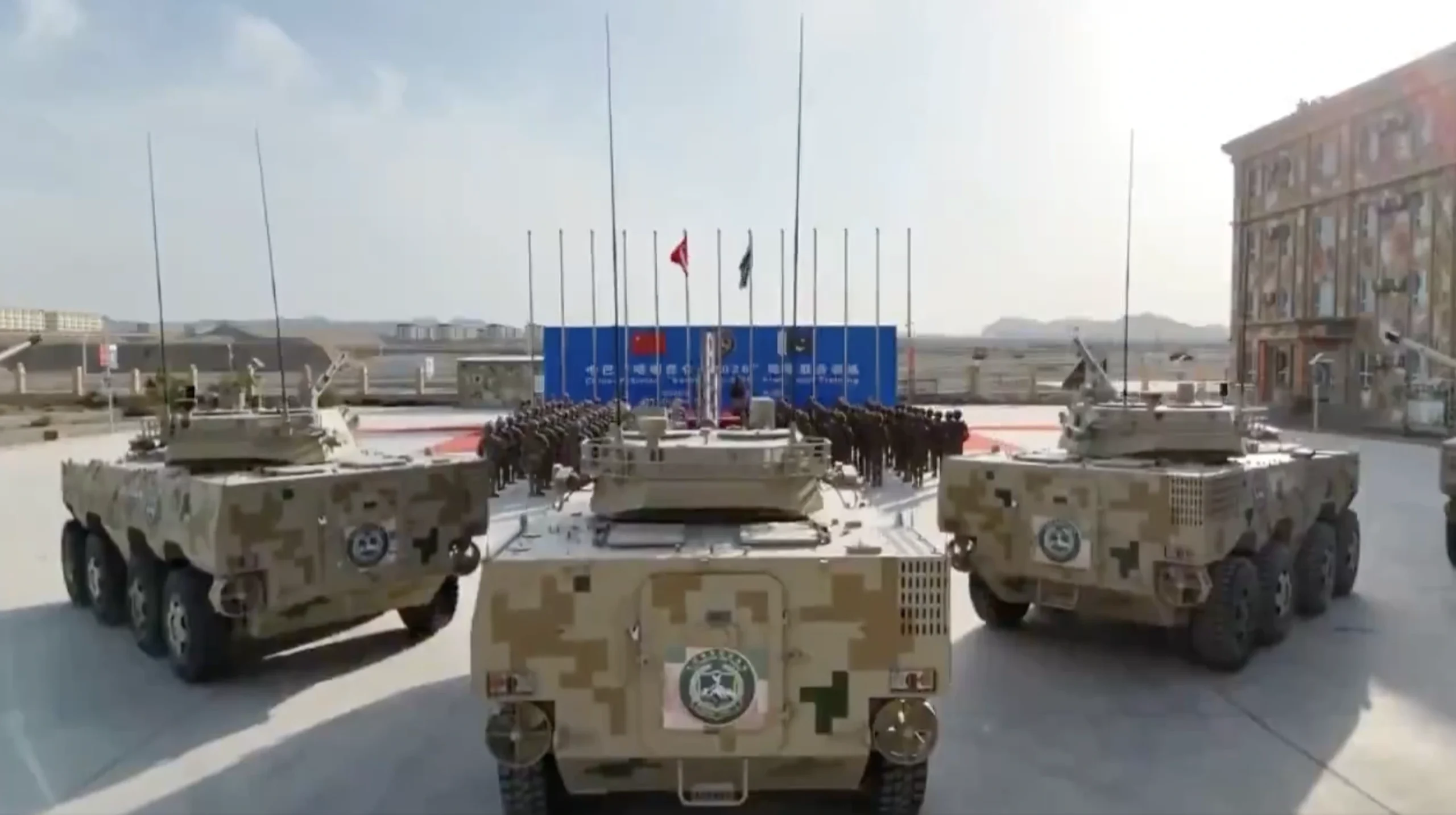
China and Pakistan opened Karakoram 2026, a joint army exercise centered on counterterrorism operations in high-altitude terrain, at a training base in Korla, in China’s Xinjiang Uyghur Autonomous Region, on October 14, 2026. China’s Ministry of National Defense describes the drill as the first joint army training between the two countries and has scheduled it to run through late October.
Senior Colonel Chen Xi, a spokesperson for the Chinese defense ministry, announced the exercise on October 10. It adds a ground component to a bilateral training calendar that already includes the Sea Guardian naval series and the Shaheen air exercises. The drill opens amid persistent instability on Pakistan’s western frontier, where Pakistani and Afghan Taliban forces have clashed repeatedly since October 2025 despite ceasefires reported in October 2025 and March 2026. Beijing has also pressed Islamabad to protect Chinese nationals working on the China-Pakistan Economic Corridor (CPEC); attacks in March and October 2024 killed seven Chinese citizens.
Karakoram 2026 Training Scope: Drones, Mobile Fire, and Long-Range Sniping
According to the Chinese defense ministry, the program covers joint counterterrorism and clearance operations in high-altitude areas. Troops from both armies cross-train in unmanned aerial vehicle (UAV) operation, on-the-move target search and firing, and long-range sniping, before progressing to joint command exercises and live-force drills. After the opening ceremony, the two contingents exchanged counterterrorism experience and Pakistani personnel observed Chinese weapons and equipment. According to the military channel of state broadcaster CCTV, all weapons and equipment used in the training are provided by China, including Type 191 rifles, Type 201 squad machine guns, Type 11 armored assault vehicles, Type 08 infantry fighting vehicles, artillery, and unmanned and anti-unmanned systems.
The exercise takes its name from the Karakoram range along the China-Pakistan border, which the Karakoram Highway crosses at the Khunjerab Pass, more than 4,600 meters above sea level. Neither government has disclosed the size of the contingents, the participating formations, or the elevation of the training area. Those gaps limit any assessment of the drill’s scale, but the stated skill set maps directly onto the tactical problem of mountain counterinsurgency.
Small UAVs provide overwatch and target cueing in terrain that masks ground observation, yet thinner air at altitude reduces rotor lift and battery endurance, forcing operators to trim payloads and shorten sorties. Long-range precision fire faces the opposite effect: lower air density reduces drag and flattens trajectories, so sniper teams need altitude-specific firing data to avoid striking high. On-the-move target search and firing points to mobile engagement drills against fleeting targets, a core requirement for units hunting small, dispersed militant groups in mountainous border districts. The joint command and live-force phases will test whether Chinese and Pakistani staffs can plan and control those effects together rather than side by side.
From the Warrior Series to Regular Army Units on Chinese Equipment
Chinese and Pakistani ground troops have trained together before. The Warrior counterterrorism series, conducted by the Pakistan Army and the People’s Liberation Army (PLA) Western Theater Command, the PLA command responsible for Xinjiang, Tibet, and the disputed frontier with India, reached its ninth iteration with Warrior-IX, which concluded at Pakistan’s National Counter Terrorism Center in Pabbi on December 14, 2025. Warrior-VIII, held at the same center in late 2024, was the first edition since 2019.
The “first” label in Beijing’s announcement therefore rests on a narrower distinction. Analysts note that earlier bilateral counterterrorism drills relied mainly on special operations and border guard units, while Karakoram involves regular army forces. Beijing has not identified which PLA units are taking part in Karakoram. The venue also shifts: both recent Warrior iterations were hosted in Pakistan, whereas Karakoram brings Pakistani troops into Xinjiang, the Chinese region that borders both Pakistan and Afghanistan.
The all-Chinese equipment set mirrors Pakistan’s procurement profile. Data released on March 9, 2026, by the Stockholm International Peace Research Institute (SIPRI) show China supplied 80 percent of Pakistan’s major arms imports in 2021-2025, up from 73 percent in 2016-2020, while Pakistan absorbed 61 percent of all Chinese arms exports. Pakistani arms imports rose 66 percent between the two periods, making the country the world’s fifth-largest importer. Publicly available data indicate the Pakistan Army already fields Chinese-origin VT-4 main battle tanks and SH-15 155 mm truck-mounted howitzers, so training on Chinese small-unit systems extends an existing logistics and doctrinal dependency rather than creating a new one.
Analysis: Karakoram 2026 matters less for its counterterrorism content, which the Warrior series already covers, than for where and with what it is conducted. Training regular Pakistani units on Chinese soil with Chinese-supplied drones and weapons builds shared tactics and procedures around the equipment base that already dominates Pakistan’s inventory. That foundation transfers beyond counterterrorism: high-altitude mobility, UAV-cued fires, and precision engagement are also core skills of mountain warfare along the Line of Control and the Line of Actual Control, the frontiers India holds against Pakistan and China, respectively. For Beijing, the drill also extends a security perimeter westward toward Afghanistan, which touches Xinjiang through the Wakhan Corridor and where China has long cited the threat of Uyghur militants it designates as the East Turkistan Islamic Movement.
Chinese officials have not announced a closing date, the forces involved, or whether Karakoram will become a recurring series. Chinese military commentator Wang Yunfei told the Global Times that the equipment fielded in the training could be procured by Pakistan in future military trade, suggesting the drill also serves as a showcase for Chinese land systems. If the annual Warrior schedule holds, a tenth iteration would follow in the final weeks of 2026, placing two bilateral ground exercises within roughly two months.