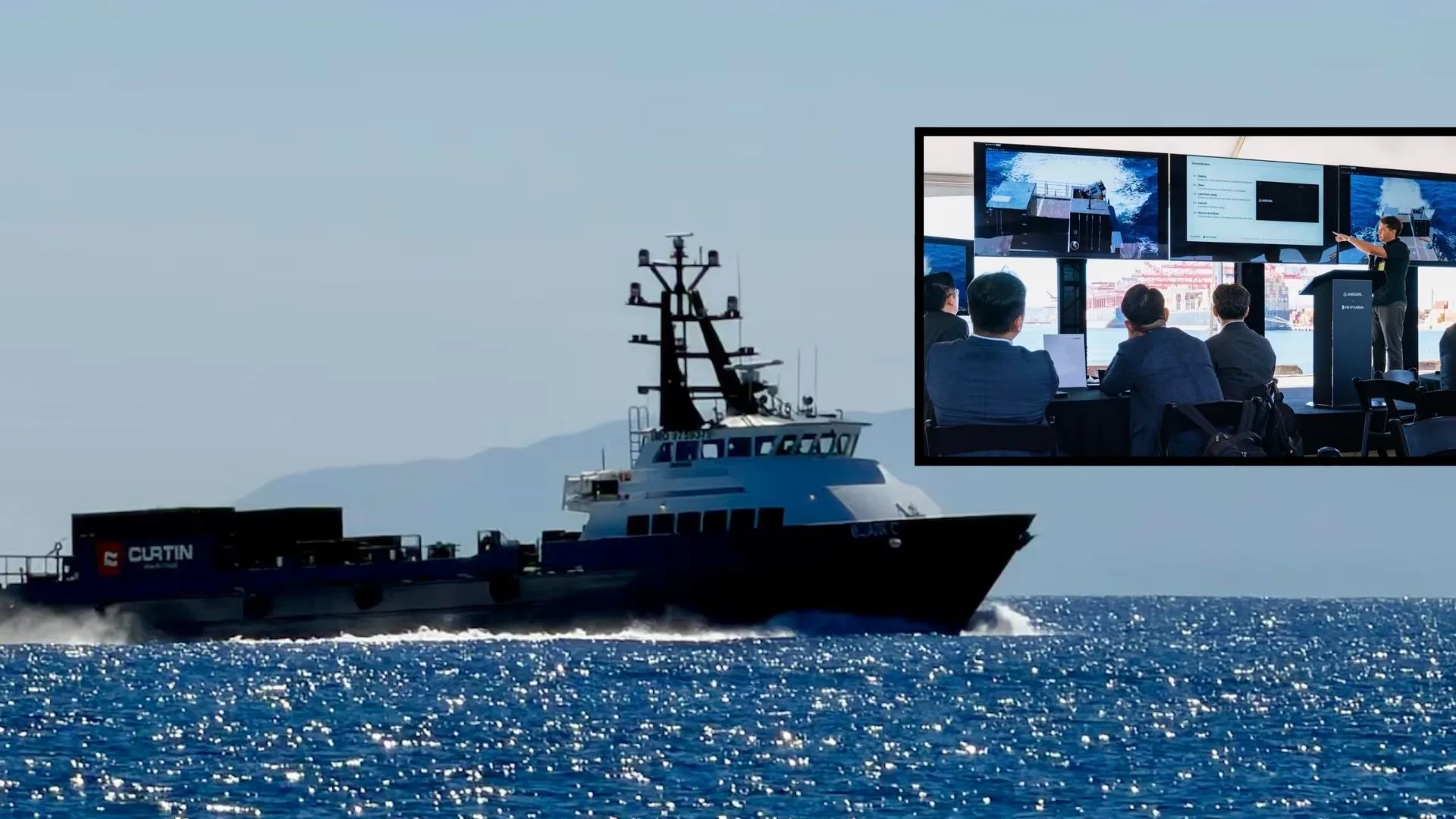
HD Hyundai and Anduril Industries demonstrated fully autonomous operations of an unmanned surface vessel (USV) off the Port of Long Beach, California, on October 14, 2026, running HD Korea Shipbuilding & Offshore Engineering’s (HD KSOE) VAone vessel autonomy suite alongside Anduril’s Lattice mission autonomy software aboard a modified 368-ton test ship previously operated by the US Navy. HD Hyundai disclosed the trial on October 19, describing it as the first USV demonstration by a South Korean company in US waters.
The demonstration comes at a decision point for Navy unmanned procurement. The service cancelled its Modular Attack Surface Craft (MASC) program in March 2026 in favor of a Medium Unmanned Surface Vessel (MUSV) Family of Systems marketplace, and on September 29 awarded Galliano Marine Services, Huntington Ingalls Industries and Saronic Technologies agreements for 10 MUSVs each at an average procurement cost of $40 million per vessel. Anduril, which confirmed in April that it was bidding for MUSV, was not among the seven companies that completed phase one at-sea testing. A phase two round opened on September 23.
Inside the VAone and Lattice Unmanned Surface Vessel Autonomy Stack
The trial ran for about three and a half hours, with the full sequence relayed to a shore-based control station where roughly 40 observers tracked mission execution in real time. They included representatives of the US Navy, the US Coast Guard, the American Bureau of Shipping (ABS), the Republic of Korea Navy and South Korea’s Defense Acquisition Program Administration (DAPA). Scenarios covered autonomous navigation, in-mission retasking, formation sailing and emergency response to machinery failures.
The architecture splits the ship into two autonomy layers. VAone, short for “Vessel Autonomy-No.1 & Only1,” runs the platform. It builds on HiNAS Prime, a navigation solution from Avikus, HD Hyundai’s autonomous navigation subsidiary, and adds an autonomous machinery management system that monitors equipment condition, flags anomalies and responds without operator input, plus a damage control module that detects hull damage and initiates corrective action. Avikus’s HiNAS Control system received DNV type approval in April 2026 and has passed 500 cumulative orders on merchant ships.
Lattice operates above that layer, assigning tasks, re-planning when orders change and coordinating multiple assets. HD Hyundai said the combined system demonstrated autonomy across navigation, machinery, damage control and weapons functions, but did not specify whether a weapons serial, live or simulated, was part of the run, nor did it identify the hull or the other vessels in the formation exercise. Jang Kwang-pil, executive vice president and head of HD KSOE’s Future Technology Research Institute, said the trial confirmed the vessel’s ability “to carry out complex missions” after leaving port.
The machinery and damage control layers carry the most operational weight. An uncrewed hull on a multi-week transit has no engineer to isolate a failed generator or a flooding compartment, which makes platform-level fault response the precondition for any long-range unmanned mission.
Anduril’s 60-Meter ASV and the Navy MUSV Competition
The Long Beach ship is a testbed, not the product. The partnership’s production design is a dual-use autonomous surface vessel (ASV) unveiled in November 2025, which Anduril has described as roughly 60 meters long and over 500 tons. It features an open-architecture payload deck for intelligence, surveillance and reconnaissance, strike and electronic warfare modules, and a central superstructure that gives sensors an unobstructed 360-degree field of view. Construction of the first hull is under way at HD Hyundai Heavy Industries’ Ulsan yard following a completed critical design review. Anduril had targeted October for the ship to enter the water; HD Hyundai is now preparing a launch ceremony in Ulsan as early as November.
US production follows a separate route. Federal law generally bars the Navy from acquiring vessels built in foreign shipyards, so Anduril has lined up Edison Chouest Offshore as a US production partner and invested in the former Foss shipyard in Seattle, while HD Hyundai is expected to build mainly for export customers.
The MUSV bar is demanding. The March solicitation sought vessels able to cover 2,500 nautical miles at 25 knots with a 25-ton deck payload in moderate seas. Phase two eases those terms: Christopher Miller, the Navy’s acting portfolio manager for robotic and autonomous systems, said the new round drops the high-speed requirement and at-sea refueling to widen the industrial base. The Navy plans to grow its Indo-Pacific USV fleet from four to 30 vessels by 2030.
In April 2026, HD Hyundai, Anduril and ABS signed a tripartite memorandum to build design, autonomy and classification frameworks for autonomous surface vessels.
What the Long Beach Demo Means for MUSV Phase Two
Analysis: The Long Beach run reads as a deliberate effort to de-risk a phase two MUSV entry. Demonstrating machinery and damage control autonomy on a former Navy hull targets the reliability question that has shadowed large USV programs, while keeping the mission and weapons layer on Anduril’s US software stack should simplify technology-security scrutiny of a Korean-built platform. The harder test is industrial: the team must show that Edison Chouest and Seattle can reproduce Ulsan’s build quality at rate, against three incumbents already contracted at about $40 million per hull.
Next milestones are the Ulsan launch, initial sea trials and the transfer of the first ASV to US waters, which Anduril has targeted for the end of 2026. Neither company has confirmed a phase two MUSV submission, and Anduril has declined to disclose the vessel’s price. The partnership’s August 2025 agreement also calls for a Korean-market USV prototype by 2027.