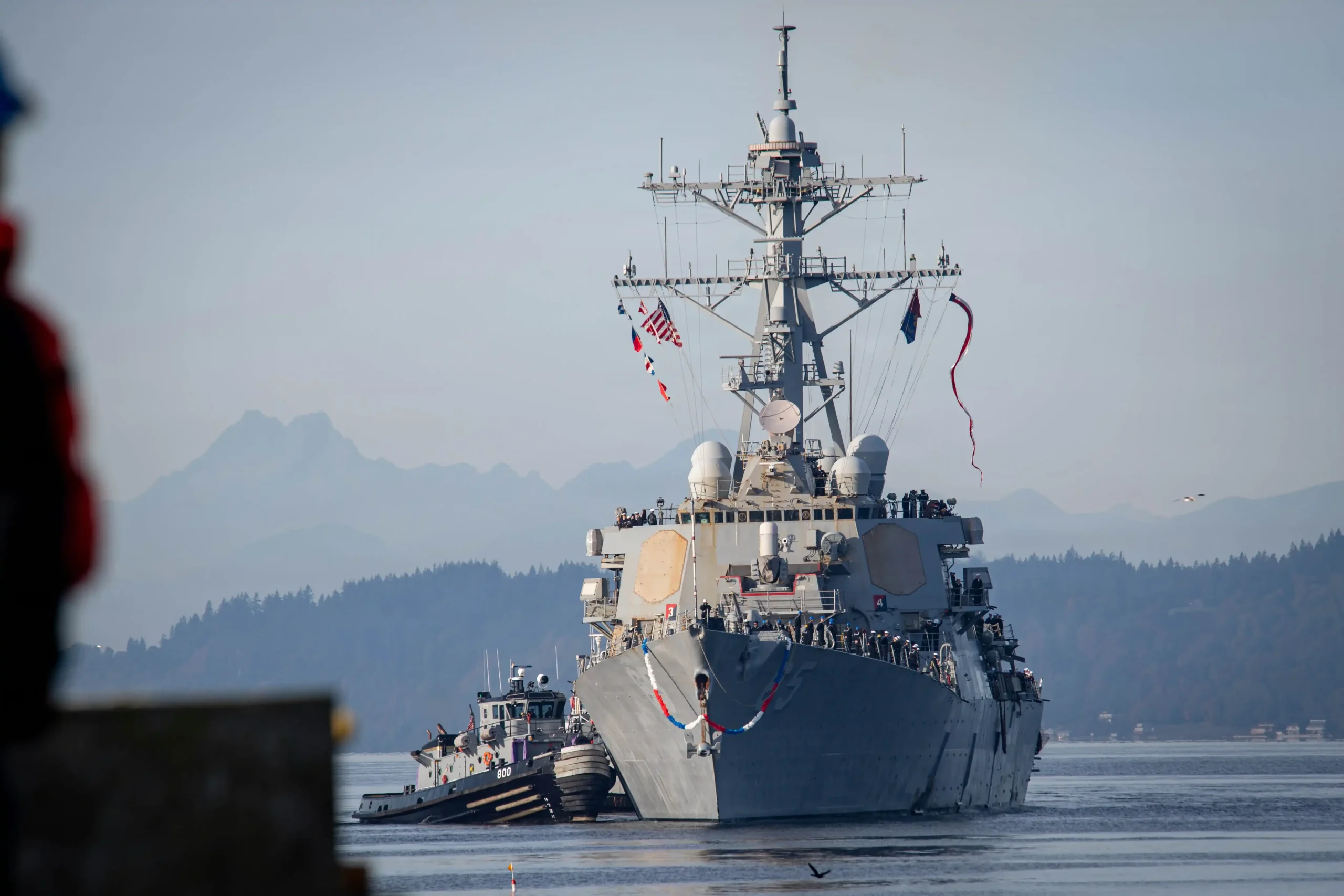
The U.S. Navy’s Arleigh Burke-class guided-missile destroyer USS Benfold (DDG 65) returned to its homeport of Naval Station Everett, Washington, on October 16, 2026, after more than eight months of operations in the Indo-Pacific across the U.S. 3rd and 7th Fleet areas of operations. The deployment covered more than 20,000 nautical miles, two major allied exercises and the ballistic missile defense (BMD) mission, and included a July generator casualty that left the ship without power and under tow to the Philippines.
It was Benfold’s first deployment since the ship closed out 10 years with the Forward Deployed Naval Forces in Japan (FDNF-J), leaving Yokosuka on September 29, 2025, and arriving in Everett on November 24, 2025. The destroyer sailed from San Diego on February 1, 2026. Commissioned on March 30, 1996, Benfold is a Flight I hull whose service life the Navy extended in August 2023 by five years, to fiscal year 2036.
USS Benfold Deployment: 20,000 Nautical Miles and 10 Refuelings
According to U.S. 3rd Fleet, Benfold executed three ammunition transfers with zero mishaps and took on more than 1 million gallons of F-76, the NATO-standard naval distillate fuel, across 10 refueling events, an average of roughly 100,000 gallons each. Four were underway replenishments with allied and partner nations. Taking fuel from foreign ships validates rigging, fuel and procedural compatibility, which extends time on station without a U.S. oiler in company.
That fuel supported transits of the Mindoro and San Bernardino straits inside the Philippine archipelago and three passages of the Luzon Strait. Mindoro Strait links the South China Sea to the Sulu Sea, while San Bernardino Strait opens the central Philippines onto the Philippine Sea. The Luzon Strait, between Taiwan and Luzon, is the principal deep-water gateway from the South China Sea to the Western Pacific and a route People’s Liberation Army Navy (PLAN) carrier groups have used to reach the Philippine Sea.
Valiant Shield, Freedom Edge and the Ballistic Missile Defense Mission
In 7th Fleet, Benfold sailed with the George Washington Carrier Strike Group, alongside USS George Washington (CVN 73), the cruiser USS Robert Smalls (CG 62) and the destroyer USS Shoup (DDG 86), during Valiant Shield 2026. The 11th iteration of the biennial exercise ran from June 22 to July 1 around Guam, the Northern Mariana Islands and Japan, with the Japan Self-Defense Forces heavily integrated for only the second time.
In September, Benfold joined Freedom Edge 26, the fourth iteration of the trilateral series. Held September 7 to 11 south of Jeju Island, it paired Benfold with the Japan Maritime Self-Defense Force (JMSDF) destroyers JS Atago and JS Asahi and, for the first time in the series, two Republic of Korea Navy (ROKN) Aegis destroyers, ROKS Seoae Ryu Seong-ryong and ROKS Yulgok Yi I, with integrated air and missile defense (IAMD) as a core objective. During a port visit to Busan, Benfold hosted ROKN Vice Adm. Kwak Kwang-Seop, commander of the Republic of Korea Fleet.
The BMD tasking rests on the ship’s midlife modernization. Benfold received Aegis Baseline 9C in San Diego, adding BMD 5.0 software, an enhanced AN/SPY-1D radar with a Multi-Mission Signal Processor, the AN/SQQ-89A(V)15 undersea warfare suite and Cooperative Engagement Capability (CEC). Baseline 9C lets one destroyer run air defense and ballistic missile defense simultaneously, the core requirement for BMD watch near Japan or the Korean Peninsula. Publicly available specifications indicate the Flight I design carries a 90-cell Mk 41 Vertical Launching System (VLS) and a 5-inch Mk 45 gun.
July Generator Casualty Tests a 30-Year-Old Flight I Destroyer
The Navy’s homecoming release does not mention the deployment’s most serious setback. On July 24, 2026, while sailing with the carrier group, Benfold reported an engineering casualty involving its generators that caused a loss of power, according to U.S. 7th Fleet, which described the incident only as occurring during routine operations in the Indo-Pacific. USNI News first reported that the destroyer spent four days without power in the South China Sea, and a U.S. official confirmed the location to Task & Purpose; Navy imagery had placed Benfold there the previous day. The roughly 300 sailors aboard lost air conditioning, galley service, sanitation and potable water. Robert Smalls supplied meals until contracted tugs brought Benfold into Subic Bay, Philippines, on July 28, where Ship Repair Facility-Japan Regional Maintenance Center (SRF-JRMC) specialists met the ship.
Power was restored on July 30, and Benfold sailed on August 8 with all systems functioning normally, per 7th Fleet. The root cause has not been disclosed. Publicly available specifications indicate Flight I destroyers draw power from three ship service gas turbine generator sets driven by Allison 501-K34 engines, each originally rated at 2,500 kW and separated by watertight bulkheads. Why that redundancy did not prevent a shipwide outage remains unexplained. The episode followed an April 28 electrical casualty that cost the Yokosuka-based USS Higgins (DDG 76) power and propulsion for several hours.
Cmdr. Rebecca M. Conti-Vock, Benfold’s commanding officer, credited the crew’s “ability to integrate rapidly and operate at the highest tactical level” and said she watched sailors “successfully overcome difficult circumstances.”
What the USS Benfold Deployment Means for the Oldest Arleigh Burke Destroyers
Analysis: Benfold’s deployment captures the central tension in the Navy’s Pacific surface posture. A 30-year-old Flight I destroyer remains capable enough to anchor trilateral IAMD training with Japan and South Korea and to stand BMD watch, which is why the Navy pushed its retirement to fiscal year 2036. Its binding constraint was material availability, not combat system performance: the ship was out of action for 15 days in contested waters and recovered because a carrier group was nearby and an allied port with forward repair support was within reach. Subic Bay functioned as the dispersed repair node a Western Pacific contingency would demand, and reliability data of this kind is what the Navy’s hull-by-hull reviews weigh in deciding how long the oldest Burkes serve.
Benfold now enters its post-deployment period in Everett. The Navy has not announced the ship’s next maintenance availability or released findings on the July casualty or the April Higgins incident, which will show whether the failures are isolated or reflect wider power plant wear across early Arleigh Burke hulls. Planning for Valiant Shield 2028 is already underway.