The U.S. Navy is scheduled to scrap 39 ships over the next five years, and 16 more will be stripped as parts donors before being recycled, according to the service’s latest 30-year shipbuilding plan. More than half of those 55 hulls are homeported in the Pacific, yet the West Coast has no ship recycling yard able to take them, so retired federal vessels are accumulating at the Suisun Bay Reserve Fleet in Benicia, California.
The Maritime Administration (MARAD) also plans to retire about 20 large logistics support ships by 2033, and Naval Vessel Register data show roughly 20 more stricken vessels in Hawaii, Bremerton, Washington, and elsewhere in the Pacific still awaiting final disposition. Meanwhile, new crewed and uncrewed ships need pier space that hulks now occupy. The default answer, a long dead-ship tow to a Gulf Coast scrapyard, is becoming costlier and less certain.
How Hull Cleaning Rules Stall Navy Ship Recycling at Suisun Bay
MARAD’s National Defense Reserve Fleet inventory for August 2026 listed 10 vessels at Suisun Bay. Five hold non-retention status and are designated for disposal: the break-bulk ships Cape Bover and Cape Jacob, the barge carrier Cape Fear, the crane ship Green Mountain State and the repair barge Peach. The anchorage also holds the decommissioned Coast Guard icebreaker Polar Sea and the Navy’s expeditionary fast transport Millinocket (T-EPF 3).
A 2010 federal court settlement with Arc Ecology, San Francisco Baykeeper, the Natural Resources Defense Council and the San Francisco Bay Regional Water Quality Control Board requires departing ships to be cleaned in a local dry dock, removing marine growth below the waterline and flaking paint above it, before any tow to a certified recycler. MARAD used that process to clear dozens of older hulls, towing them to Brownsville, Texas.
That pipeline has now closed. Mare Island Dry Dock in Vallejo, the region’s last major commercial graving dock operator, ceased operations on January 1, 2026, after losing a U.S. Coast Guard maintenance contract. Its larger dock measured 720 feet, short of the 754-foot length of a Supply-class fast combat support ship. Without a local dry dock, as Forbes senior contributor Craig Hooper has pointed out, a vessel laid up in Suisun Bay today has no clear compliant path out.
Panama Canal Costs and Gulf Coast Limits Squeeze Disposal Options
The fallback tow through the Panama Canal has rarely been costlier. Drought linked to El Niño has forced the Panama Canal Authority to cut daily transit capacity and reduce Neopanamax draft limits, and Panama declared a national emergency in late August. A South Korean shipper paid a record $5.3 million auction premium, on top of normal tolls, to secure a September 1 transit. The figure is an outlier, but it signals scarce capacity, and elevated fuel prices add to the cost of any long-haul tow.
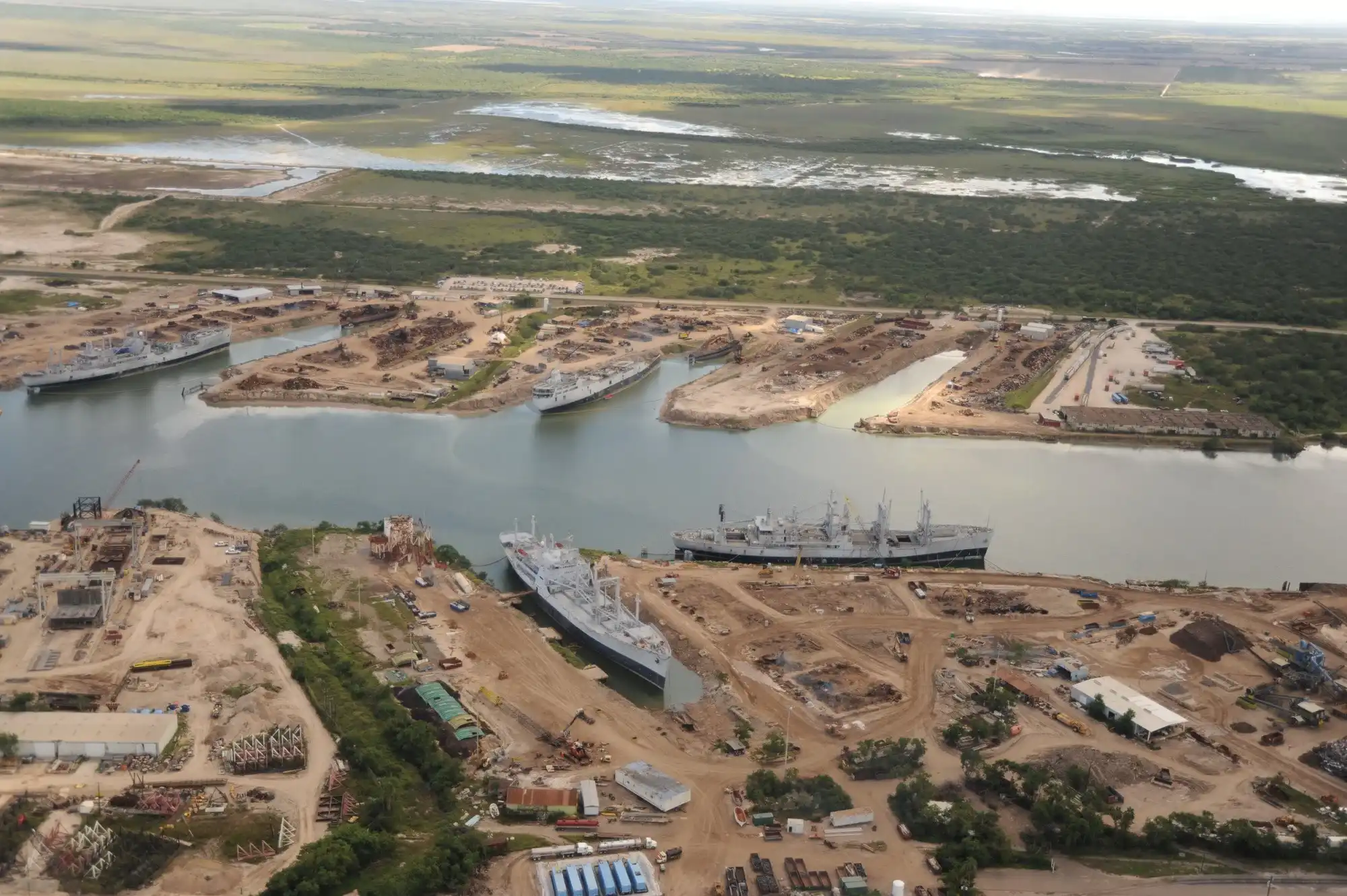
At the far end, the Port of Brownsville handles the bulk of U.S. ocean vessel recycling. One tenant, International Shipbreaking, invested $30 million to earn European Union Ship Recycling Regulation accreditation. Most Gulf Coast hulls, however, are still cut up in excavated slips rather than enclosed facilities, and the local workforce now faces competition from fast-growing employers such as SpaceX’s Starbase complex. Hooper argues in Forbes that a tighter labor market and rising environmental expectations could erode the low-cost model that made Brownsville the national default.
Delay carries its own bill. Inactivating, storing and dismantling the former nuclear carrier Enterprise (CVN 65) has cost the Navy more than $1.3 billion, including $111 million for storage alone; NorthStar Maritime Dismantlement Services will finish the job in Mobile, Alabama, under a $418.5 million contract awarded July 15, 2026. Conventional hulls cost far less, but every year a stricken ship waits adds caretaker and monitoring expense.
How a Bay Area Shiplift Could Process Cruisers and Auxiliaries
Hooper has proposed an alternative: a federally backed ship recycling center in the San Francisco Bay Area built around a heavy-lift shiplift of roughly 1,000 feet. Rather than cutting ships in the water or in dirt slips, the yard would lift hulls clear, move them on robotic transporters into an enclosed dismantling hall with filtered air handling and drainage controls, and share the lift with shipbuilding and repair work to smooth the industry’s boom-and-bust cycles.
The hull mix fits the concept. Retired Ticonderoga-class cruisers, which publicly available specifications put at 567 feet and roughly 9,600 tons full load, stripped big-deck amphibious ships and Supply-class auxiliaries can all reach the Delta. Nuclear carriers cannot. Uncrewed surface vessels now entering service, most of them in the Pacific, will add to the pipeline within a decade.
The civilian case reinforces the military one. Derelict vessels drift to the Sacramento-San Joaquin Delta, where cash-strapped cities absorb the cleanup bill. The 294-foot former cruise ship Aurora sank in Little Potato Slough on May 22, 2024, forcing Stockton to shut a municipal water intake; the city later approved more than $8.2 million for salvage and disposal. In Vallejo, the burned-out 130-foot paddlewheeler Grand Romance remains beached after a 2023 partial sinking and repeated fires.
Analysis: The West Coast gap is a fleet readiness issue presented as an environmental one. Pier space, caretaker crews and maintenance dollars tied up in hulks are unavailable for the ships and uncrewed systems the Navy is fielding for the Indo-Pacific. Routing nearly all disposal through one Gulf Coast cluster, reachable from the Pacific only via a drought-constrained canal, creates a single point of failure in the fleet’s life cycle. A Bay Area yard would be expensive and hard to permit, but it would turn a growing liability into a domestic industrial asset.
No funding line, site, lift specification or lead agency exists for a Pacific recycling center, and neither the Navy nor MARAD has publicly proposed one. Indicators to watch include whether Congress addresses ship disposal capacity in the fiscal 2027 National Defense Authorization Act, how MARAD disposes of the five non-retention ships at Suisun Bay, and whether canal restrictions ease.