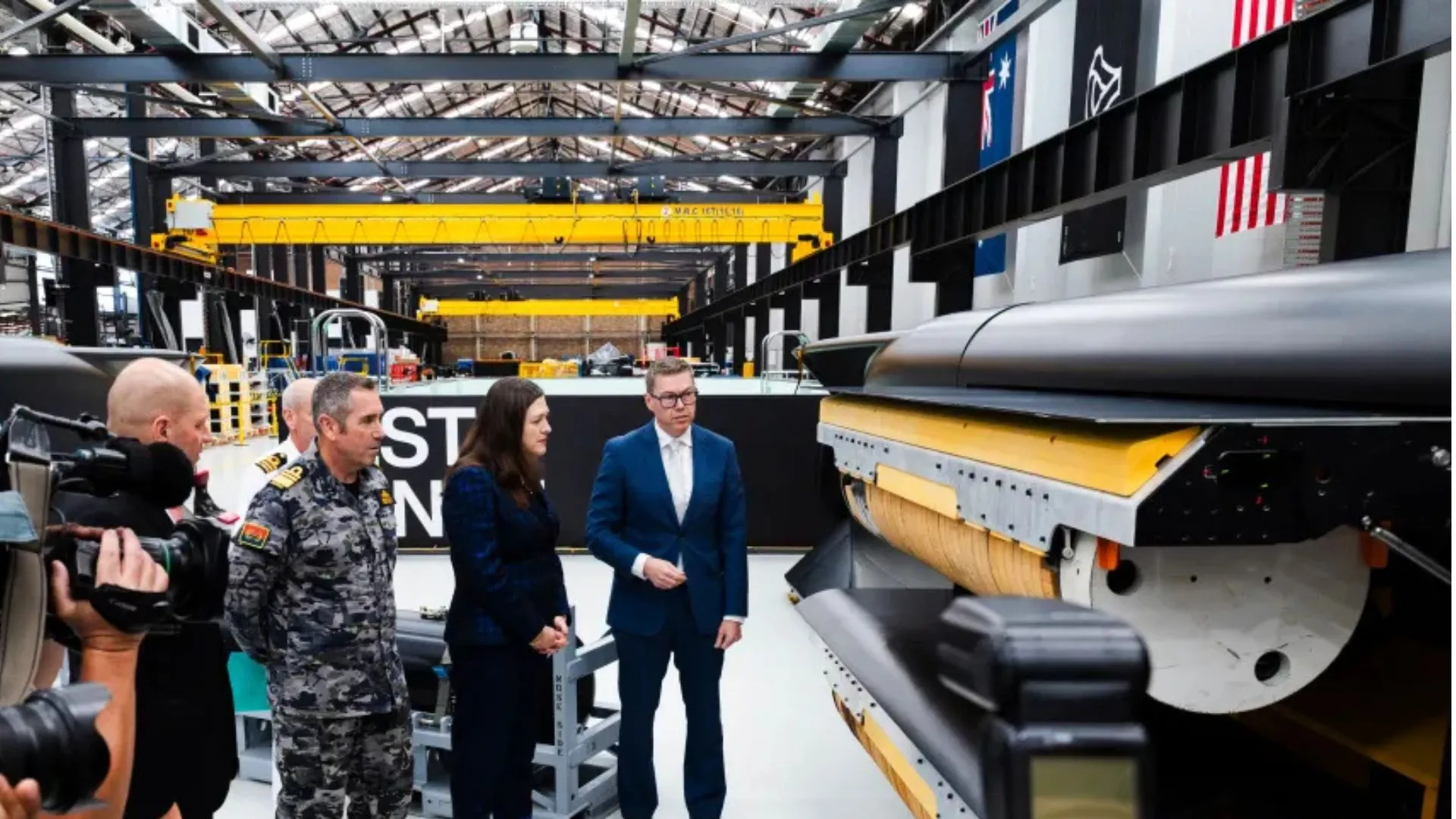
Australia has disclosed the first concrete mission payloads for its Ghost Shark extra-large autonomous undersea vehicle (XL-AUV), confirming the Anduril-built platform will lay up to 12 sea mines per mission, launch ALTIUS uncrewed aerial vehicles and emplace supply caches on the seabed. Minister for Defence Industry Pat Conroy unveiled the capabilities on October 19, 2026, at Anduril Australia’s factory in Sydney, where a Ghost Shark was shown with its payload bay open for the first time.
Since the first prototype was unveiled in April 2024, Canberra had described Ghost Shark’s role only as persistent intelligence, surveillance, reconnaissance and strike. The program became a Program of Record in September 2025, when the Royal Australian Navy (RAN) awarded Anduril Australia an A$1.7 billion (approximately $1.19 billion) five-year contract covering a fleet officials describe only as “dozens” of vehicles. The 2026 National Defence Strategy and Integrated Investment Program allocate up to A$5.8 billion (approximately $4.05 billion) over the decade to autonomous and uncrewed undersea warfare.
Ghost Shark Payloads: Sea Mines, ALTIUS Drones and Seabed Caches
“Ghost Shark now has teeth, and will have the ability to inflict damage on any potential adversary,” Conroy said. The minelaying module can deploy up to 12 sea mines in a single mission, but Defence has not identified the mine the RAN intends to field. A Rheinmetall Asteria was displayed next to the vehicle without being installed in its bay. The Asteria is a 533 mm multi-influence mine designed for release from surface ships, aircraft or submarine torpedo tubes, can be controlled remotely through an acoustic link and is optimized for the defense of harbors, ports and straits. Paired with Ghost Shark, such a mine would let the RAN seed a chokepoint covertly without risking a crewed submarine or surface minelayer.
The second module launches Anduril’s ALTIUS tube-launched, fixed-wing uncrewed aerial vehicles. Variants have not been disclosed; the airframes shown in Sydney belonged to the ALTIUS-600 family, including the ALTIUS-600 reconnaissance model and the ALTIUS-600M loitering munition. Publicly available manufacturer data puts the ALTIUS-600 at 9 to 12 kg (20 to 27 lb) with a 1.4 to 3.2 kg payload, a range of roughly 440 km (275 miles) and at least four hours of endurance. Launched from below the surface, the drone gives Ghost Shark an organic sensor beyond the reach of its own sonar and, in the 600M configuration, a way to strike coastal radars or small craft without revealing the host vehicle. The launch capsule has not been shown.
The third payload is a logistics cache developed by the Defence Science and Technology Group (DSTG), allowing Ghost Shark to pre-position equipment on the seabed for later retrieval where surface or air resupply would be detected. No cache hardware was displayed, and Defence has not specified its end users, dimensions or whether the containers can be commanded to surface.
Inside Ghost Shark’s Modular Payload Bay and Dive-XL Lineage
The open bay contained segmented cylindrical spacers rather than operational stores. As The War Zone (TWZ) noted, they appear to be made of plywood or a similar material, so it is unclear whether they represent trial ballast or a display mockup. The layout nevertheless illustrates the architecture: separate nose and tail sections bracket an expandable midbody built from modular hull sections of different lengths, allowing large payloads to be oriented in several ways.
Ghost Shark is the RAN’s militarized version of Anduril’s Dive-XL. Manufacturer data for the baseline vehicle cites a maximum range above 2,000 nautical miles (3,704 km), a payload volume of approximately 11.4 cubic meters, all-electric propulsion and the ability to stay submerged for weeks. Ghost Shark-specific length, displacement, depth rating and transit speed have not been released. Conroy described concepts in which the vehicle deploys from a shipping container or is craned off a small vessel, and a Ghost Shark has already been flown in a standard container aboard a Royal Australian Air Force C-17A Globemaster III. That footprint lets the RAN generate launch points far from its main bases without a dedicated mothership.
AUKUS Pillar II Testing at Maritime Big Play Pacific
Some of the payloads are taking part in Exercise Maritime Big Play Pacific, running October 5 to 25, 2026, in San Diego. The AUKUS Pillar II activity focuses on advanced maritime capabilities and interoperability. Development involves the RAN, DSTG, the Advanced Strategic Capabilities Accelerator (ASCA) and industry.
The same announcement covered payload integration on C2 Robotics’ Speartooth large uncrewed underwater vehicle and the Ocius Bluebottle uncrewed surface vessel, without specifying those payloads. Anduril opened its 7,400 square meter Ghost Shark factory in Sydney on October 31, 2025, with the first production vehicle slated for RAN delivery in January 2026 and full-scale production planned during 2026. In the United States, the Defense Innovation Unit has selected the Dive-XL for the U.S. Navy’s Combat Autonomous Maritime Platform (CAMP) project, and the U.S. Navy has assigned minelaying as the first mission of its Orca extra-large uncrewed undersea vehicle, giving the AUKUS partners a basis for payload commonality.
Analysis: The payload disclosure turns Ghost Shark from an abstract surveillance and strike promise into a defined sea-denial tool. Australia’s strategy of denial depends on holding distant approaches and chokepoints at risk, and dozens of vehicles each able to lay up to 12 mines would deliver offensive mining capacity beyond what the RAN’s six Collins-class submarines can spare. The ALTIUS module adds an air-domain sensor and effector to an undersea platform, while the seabed cache targets contested logistics. The caveat is maturity: all three payloads are in development and testing, not fielded, and the mine type, ALTIUS variant, launch mechanism and autonomy rules governing lethal emplacement remain undisclosed.
The next markers are the results of Maritime Big Play Pacific, disclosure of the mine and ALTIUS launch hardware selected for the RAN, and confirmation that Sydney has reached full-scale production. Fleet size under the A$1.7 billion contract remains undisclosed, and exports to allied navies remain subject to Australian government approval.