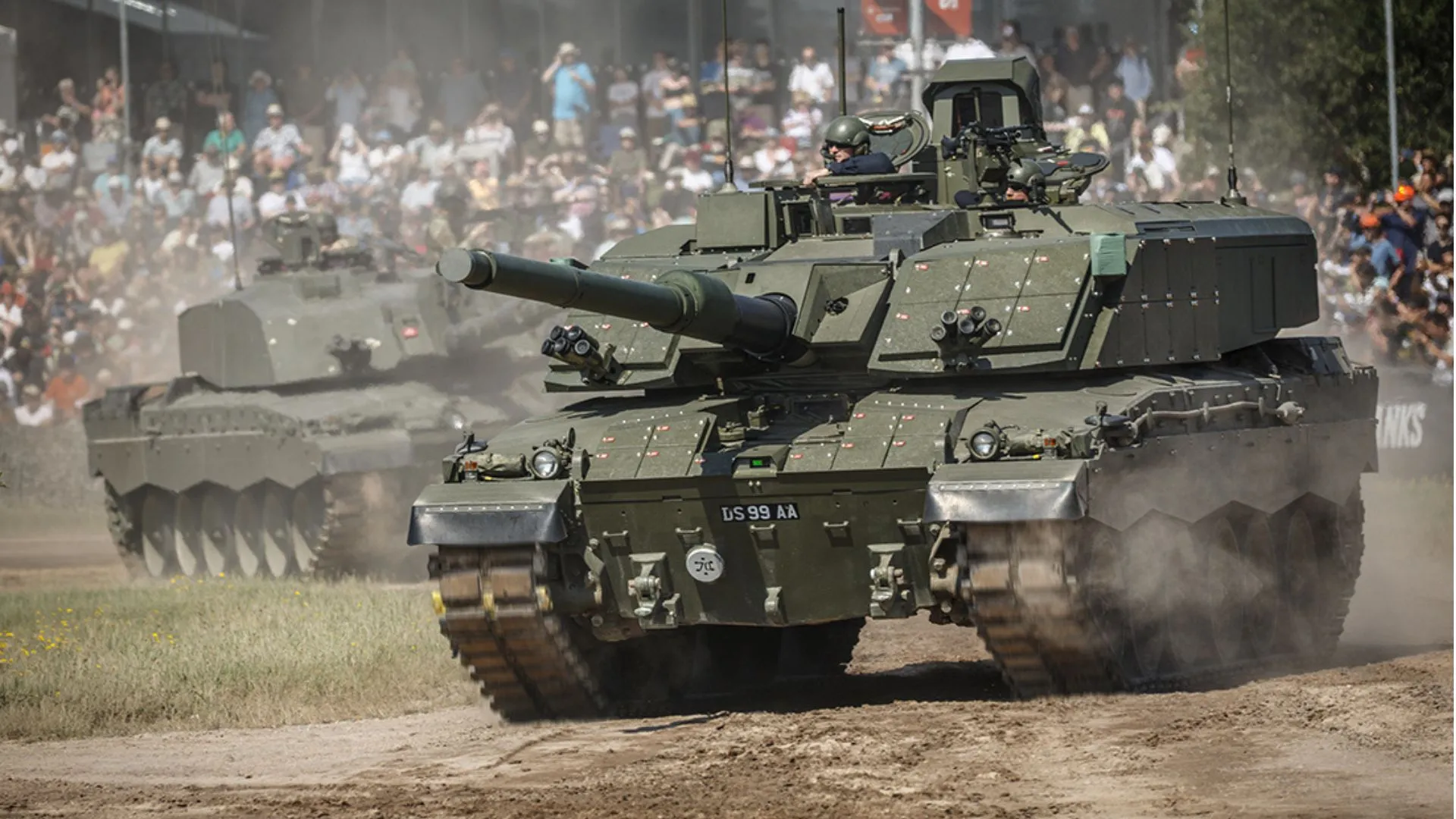
The UK Ministry of Defence (MoD) has taken delivery of seven Challenger 3 prototype main battle tanks for the program’s Demonstration Phase trials, with an eighth vehicle in the final stages of build, Defence Minister Luke Pollard told Parliament in a written answer on October 19, 2026. No series-production Challenger 3 has yet reached the British Army.
Responding to Conservative MP Ben Obese-Jecty, Pollard said the vehicles “are being used to demonstrate and assure the performance and safety of the Challenger 3 capability in preparation for manufacture.”
The answer arrives while the program sits under formal review. Rheinmetall BAE Systems Land (RBSL), the joint venture of Rheinmetall and BAE Systems, won an £800 million contract in May 2021 to convert 148 Challenger 2 hulls at its Telford, Shropshire, plant. In September 2026, the MoD confirmed that the Armour Main Battle Tank Programme faces a performance review and reapproval expected during fiscal year 2026-27. The original targets, Initial Operating Capability (IOC) in 2027 and Full Operating Capability (FOC) in 2030, are under review, with no revised dates published.
Challenger 3 Prototypes, Trials Timeline and Program Reapproval
The prototype count is the clearest public measure of progress. RBSL rolled out the first prototype at Telford in January 2024 and displayed the tank publicly at the Defence Vehicle Dynamics event at Millbrook in September 2024. In 2025, ministers reported four prototypes completed and four under construction. A ministerial update to the House of Commons Defence Committee, reflecting the position in September 2025, recorded six built with signature and mobility trials complete, while warning of significant delivery risks tied to industry performance.
The MoD said in September 2025 that trials were planned to conclude by the end of 2026, subject to review, and has since stated that manufacturing will begin once performance is proven rather than against a fixed deadline. With the eighth prototype still in build, it has not said whether the end-2026 target holds.
Trials have already driven design changes. In June 2026, Pollard confirmed the prime contractor had refined the Turret Power Traverse Gearbox, calling it normal engineering practice not assessed to affect delivery; UK press reports had cited insiders warning of up to two years of slippage. Traverse speed governs how fast a crew switches between targets, making the fix a lethality issue, not a footnote.
Cost has moved too. Whole-life costs, estimated at £1.3 billion in 2021, reached an internal MoD estimate of £1.99 billion by 2024, now covering modular armor and active protection. The 148 conversions, prototypes included, compare with 386 Challenger 2 tanks ordered in 1991 and 1994, and open-source force-structure analyses indicate 132 would go to front-line units, the rest to reserve. The out-of-service date is still assumed to be 2040, and on September 18, 2026, the MoD said a main battle tank requirement endures but no successor has been chosen.
L55A1 Gun, Trophy APS and the New Challenger 3 Turret
Challenger 3 keeps the Challenger 2 hull but replaces everything above the turret ring. The new fully digital, stabilized turret mounts the Rheinmetall L55A1 120mm smoothbore gun in place of the L30A1, the last rifled tank gun in NATO service. The switch opens access to NATO-standard ammunition, including programmable high-explosive rounds, and aligns the tank with the gun fitted to the Leopard 2A7V and Leopard 2A8. In a protracted conflict, British crews could draw on allied stockpiles, something Challenger 2’s bespoke rifled rounds never allowed. Where the L30A1 fires separate-loading rounds with bagged charges, the L55A1 takes unitary NATO rounds; Challenger 3 nonetheless keeps a four-person crew with a manual loader.
Survivability rests on a new modular armor system, contracted to RBSL in January 2024, and the Trophy active protection system from Israel’s Rafael Advanced Defense Systems, which uses radar to detect incoming anti-tank missiles and rockets and fires hard-kill countermeasures to defeat them. Trophy also equips the Leopard 2A8 and U.S. Army M1A2 Abrams tanks, bringing Challenger 3 to the allied protection baseline.
The British Army lists day and night primary sights for commander and gunner, supporting hunter-killer target handover between the two, improved tactical communications and an electronic architecture with added electrical power. The Heavy Armour Automotive Improvement Programme adds third-generation hydrogas suspension and engine improvements; publicly available specifications indicate the Perkins CV12 diesel is uprated to about 1,500 hp, against 1,200 hp on Challenger 2. Core weight is 66 tonnes, while the deployable configuration’s weight is withheld for security reasons.
Analysis: The October answer confirms that Challenger 3 has not crossed from demonstration into manufacture, nearly three years after the first prototype left Telford. The technical case has only strengthened: NATO ammunition commonality and active protection now read as baseline requirements for allied heavy armor. The problem is time. Each quarter in demonstration keeps British armored regiments on rifled-gun Challenger 2s, and unless the 2040 out-of-service date moves, each year of slippage removes a year of Challenger 3 front-line service rather than shifting the timeline right. For NATO planners counting on a British heavy armored contribution, the reapproval decision now matters more than the prototype tally.
Next milestones are completion of the eighth prototype, the close of Demonstration Phase trials and reapproval before the 2026-27 fiscal year ends on March 31, 2027. Manufacture timing, revised IOC and FOC dates, and any decision to extend service beyond 2040 remain undisclosed.