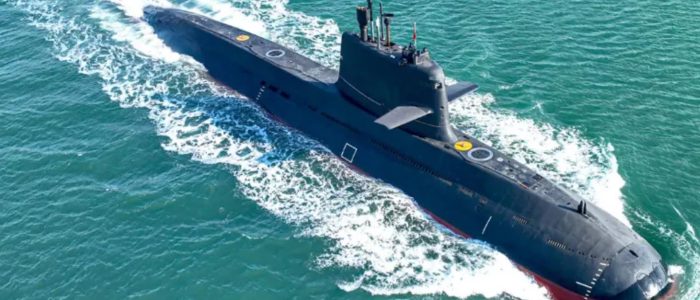
The Pakistan Navy’s lead Hangor-class submarine, PNS/M Hangor, fired an anti-ship cruise missile against a designated long-range target in the North Arabian Sea during its first live weapon firing, the Inter-Services Public Relations (ISPR) directorate announced on September 27, 2026. Chief of the Naval Staff Admiral Naveed Ashraf witnessed the shot. ISPR did not name the missile or disclose the engagement range.
The firing comes five months after the boat’s commissioning in Sanya, China, on April 30, 2026, and marks the first announced weapon employment from the eight-boat Hangor program. It also follows by 12 days a September 15 collision between the corvette PNS Hunain and the Indian destroyer INS Kolkata during Pakistan’s SEASPARK-26 exercise, an incident each government blamed on the other and the first overt military tension between the nuclear-armed rivals since their four-day conflict in May 2025.
PNS Hangor Live Firing: What the Missile Test Validated
Pakistani officials said the missile struck its target with precision at extended range, validating the boat’s weapon systems and combat readiness. A live shot exercises the full engagement chain: target cueing, fire-control solution, encapsulated launch from a bow tube, and terminal homing. The Hangor carries six bow tubes, assessed in open sources as 533 mm, able to fire heavyweight torpedoes and tube-launched missiles.
The Pakistan Navy has never confirmed the class’s missile fit. Open-source assessments point to the CM-708UNB, an export member of China’s YJ-82 family launched from a buoyant capsule. Publicly available specifications indicate a Mach 0.9 cruise, a sea-skimming terminal phase near 7 m, inertial midcourse guidance with active radar homing, a 165 kg warhead, and a range of up to 290 km. The export YJ-18E, credited with a similar range, is the other candidate analysts cite.
At those distances the submarine’s own sensors cannot see the target. A shot beyond the horizon requires cueing from maritime patrol aircraft, unmanned systems, or surface units, and ISPR did not describe how the target was located. That targeting chain, more than the missile itself, determines whether the capability holds against a defended surface group.
The weapon choice also carries a message. Pakistan tested the nuclear-capable Babur-3 submarine-launched cruise missile, with a stated 450 km range, from an underwater platform in January 2017 and March 2018. The Hangor’s first announced shot was a conventional anti-ship engagement, consistent with open-source reporting that the navy intends to reserve the class for anti-surface and anti-submarine roles.
Stirling AIP and Six Tubes: Inside the Hangor-Class Design
The Hangor-class derives from the S26 export design of China Shipbuilding & Offshore International Co. (CSOC), itself based on the People’s Liberation Army Navy Type 039A/B Yuan class. Specifications shown by Karachi Shipyard & Engineering Works (KSEW) at the 2018 International Defence Exhibition and Seminar list a 2,800-ton displacement, 76 m length, and 6.2 m draught. That makes the Hangor heavier but shorter than the 2,550-ton, 77.7 m S26 baseline, and the largest submarine Pakistan has operated.
The Pakistan Navy confirms the boat uses air-independent propulsion (AIP); open-source assessments identify a Stirling-cycle system. CSOC data for the Thai S26T variant cites about 20 days of AIP-only endurance at low speed, a 300 m diving depth, 17 knots submerged, and up to 65 days at sea. The diesel plant uses Chinese CHD620 engines, adopted after Germany declined export licenses for the MTU 396 units first specified. Crew is estimated at about 38.
In the North Arabian Sea, that endurance lets a boat hold station for weeks without snorkeling, shrinking the windows in which Indian P-8I patrol aircraft and escorts can detect it. The Hangor outweighs Pakistan’s three Khalid-class (Agosta 90B) boats, which use French-designed MESMA AIP, by roughly 700 tons, and India’s Kalvari-class Scorpène boats by about 1,000 tons.
The program has run late. Pakistan approved eight boats in April 2015 in a deal reported at $4 billion to $5 billion, with four built by Wuchang Shipbuilding in Wuhan and four at KSEW under technology transfer. The first four were originally due by 2023. Follow-on boats PNS/M Shushuk, Mangro, and Ghazi launched on March 15, August 15, and December 17, 2025; Pakistan has not announced their commissioning.
Analysis: The firing turns the Hangor from a delivered hull into a demonstrated standoff anti-surface platform, and that changes the planning problem for Indian task groups operating off Pakistan’s coast. If the three follow-on Chinese-built boats commission as Pakistani officials have signaled, the navy’s AIP-capable fleet would grow from three boats to seven, enough to sustain several simultaneous patrols. The timing, days after the Hunain-Kolkata collision, gives the test a signaling dimension whether or not it was scheduled for that purpose. Still, one shot from one boat proves integration, not fleet capability. The missile’s identity, the over-the-horizon targeting chain, and the acoustic behavior of a Stirling plant in warm, shallow water remain unverified in public.
The next markers are the commissioning of Shushuk, Mangro, and Ghazi, which Pakistan’s naval chief said in late 2025 would enter service in 2026; any official disclosure of the class’s missile and torpedo fit; and progress on the four KSEW hulls, which open-source assessments place in the early 2030s. The Pakistan Navy has not said whether further Hangor firings, including a heavyweight torpedo shot, are planned.